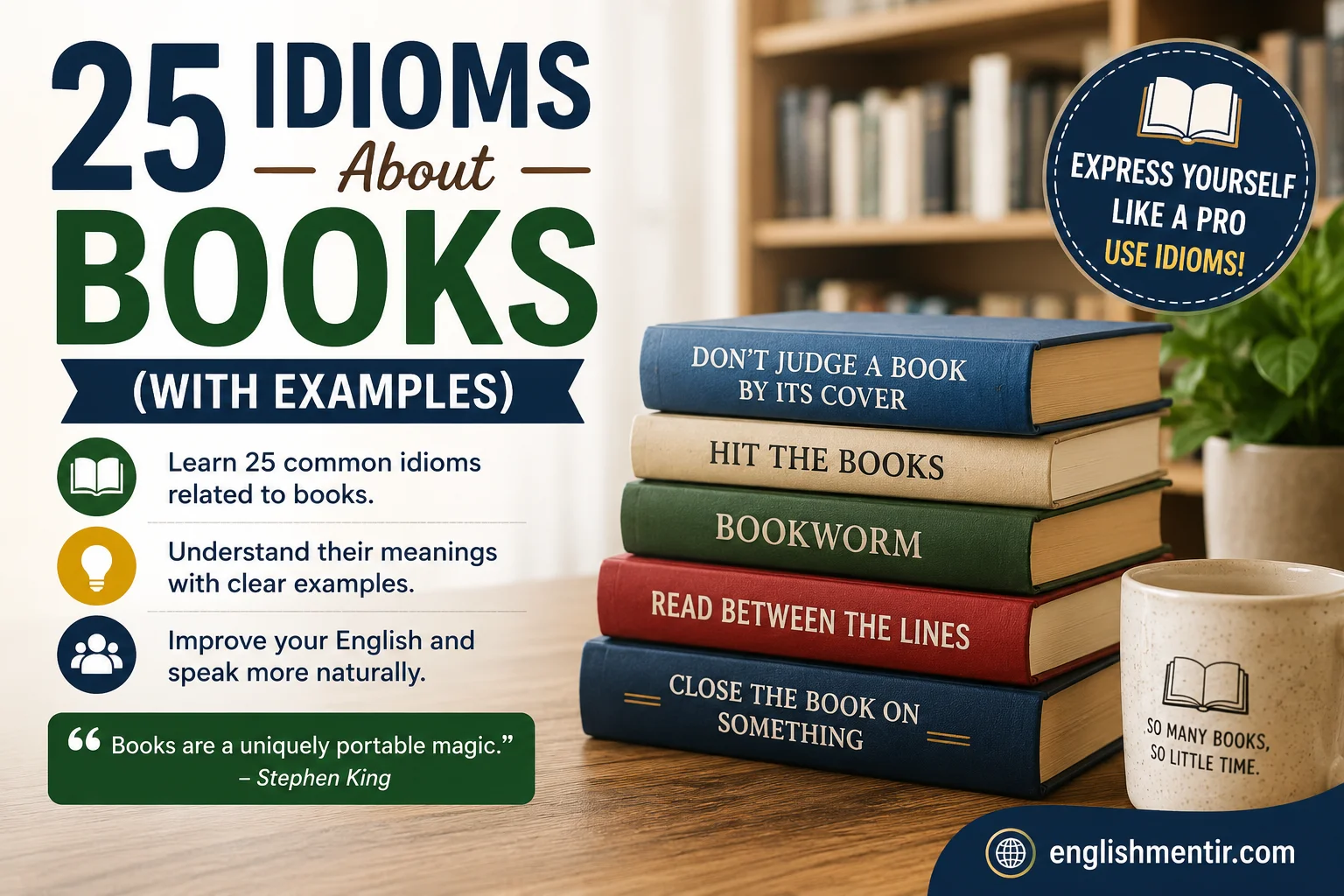
Discover 25 Idioms About Books (With Examples) and learn their meanings with simple, clear examples to improve your English and vocabulary.
Explore 25 Idioms About Books (With Examples) to understand figurative language, rich metaphors, and everyday expressions with simple meanings. Books and reading have become a creative source for many idioms in English, helping people convey ideas, feelings, and deeper meanings in everyday life. For example, hitting the books means studying rather than physically striking a book, while every name in the book is a fixed expression that requires you to understand its meaning beyond the individual words. A bookworm can appreciate the rich color and vibrancy these phrases add to our language. With time, learning these expressions can make it easier to listen to natural conversations, speak, and use English confidently.
Many book-related sayings have transformed reading into an intriguing and insightful way to express ideas. Judging a book by its cover, a closed book, an open book, and to be on the same page are popular idioms that reveal cultural nuances, stories, traditions, and a unique background and context. By exploring them, you can engage with language on a new level and uncover how books shape the way we think, talk, and speak. Their meanings provide a fresh perspective on everyday language, while simple meanings, real-life examples, and clear definitions help you learn and use them confidently in speaking and writing. If you love learning English, this complete guide can help you appreciate these timeless expressions and see how each idiom reflects language beautifully.
1. Read Between the Lines
Meaning: To understand the hidden or deeper meaning of something rather than only its obvious meaning.
In a Sentence: You need to read between the lines to understand what the writer really means.
Other Ways to Say: Look deeper, understand the hidden meaning, look beyond the words.
2. An Open Book
Meaning: A person who is honest, open, and easy to understand.
In a Sentence: Sarah is an open book, so she always tells us how she feels.
Other Ways to Say: Honest person, easy to understand, very open.
3. Judge a Book by Its Cover
Meaning: To form an opinion about someone or something based only on appearance.
In a Sentence: Don’t judge a book by its cover; the quiet student may have wonderful ideas.
Other Ways to Say: Don’t judge by appearance, look beyond the surface, avoid assumptions.
4. By the Book
Meaning: To do something according to the official rules or instructions.
In a Sentence: The manager always follows company policies by the book.
Other Ways to Say: Follow the rules, do it correctly, follow instructions.
5. Every Trick in the Book
Meaning: To use every possible method or strategy to achieve something.
In a Sentence: The team tried every trick in the book to solve the difficult problem.
Other Ways to Say: Try everything, use every method, use every possible strategy.
6. Close the Book on Something
Meaning: To finish or end something permanently.
In a Sentence: After years of investigation, the police finally closed the book on the case.
Other Ways to Say: End something, finish the matter, put something behind you.
7. Open the Books
Meaning: To make financial records or information available for examination.
In a Sentence: The company decided to open the books so investors could review its finances.
Other Ways to Say: Reveal records, show financial information, make accounts available.
8. Take a Leaf Out of Someone’s Book
Meaning: To copy or learn from someone’s successful behavior.
In a Sentence: You should take a leaf out of your sister’s book and organize your work earlier.
Other Ways to Say: Follow someone’s example, learn from someone, copy a good habit.
9. A Closed Book
Meaning: Something that is unknown, unfamiliar, or difficult to understand.
In a Sentence: Computer programming was a closed book to me before I took the course.
Other Ways to Say: Mystery, unfamiliar subject, something difficult to understand.
10. Throw the Book at Someone
Meaning: To give someone the harshest possible punishment.
In a Sentence: The judge decided to throw the book at the criminal because of the serious offense.
Other Ways to Say: Give a severe punishment, punish harshly, impose the maximum penalty.
11. Bookworm
Meaning: A person who loves reading books and spends a lot of time reading.
In a Sentence: My brother is a real bookworm who reads several novels every month.
Other Ways to Say: Avid reader, passionate reader, reading enthusiast.
Read More: 25 Idioms About Wasting Time (With Examples)
12. Hit the Books
Meaning: To start studying seriously, especially for an exam.
In a Sentence: I need to hit the books tonight because my final exam is tomorrow.
Other Ways to Say: Study hard, start studying, prepare for an exam.
13. Don’t Write Someone Off
Meaning: To decide that someone is unlikely to succeed or is no longer worth considering.
In a Sentence: Don’t write him off just because he made one mistake.
Other Ways to Say: Don’t give up on someone, don’t dismiss someone, give someone another chance.
14. Write Something Off
Meaning: To decide that something is not worth saving, repairing, or considering.
In a Sentence: The mechanic said the old car was too damaged, so we wrote it off.
Other Ways to Say: Abandon, dismiss, consider a loss.
15. Write Home About
Meaning: Something that is special, impressive, or worth telling others about.
In a Sentence: The restaurant was nice, but the food wasn’t anything to write home about.
Other Ways to Say: Worth mentioning, impressive, remarkable.
16. The Oldest Trick in the Book
Meaning: A very familiar or well-known method of achieving something, often through cleverness or deception.
In a Sentence: Pretending to forget his wallet was the oldest trick in the book.
Other Ways to Say: Common trick, familiar strategy, well-known method.
17. In Someone’s Good Books
Meaning: To be liked or approved of by someone.
In a Sentence: I think I’m in my teacher’s good books because I always complete my assignments on time.
Other Ways to Say: Be liked, be in favor, have someone’s approval.
18. In Someone’s Bad Books
Meaning: To be disliked or disapproved of by someone.
In a Sentence: He is in his manager’s bad books after missing several important meetings.
Other Ways to Say: Be disliked, be in trouble, lose someone’s approval.
19. Read Like a Book
Meaning: To understand someone’s thoughts, feelings, or intentions very easily.
In a Sentence: My best friend can read me like a book whenever I am worried.
Other Ways to Say: Understand easily, know someone’s feelings, see through someone.
20. Book Smart
Meaning: Having a lot of knowledge gained through education or studying.
In a Sentence: Emma is very book smart, especially when it comes to science.
Other Ways to Say: Academically knowledgeable, well-educated, good at studying.
21. Book It
Meaning: To leave or move quickly, especially in informal American English.
In a Sentence: When we saw the storm coming, we decided to book it home.
Other Ways to Say: Hurry away, leave quickly, run off.
22. Balance the Books
Meaning: To make sure that financial records are accurate and that income and expenses match correctly.
In a Sentence: The accountant stayed late to balance the books.
Other Ways to Say: Check the accounts, reconcile finances, make the accounts match.
23. A Chapter in Your Life
Meaning: A particular period or stage of someone’s life, often one that has ended or changed.
In a Sentence: Moving to a new city marked a new chapter in my life.
Other Ways to Say: Life stage, period of life, new beginning.
24. Turn the Page
Meaning: To move forward and leave a difficult experience or period behind.
In a Sentence: After the difficult year, she decided to turn the page and start again.
Other Ways to Say: Move on, make a fresh start, leave the past behind.
25. Write Your Own Story
Meaning: To take control of your life and make your own choices rather than allowing others to decide your future.
In a Sentence: Don’t let other people define your future; write your own story.
Other Ways to Say: Shape your future, make your own path, control your destiny.
MCQs
1. What does “read between the lines” mean?
A. Read a book quickly
B. Understand the hidden meaning
C. Read two books together
D. Skip difficult words
2. If someone is “an open book,” they are:
A. Secretive
B. Confused
C. Honest and easy to understand
D. Very quiet
3. “Don’t judge a book by its cover” teaches us to:
A. Buy expensive books
B. Read every book
C. Avoid judging by appearance
D. Judge people quickly
4. What does “by the book” mean?
A. According to the rules
B. Inside a library
C. Reading a novel
D. Writing a story
5. A “bookworm” is someone who:
A. Sells books
B. Loves reading
C. Writes textbooks
D. Repairs books
6. What does “hit the books” mean?
A. Damage books
B. Buy books
C. Study hard
D. Close a book
7. “Take a leaf out of someone’s book” means:
A. Tear a page
B. Learn from someone’s example
C. Read someone’s diary
D. Borrow a book
8. What does “throw the book at someone” mean?
A. Give someone a book
B. Read to someone
C. Punish someone severely
D. Recommend a novel
9. If something is “a closed book” to you, it is:
A. Very familiar
B. Easy to explain
C. Unknown or difficult to understand
D. Your favorite subject
10. What does “turn the page” mean?
A. Read faster
B. Move forward from the past
C. Buy another book
D. Write a new page
11. What does “in someone’s good books” mean?
A. Being liked or approved of
B. Reading their books
C. Borrowing their books
D. Working in a library
12. “Balance the books” is mainly related to:
A. Literature
B. Sports
C. Finances
D. Cooking
13. What does “read someone like a book” mean?
A. Read their favorite novel
B. Understand them easily
C. Give them a book
D. Ask them to read
14. What does “a chapter in your life” describe?
A. A book’s ending
B. A particular period of your life
C. A school textbook
D. A reading lesson
15. “Write your own story” encourages someone to:
A. Become a novelist
B. Read more books
C. Control their own future
D. Copy another person’s life
Answers
- B — Understand the hidden meaning
- C — Honest and easy to understand
- C — Avoid judging by appearance
- A — According to the rules
- B — Loves reading
- C — Study hard
- B — Learn from someone’s example
- C — Punish someone severely
- C — Unknown or difficult to understand
- B — Move forward from the past
- A — Being liked or approved of
- C — Finances
- B — Understand them easily
- B — A particular period of your life
- C — Control their own future
Conclusion
Learning 25 Idioms About Books (With Examples) can make your English more natural, expressive, and engaging. These idioms help you talk about reading, stories, knowledge, learning, and books in a more creative way. Instead of using ordinary expressions, you can use these phrases in conversations, writing, and everyday communication. With regular practice, you’ll become more confident in understanding and using book-related idioms correctly.
Whether you’re a student, teacher, reader, or English learner, knowing these idioms can expand your vocabulary and improve your communication skills. Try using a few of them in your own sentences, conversations, or writing. The more you practice, the easier it becomes to remember their meanings and contexts.
FAQs
1. What are idioms about books?
Idioms about books are common expressions related to books, reading, stories, and learning. Their meanings are often different from the literal meanings of the individual words.
2. Why should I learn book-related idioms?
Learning book-related idioms can improve your English vocabulary, make your speech more natural, and help you understand native English speakers and written content more easily.
3. What is an example of a book-related idiom?
One example is “an open book,” which describes a person who is easy to understand because they openly share their thoughts and feelings.
4. Can I use book idioms in everyday conversations?
Yes. Many book idioms are suitable for everyday conversations, writing, presentations, and informal communication. Always consider the context before using one.
5. How can I remember idioms about books?
The best way is to practice each idiom in your own sentences. Reading books, writing examples, and using the idioms in conversations can help you remember their meanings and usage.









1 thought on “25 Idioms About Books (With Examples)”