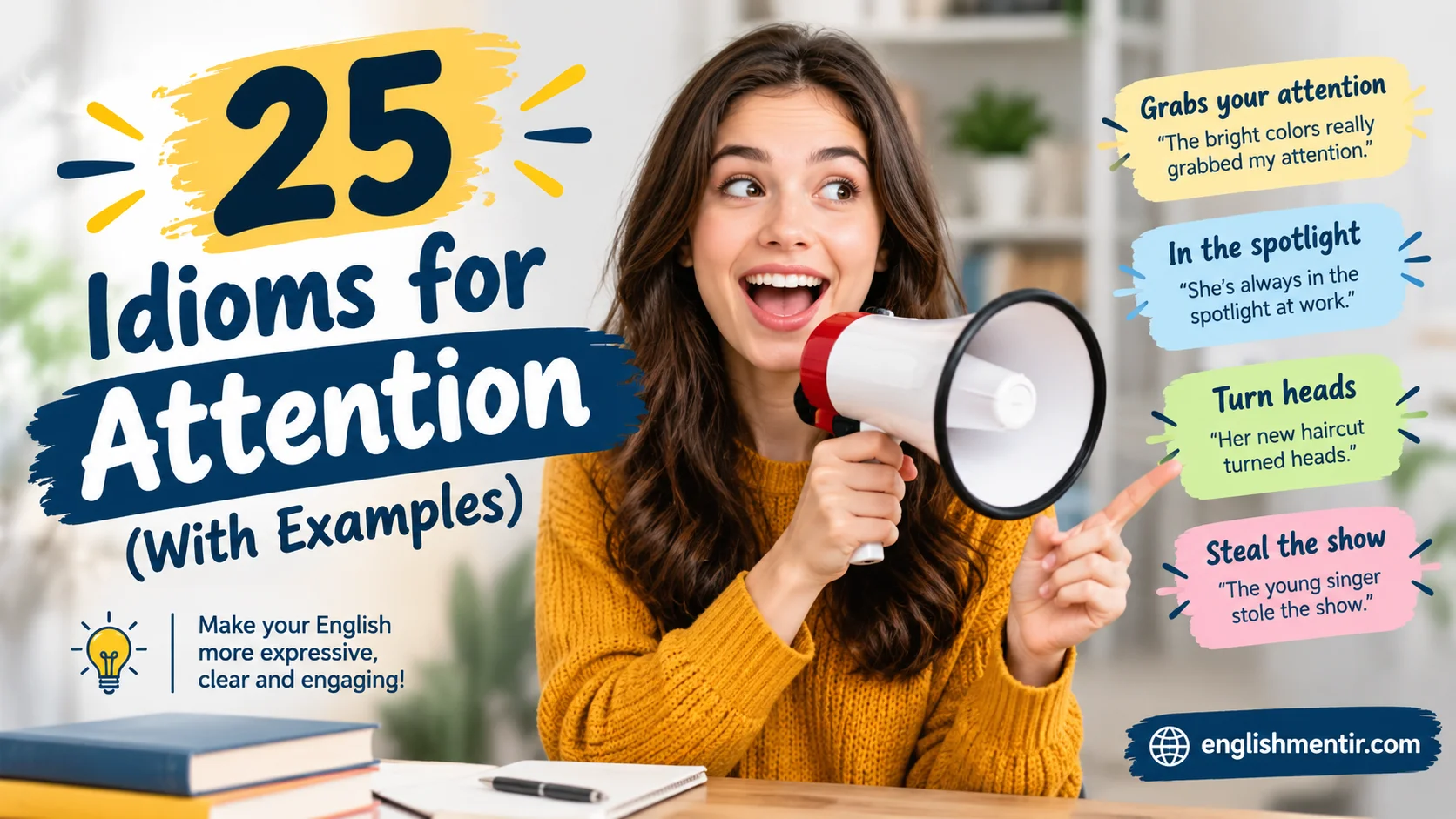
Learn 25 Idioms for Attention (With Examples) to improve your listening, notice details, and speak English naturally in everyday conversations.
Imagine sitting in a busy café where everyone is talking, phones are buzzing, and music is playing softly. You want to tell a friend something important, but they are not listening. You might wave your hand and say, “Hey, listen!” However, asking, “Can I bend your ear for a second?” sounds warmer, more natural, and more human. This shows the power of idioms. These colorful expressions have meanings that are often not literal. Native speakers use them every day to add emotion, color, and personality to language. Idioms for attention help you ask for focus, show interest, warn someone, and describe attention gained or attention lost. This article introduces 25 idioms for attention, including 15+ common idioms, grouped by emotion and context, with short stories, dialogues, tables, and real-life examples.
Whether you are a student, writer, or English learner, understanding idioms helps you communicate clearly and confidently. These figurative expressions describe focusing, noticing, listening carefully, and attracting someone’s interest. In my experience, choosing the right words makes communication easier and more vivid than relying on literal language alone. Idioms improve concentration, awareness, alertness, observation, and communication skills in spoken and written English. They support effective communication in everyday conversations, social interaction, café conversation, emails, classroom discussions, and workplace communication. Learning these natural expressions can strengthen your English vocabulary, speaking skills, and writing style. This guide includes simple meanings, practical example sentences, alternative expressions, and useful FAQs. A 15-question practice exercise helps you test your understanding, develop comprehension, and build confidence in communication while improving your ability to notice details and pay attention to what matters.
1. Pay Attention
Meaning: To listen carefully or focus on something important.
In a Sentence: Please pay attention to the teacher’s instructions before starting the assignment.
Other Ways to Say: Focus carefully, listen closely, concentrate, take notice.
2. Keep an Eye On
Meaning: To watch or monitor someone or something carefully.
In a Sentence: Could you keep an eye on my bag while I buy a ticket?
Other Ways to Say: Watch carefully, monitor, look after, keep watch.
3. Catch Someone’s Eye
Meaning: To attract someone’s attention visually.
In a Sentence: The bright red dress caught my eye as soon as I entered the store.
Other Ways to Say: Attract attention, stand out, draw someone’s gaze, get noticed.
4. Grab Someone’s Attention
Meaning: To make someone notice something immediately.
In a Sentence: The speaker used an interesting story to grab the audience’s attention.
Other Ways to Say: Capture attention, attract interest, make an impression, get noticed.
5. Bring Something to Someone’s Attention
Meaning: To inform someone about something they may not have noticed.
In a Sentence: I would like to bring this issue to your attention before the meeting begins.
Other Ways to Say: Inform someone, point something out, highlight an issue, make someone aware.
6. Pay Attention
Meaning: To listen carefully or focus on someone or something.
In a Sentence: Please pay attention to the teacher’s instructions so you don’t miss any important details.
Other Ways to Say: Focus closely, listen carefully, take notice, keep an eye on.
7. Lend an Ear
Meaning: To listen carefully and sympathetically to someone.
In a Sentence: My friend was upset, so I offered to lend an ear and listen to her concerns.
Other Ways to Say: Listen patiently, hear someone out, offer support, pay attention.
8. Keep Your Eyes Peeled
Meaning: To watch carefully for something or someone.
In a Sentence: Keep your eyes peeled for the blue sign when you reach the next street.
Other Ways to Say: Stay alert, watch closely, look carefully, be on the lookout.
9. Be All Ears
Meaning: To be ready and willing to listen.
In a Sentence: You said you have exciting news, and I’m all ears!
Other Ways to Say: Listen attentively, be ready to listen, give someone your attention, listen closely.
10. Take Note Of
Meaning: To notice or remember something important.
In a Sentence: Please take note of the changes to the examination schedule.
Other Ways to Say: Remember, observe, pay attention to, make a note of.
11. Zero In On
Meaning: To focus closely on a particular person, problem, or detail.
In a Sentence: The detective zeroed in on the small clue that helped solve the mystery.
Other Ways to Say: Focus on, concentrate on, target, identify the key point.
12. Draw Attention To
Meaning: To make people notice a particular issue, fact, or detail.
In a Sentence: The campaign aims to draw attention to the importance of protecting the environment.
Other Ways to Say: Highlight, emphasize, point out, bring into focus.
13. Keep Your Eyes Open
Meaning: To remain alert and notice what is happening around you.
In a Sentence: Keep your eyes open for new opportunities to improve your skills.
Other Ways to Say: Stay alert, remain watchful, be observant, look out for.
14. Have Your Eye On
Meaning: To watch, monitor, or be interested in something.
In a Sentence: I have my eye on a new laptop that would help me with my studies.
Other Ways to Say: Keep watching, be interested in, consider buying, watch closely.
15. In the Spotlight
Meaning: Receiving a great deal of public attention.
In a Sentence: The young scientist was in the spotlight after winning an international award.
Other Ways to Say: In the public eye, receiving attention, in the limelight, widely noticed.
16. Come to Light
Meaning: To become known or discovered, especially after being hidden.
In a Sentence: Several important facts came to light during the investigation.
Other Ways to Say: Be revealed, become known, emerge, be discovered.
17. Make a Point Of
Meaning: To deliberately ensure that you do something or give something special attention.
In a Sentence: I make a point of greeting everyone when I arrive at the office.
Other Ways to Say: Make an effort to, ensure, take care to, deliberately do.
18. Keep Tabs On
Meaning: To regularly check or monitor someone or something.
In a Sentence: The project manager keeps tabs on the team’s progress throughout the week.
Other Ways to Say: Monitor, track, keep watch on, stay informed about.
19. Watch Like a Hawk
Meaning: To observe someone or something extremely carefully.
In a Sentence: The coach watched the players like a hawk during the final minutes of the match.
Other Ways to Say: Watch closely, observe carefully, monitor constantly, keep a close eye on.
20. Sit Up and Take Notice
Meaning: To suddenly become interested in or pay serious attention to something.
In a Sentence: Her excellent presentation made the entire audience sit up and take notice.
Other Ways to Say: Become interested, pay close attention, take notice, become alert.
21. At the Back of Your Mind
Meaning: To remain in your thoughts even when you are not actively thinking about something.
In a Sentence: The upcoming deadline was always at the back of my mind while I worked on the project.
Other Ways to Say: Remain in your thoughts, stay in mind, be a concern, linger in your thoughts.
22. Have Eyes in the Back of Your Head
Meaning: To seem aware of everything happening around you, even when you cannot see it directly.
In a Sentence: The teacher seemed to have eyes in the back of her head because she noticed every student talking.
Other Ways to Say: Notice everything, be highly observant, stay aware, keep track of everything.
23. A Wake-Up Call
Meaning: An event or experience that makes someone realize they need to pay attention to a problem.
In a Sentence: Failing the first test was a wake-up call that encouraged him to study more seriously.
Other Ways to Say: A warning sign, a reality check, a warning, a moment of realization.
24. Get the Message Across
Meaning: To communicate an idea clearly so that others understand it.
In a Sentence: The teacher used a simple example to get the message across to her students.
Other Ways to Say: Communicate clearly, make yourself understood, explain effectively, convey the idea.
25. Read Between the Lines
Meaning: To understand a hidden meaning that is not directly expressed.
In a Sentence: If you read between the lines, you can tell that she is worried about the upcoming changes.
Other Ways to Say: Understand the hidden meaning, interpret clues, look beyond the words, recognize an implication.
Exercise to Practice: 15 Multiple-Choice Questions
Test your understanding of the 25 idioms for attention by choosing the correct answer for each question.
Questions
1. What does “pay attention” mean?
A. Ignore someone B. Focus carefully C. Leave the room D. Speak loudly
2. If something “catches your eye,” what happens?
A. It hurts your eyes B. You forget about it C. It attracts your attention D. You close your eyes
3. What does “lend an ear” mean?
A. Listen to someone B. Give someone money C. Avoid a conversation D. Ask someone to leave
Types of Attention and Observation?
A. Look carefully B. Notice every detail C. Watch something closely D. Deliberately ignore something
5. What does “keep your eyes peeled” mean?
A. Sleep well B. Stay alert and watch carefully C. Stop looking D. Become confused
6. If someone is “all ears,” they are:
A. Ready to listen B. Feeling angry C. Speaking continuously D. Ignoring advice
7. What does “zero in on” mean?
A. Move away from a problem B. Forget an important detail C. Focus on something specific D. Change the subject
8. If you “draw attention to” an issue, you:
A. Hide it B. Make people notice it C. Solve it immediately D. Forget it
9. What does “keep tabs on” mean?
A. Stop communicating B. Avoid responsibility C. Monitor something regularly D. Make a quick decision
10. If someone is “in the spotlight,” they are:
A. Receiving public attention B. Standing in darkness C. Working alone D. Avoiding people
11. What does “come to light” mean?
A. Become brighter B. Disappear completely C. Remain secret D. Become known or discovered
12. If you “watch someone like a hawk,” you:
A. Trust them without question B. Observe them very carefully C. Ignore their actions D. Follow them casually
13. What does “a wake-up call” mean?
A. An ordinary phone call B. An invitation to a party C. An event that makes you recognize a problem D. A request to go to sleep
14. If you “get the message across,” you:
A. Communicate an idea clearly B. Forget what you wanted to say C. Change the meaning D. Avoid explaining something
15. What does “read between the lines” mean?
A. Read a book quickly B. Copy a written paragraph C. Skip difficult sentences D. Understand an unstated meaning
Answer Key
- B — Focus carefully
- C — It attracts your attention
- A — Listen to someone
- D — Deliberately ignore something
- B — Stay alert and watch carefully
- A — Ready to listen
- C — Focus on something specific
- B — Make people notice it
- C — Monitor something regularly
- A — Receiving public attention
- D — Become known or discovered
- B — Observe them very carefully
- C — An event that makes you recognize a problem
- A — Communicate an idea clearly
- D — Understand an unstated meaning
FAQs:
1. What Are Idioms for Attention?
Idioms for attention are expressions used to describe listening carefully, noticing details, focusing on something important, or getting someone’s interest. They make everyday English more natural and engaging.
2. Why Should I Learn Idioms for Attention?
Learning these idioms improves your English vocabulary, speaking skills, and writing style. They also help you understand native speakers and communicate more confidently.
3. What Is an Example of an Idiom for Attention?
“Bend your ear” is an idiom that means talking to someone about something you want them to hear. For example, “Can I bend your ear for a minute?”
4. How Can I Use Idioms for Attention in Daily Conversations?
You can use them when talking with friends, participating in classroom discussions, writing emails, or communicating at work. Choose an idiom that fits the situation and practice using it in simple sentences.
5. How Can I Remember Idioms for Attention Easily?
Learn a few idioms at a time, understand their meanings, and create your own example sentences. Reading short stories, practicing dialogues, and reviewing regularly can also help you remember them.
Conclusion:
Idioms for attention make communication more interesting, natural, and expressive. They help you describe focus, careful listening, awareness, and the ways people gain or lose attention. Whether you are speaking with friends, writing emails, or participating in classroom discussions, using the right idiom can make your message clearer and more engaging.
To improve your English, practice these idioms in everyday situations and learn their meanings through practical examples. Start with a few expressions, use them in your own sentences, and gradually add more to your vocabulary. With regular practice, you can strengthen your speaking and writing skills, understand native speakers more easily, and communicate with greater confidence.