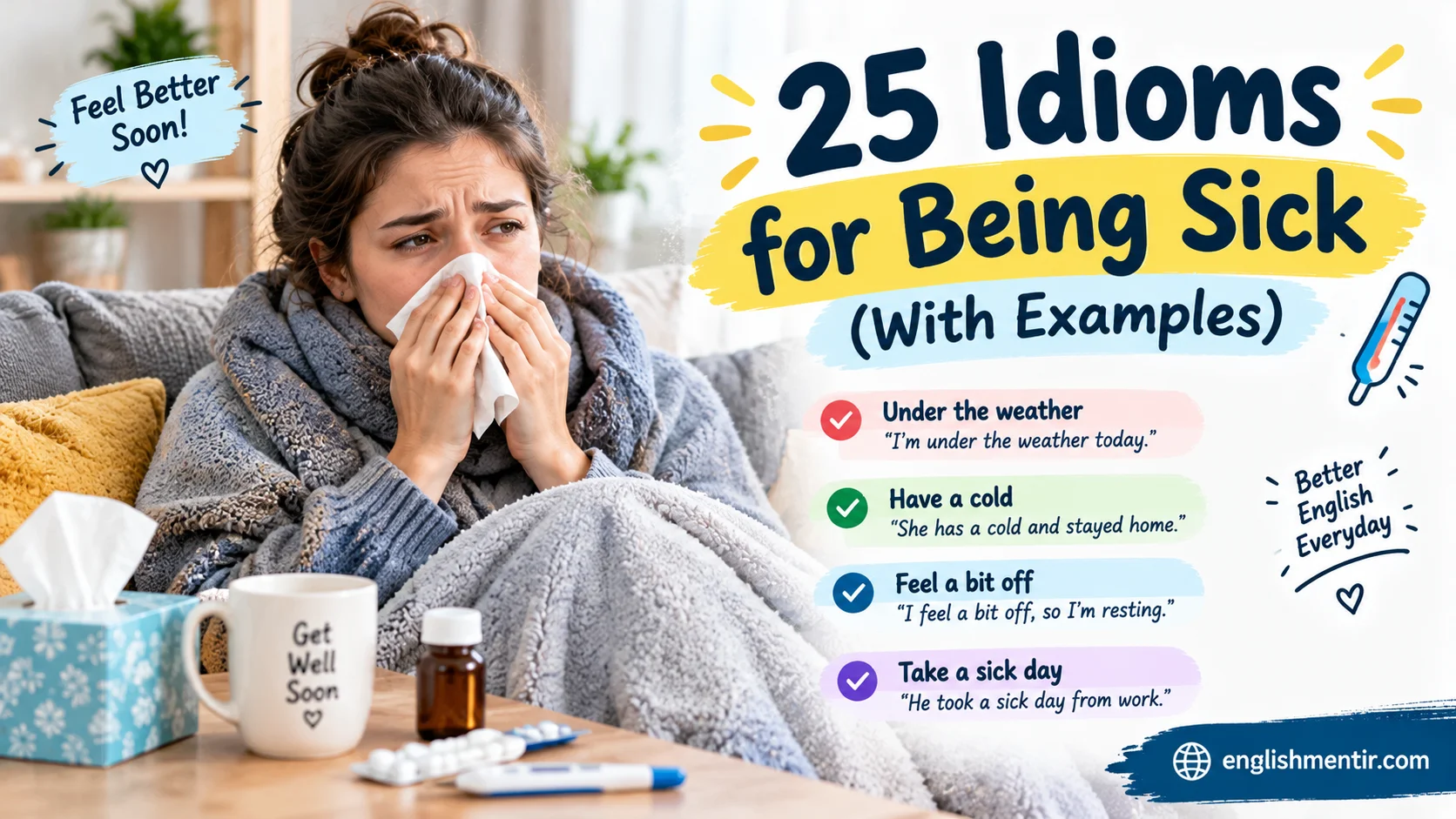
25 Idioms for Being Sick (With Examples) helps English learners use natural phrases to discuss illness confidently in everyday conversations.
Idioms for being sick help students, professionals, and language learners improve their vocabulary, spoken English, and conversational English. Native speakers use idiomatic expressions to describe illness, tiredness, stress, and physical discomfort in casual conversations, workplaces, and schools. For example, under the weather means feeling unwell, while coming down with something means starting to get sick. These health-related idioms improve communication skills, make conversations more engaging, and help people express feelings naturally.
Understanding idiom meanings and context helps you choose the right words. These common idioms can describe a cold, fever, flu, nausea, or exhaustion. While natural expressions work well in informal conversations, medical expressions are often better for formal writing. Learning with simple examples, a practice exercise, and a multiple-choice quiz containing 15 multiple-choice questions can improve language comprehension and help you test your knowledge
1. Under the Weather
Meaning: Feeling slightly sick or unwell.
In a Sentence: I am feeling under the weather, so I will stay home and rest today.
Other Ways to Say: Feeling unwell, feeling poorly, not feeling well.
2. Feel Like Death Warmed Over
Meaning: Feeling extremely sick, tired, or weak.
In a Sentence: After catching a bad flu, I felt like death warmed over.
Other Ways to Say: Feeling terrible, feeling awful, feeling very ill.
3. Come Down With Something
Meaning: To begin experiencing symptoms of an illness.
In a Sentence: I think I am coming down with something because I have a sore throat and a headache.
Other Ways to Say: Start feeling sick, develop an illness, begin to feel unwell.
4. Catch a Cold
Meaning: To become infected with a common cold.
In a Sentence: She caught a cold after spending time with her sick brother.
Other Ways to Say: Get a cold, develop a cold, become ill with a cold.
5. Go Down With Something
Meaning: To become ill with a particular sickness.
In a Sentence: Several students went down with the flu after returning from their school trip.
Other Ways to Say: Fall ill with, become sick with, come down with.
6. Feel Queasy
Meaning: To feel sick in the stomach, as if you might vomit.
In a Sentence: I felt queasy after eating too much food at dinner.
Other Ways to Say: Feel nauseated, feel sick to the stomach, feel unsettled.
7. Be Sick as a Dog
Meaning: To feel extremely ill, often with vomiting or other strong symptoms.
In a Sentence: He was sick as a dog all night and could not get any sleep.
Other Ways to Say: Feel very ill, be terribly sick, feel awful.
8. Look Like Death
Meaning: To look extremely tired, pale, or unwell.
In a Sentence: You look like death this morning; perhaps you should take a break and rest.
Other Ways to Say: Look exhausted, look pale, look very unwell.
9. Have a Bug
Meaning: To have a minor illness, often a stomach bug or a virus.
In a Sentence: I cannot come to the party because I have a bug and need to rest.
Other Ways to Say: Have a virus, have a stomach bug, be a little sick.
10. Be Laid Up
Meaning: To be unable to do normal activities because of illness or injury.
In a Sentence: My father was laid up with the flu for several days.
Other Ways to Say: Be confined to bed, be unable to get around, be stuck resting.
11. Take to Your Bed
Meaning: To go to bed because you feel too ill to continue your usual activities.
In a Sentence: After developing a high fever, she decided to take to her bed.
Other Ways to Say: Go to bed, stay in bed, rest because of illness.
12. Be Out of Action
Meaning: To be unable to work or do normal activities because of sickness or injury.
In a Sentence: I will be out of action for a few days while I recover from the flu.
Other Ways to Say: Be unable to work, take time off, be temporarily inactive.
13. Have a Splitting Headache
Meaning: To have a very severe headache.
In a Sentence: I have a splitting headache, so I need to turn off the lights and rest.
Other Ways to Say: Have a terrible headache, have a pounding headache, have a severe headache.
14. Feel Off-Color
Meaning: To feel slightly ill or not as healthy as usual.
In a Sentence: I have been feeling off-color since yesterday, so I will take it easy today.
Other Ways to Say: Feel under the weather, feel poorly, feel a little unwell.
15. Be Green Around the Gills
Meaning: To look pale or sick, especially when feeling nauseated.
In a Sentence: The rough boat ride left Mark green around the gills.
Other Ways to Say: Look nauseated, look pale, appear sick.
16. Bring Something Up
Meaning: To vomit, usually used in an informal conversation.
In a Sentence: The child felt sick and brought up everything he had eaten.
Other Ways to Say: Throw up, vomit, be sick.
17. Feel Rotten
Meaning: To feel very unwell or physically uncomfortable.
In a Sentence: I feel rotten today because I have a sore throat and body aches.
Other Ways to Say: Feel awful, feel terrible, feel miserable.
18. Be on the Mend
Meaning: To be getting better after an illness or injury.
In a Sentence: After three days of rest, my grandmother is finally on the mend.
Other Ways to Say: Be recovering, get better, improve gradually.
19. Bounce Back
Meaning: To recover quickly from an illness or difficult situation.
In a Sentence: With enough rest, she managed to bounce back after a few days of sickness.
Other Ways to Say: Recover quickly, get back on your feet, regain your strength.
20. Get Back on Your Feet
Meaning: To recover and return to normal activities after being ill.
In a Sentence: It took a week of rest for him to get back on his feet after the flu.
Other Ways to Say: Recover, regain your strength, return to normal.
21. Be Past the Worst
Meaning: To have passed the most difficult or unpleasant stage of an illness.
In a Sentence: My fever has gone down, and I think I am past the worst.
Other Ways to Say: Be through the hardest part, begin to improve, turn the corner.
22. Run a Fever
Meaning: To have a higher-than-normal body temperature because of illness.
In a Sentence: The little boy was running a fever, so his parents contacted their doctor.
Other Ways to Say: Have a fever, have an elevated temperature, be feverish.
23. Have the Sniffles
Meaning: To have a runny or blocked nose, usually because of a mild cold.
In a Sentence: I have the sniffles, but I feel well enough to finish my homework.
Other Ways to Say: Have a runny nose, have mild cold symptoms, be a little congested.
24. Be Full of Beans Again
Meaning: To have your energy and enthusiasm back after feeling tired or unwell.
In a Sentence: After a few days of rest, the children were full of beans again.
Other Ways to Say: Feel energetic again, regain your energy, be lively again.
25. Turn the Corner
Meaning: To reach a point where an illness begins to improve.
In a Sentence: After several difficult days, Dad finally turned the corner and started feeling better.
Other Ways to Say: Begin to recover, start improving, move toward recovery.
Exercise to Practice: 15 Multiple-Choice Questions
Choose the correct answer for each question to test your understanding of idioms for being sick.
1. What does “under the weather” mean?
A. Feeling excited
B. Feeling slightly sick
C. Feeling hungry
D. Feeling angry
2. If you “come down with something,” what happens?
A. You begin to feel ill
B. You start exercising
C. You fall asleep
D. You finish your work
3. Which idiom means feeling extremely sick?
A. Full of beans
B. On the mend
C. Sick as a dog
D. Turn the corner
4. What does “be laid up” mean?
A. To travel somewhere
B. To be unable to do normal activities because of illness or injury
C. To wake up early
D. To become more energetic
5. If someone is “on the mend,” what is happening?
A. They are getting worse
B. They are becoming angry
C. They are recovering
D. They are going on a trip
6. Which idiom means to recover quickly?
A. Bounce back
B. Have the sniffles
C. Feel queasy
D. Run a fever
7. What does “have the sniffles” usually describe?
A. A severe headache
B. Mild cold symptoms
C. A broken bone
D. Extreme hunger
8. If someone looks “green around the gills,” how might they look?
A. Healthy and energetic
B. Pale or nauseated
C. Happy and excited
D. Relaxed and sleepy
9. What does “turn the corner” mean when discussing an illness?
A. To change direction while walking
B. To begin improving after a difficult period
C. To stop taking a break
D. To become sick suddenly
10. Which expression means having a very severe headache?
A. Have a splitting headache
B. Catch a cold
C. Be full of beans
D. Be on the mend
11. What does “out of action” mean?
A. Ready for a competition
B. Unable to do normal activities temporarily
C. Feeling unusually hungry
D. Starting a new job
12. If someone is “running a fever,” what do they have?
A. A stomach ache only
B. A higher-than-normal body temperature
C. A broken arm
D. A common headache only
13. Which idiom means looking or feeling extremely unwell?
A. Feel like death warmed over
B. Bounce back
C. Full of beans again
D. Get back on your feet
14. What does “get back on your feet” mean?
A. Start walking for the first time
B. Recover and return to normal activities
C. Fall asleep
D. Develop a cold
15. Which idiom describes having energy and enthusiasm again?
A. Be green around the gills
B. Be laid up
C. Be full of beans again
D. Feel rotten
Answers to the 15 MCQs
- B — Feeling slightly sick
- A — You begin to feel ill
- C — Sick as a dog
- B — Unable to do normal activities because of illness or injury
- C — They are recovering
- A — Bounce back
- B — Mild cold symptoms
- B — Pale or nauseated
- B — Begin improving after a difficult period
- A — Have a splitting headache
- B — Unable to do normal activities temporarily
- B — A higher-than-normal body temperature
- A — Feel like death warmed over
- B — Recover and return to normal activities
- C — Be full of beans again
FAQs:
1. What are idioms for being sick?
Idioms for being sick are common expressions used to describe illness or feeling unwell. For example, “under the weather” means feeling sick or not feeling well.
2. What is the most common idiom for being sick?
“Under the weather” is one of the most common idioms for being sick. For example, “I’m feeling under the weather, so I’ll stay home today.”
3. How do you say you are sick using idioms?
You can say “I’m feeling under the weather,” “I’m down with a cold,” or “I’m not feeling myself.” These expressions help you describe how you feel in everyday conversations.
4. Are idioms for being sick formal or informal?
Most idioms for being sick are informal and work well in everyday conversations with friends, family, and coworkers. In formal situations, it is often better to say “I am feeling unwell” or “I am recovering from an illness.”
5. Why should English learners learn idioms about sickness?
Learning these idioms helps English learners understand native speakers, improve their speaking skills, and express feelings naturally. They are also useful for reading books, watching movies, and having everyday conversations.
Conclusion:
Learning 25 idioms for being sick is a useful way to improve your English vocabulary and communicate more naturally. Expressions such as “under the weather,” “down with a cold,” and “not feeling myself” help you explain how you feel in simple, everyday language. Each idiom has its own meaning and usage, so learning examples can help you understand when to use it.
Practice these idioms in conversations and writing to remember them more easily. You can use them when talking with friends, explaining why you need rest, or discussing an illness. With regular practice, you will become more confident using English idioms and expressing yourself clearly in different situations.