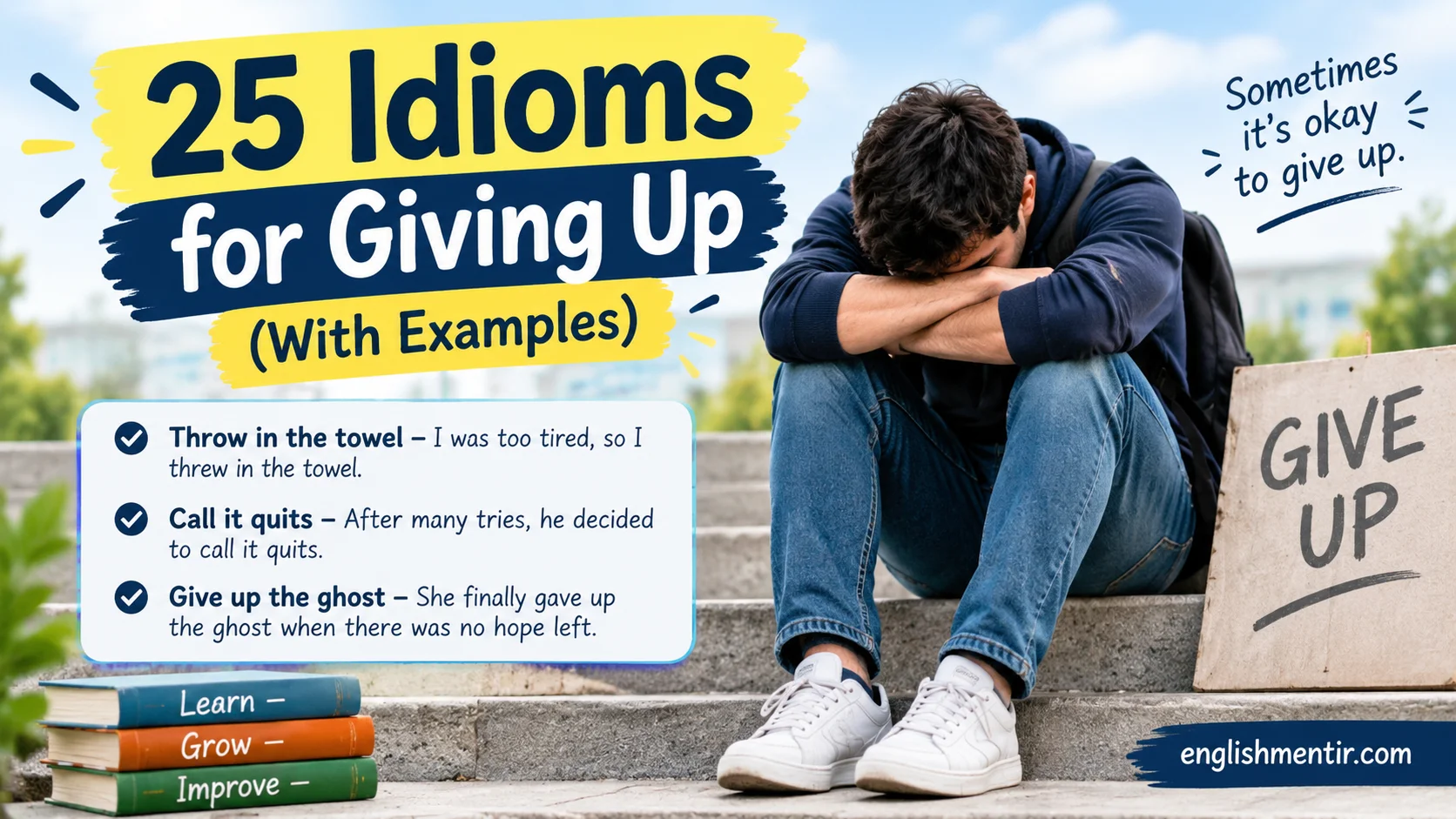
25 Idioms for Giving Up (With Examples) explores expressions that describe surrender, losing hope, accepting defeat, and deciding to stop trying when facing challenges.
These idioms help you express frustration, recognize setbacks, accept difficult situations, and describe moments when someone chooses to quit. They make English more natural and expressive in daily conversations, formal writing, storytelling, and professional communication.
Learn their meanings, tones, and sentence examples to improve your English, communicate with confidence, and use the right expressions to describe giving up in everyday and professional situations.
Think
To pick up a draggable item, press the space bar. While dragging, use the arrow keys to move the item. Press space again to drop the item in its new position, or press escape to cancel.
1. Throw in the Towel
Meaning: To give up or admit that you can no longer continue trying to do something.
In a Sentence: After trying to fix the computer for three hours, Ahmed decided to throw in the towel and call a technician.
Other Ways to Say:
- Give up
- Admit defeat
- Stop trying
- Call it quits
2. Throw in the Sponge
Meaning: To stop trying because a task or situation seems too difficult. This is a less common variation of “throw in the towel.”
In a Sentence: After several unsuccessful attempts to repair the old car, he decided to throw in the sponge.
Other Ways to Say:
- Give up
- Stop making an effort
- Admit defeat
- Abandon the attempt
3. Call It Quits
Meaning: To decide to stop doing something, especially when continuing no longer seems worthwhile.
In a Sentence: After working on the project all night, the team decided to call it quits and finish the rest the next morning.
Other Ways to Say:
- Stop for good
- Give up
- End the attempt
- Pack it in
4. Wave the White Flag
Meaning: To surrender or accept that you cannot win a particular struggle.
In a Sentence: After losing several matches in a row, the exhausted player finally waved the white flag.
Other Ways to Say:
- Surrender
- Give in
- Admit defeat
- Stop fighting
5. Admit Defeat
Meaning: To accept that you have lost or cannot achieve a particular goal.
In a Sentence: Although she had prepared carefully, Maria had to admit defeat when she could not solve the final problem.
Other Ways to Say:
- Accept failure
- Acknowledge a loss
- Concede
- Accept the outcome
6. Give Up the Ghost
Meaning: To stop functioning or finally stop trying to keep something going. This idiom is often used for machines, plans, or efforts that have come to an end.
In a Sentence: After years of faithful service, our old washing machine finally gave up the ghost.
Other Ways to Say:
- Stop working
- Break down completely
- Come to an end
- Give out
7. Pack It In
Meaning: To stop working or trying, usually because you are tired or feel that enough is enough.
In a Sentence: We had been hiking since sunrise, so we decided to pack it in before the weather became worse.
Other Ways to Say:
- Call it a day
- Stop trying
- Give up for now
- Finish up
8. Back Down
Meaning: To stop defending a position or demanding something, often because of pressure or disagreement.
In a Sentence: After a long discussion, Daniel decided to back down and consider his colleague’s suggestion.
Other Ways to Say:
- Give in
- Yield
- Retreat from a position
- Relent
9. Throw Up Your Hands
Meaning: To stop trying to solve a problem because you feel frustrated, helpless, or overwhelmed.
In a Sentence: Faced with one technical problem after another, the designer threw up her hands in frustration.
Other Ways to Say:
- Give up in frustration
- Feel helpless
- Stop trying to solve it
- Admit you are stuck
10. Lose Heart
Meaning: To become discouraged and lose the confidence or motivation to continue.
In a Sentence: Do not lose heart if your first job application is unsuccessful; another opportunity may be waiting for you.
Other Ways to Say:
- Become discouraged
- Lose confidence
- Feel disheartened
- Lose motivation
11. Lose Hope
Meaning: To stop believing that a desired result will happen.
In a Sentence: Even after months without a response, she refused to lose hope of finding a suitable job.
Other Ways to Say:
- Become pessimistic
- Stop believing
- Feel discouraged
- Give up hope
12. Reach the End of Your Rope
Meaning: To reach the point where you feel you have no patience, energy, or solutions left.
In a Sentence: After dealing with repeated delays and unexpected expenses, the small business owner had reached the end of his rope.
Other Ways to Say:
- Reach your limit
- Run out of patience
- Feel overwhelmed
- Be at your breaking point
13. Hit a Dead End
Meaning: To reach a point where no further progress seems possible.
In a Sentence: After checking every available source, the researchers hit a dead end in their investigation.
Other Ways to Say:
- Reach a standstill
- Make no progress
- Reach a roadblock
- Find no way forward
14. Run Out of Steam
Meaning: To lose energy, enthusiasm, or momentum while doing something.
In a Sentence: The team started the project with great excitement but ran out of steam halfway through.
Other Ways to Say:
- Lose momentum
- Run out of energy
- Lose enthusiasm
- Slow down
15. Fold Under Pressure
Meaning: To give in or stop resisting when a situation becomes too stressful or demanding.
In a Sentence: The negotiator refused to fold under pressure, even when the discussion became difficult.
Other Ways to Say:
- Give in to pressure
- Back down
- Lose confidence
- Surrender under stress
16. Let Go
Meaning: To stop holding on to something emotionally, mentally, or practically when it is time to move forward.
In a Sentence: After realizing that the old plan was no longer realistic, she decided to let go and explore new possibilities.
Other Ways to Say:
- Move on
- Release your attachment
- Accept the situation
- Stop holding on
17. Walk Away
Meaning: To leave a situation or stop participating because continuing is no longer worthwhile.
In a Sentence: When the business negotiations became unfair, Priya chose to walk away rather than accept a bad deal.
Other Ways to Say:
- Leave the situation
- Withdraw
- Step away
- End your involvement
18. Cut Your Losses
Meaning: To stop investing time, money, or effort in something that is failing to avoid greater losses.
In a Sentence: After months of declining sales, the owners decided to cut their losses and close the unsuccessful shop.
Other Ways to Say:
- Limit further damage
- Stop investing in a failure
- Minimize losses
- End an unsuccessful effort
19. Throw Up the Sponge
Meaning: To give up or stop making an effort. This is an uncommon variation of “throw in the towel.”
In a Sentence: After several failed attempts to fix the leaking pipe, the homeowner nearly threw up the sponge and called a plumber.
Other Ways to Say:
- Give up
- Admit defeat
- Stop trying
- Abandon the effort
20. Cry Uncle
Meaning: To admit defeat or surrender, often after someone has put you under pressure. It is an informal expression commonly used in American English.
In a Sentence: After losing several rounds of their friendly wrestling match, Ben finally cried uncle.
Other Ways to Say:
- Surrender
- Give in
- Admit defeat
- Cry for mercy
21. Throw in the Towel on Something
Meaning: To abandon a particular task, goal, or effort because you no longer believe you can succeed.
In a Sentence: After months of trying to make the outdated software work, the company decided to throw in the towel on the project.
Other Ways to Say:
- Abandon the project
- Give up on the goal
- Stop pursuing something
- Call it quits
22. Go Down Fighting
Meaning: To continue resisting or trying even when defeat seems likely. Unlike most idioms on this list, it describes refusing to give up easily.
In a Sentence: Although the team was behind by twenty points, its players chose to go down fighting until the final whistle.
Other Ways to Say:
- Keep fighting until the end
- Resist until the last moment
- Never surrender easily
- Make one final effort
23. Bite the Dust
Meaning: To fail, be defeated, or come to an end. It is an informal expression and can sound dramatic.
In a Sentence: After several unsuccessful attempts to attract customers, the struggling café finally bit the dust.
Other Ways to Say:
- Fail
- Be defeated
- Come to an end
- Collapse
24. Reach the Breaking Point
Meaning: To reach a stage where emotional or physical pressure becomes almost impossible to tolerate.
In a Sentence: After weeks of working overtime without a break, the exhausted employee reached the breaking point.
Other Ways to Say:
- Reach your limit
- Become overwhelmed
- Run out of patience
- Feel unable to continue
25. Throw in the Towel and Move On
Meaning: To stop pursuing something that is not working and direct your energy toward a new opportunity.
In a Sentence: After repeated attempts to save the failing business, the partners decided to throw in the towel and move on to a different venture.
Other Ways to Say:
- Accept the outcome and move forward
- Leave the past behind
- Start afresh
- Pursue a new direction
Exercise: Practice Idioms for Giving Up
Test your understanding of these 25 idioms with the following 15 multiple-choice questions (MCQs). Choose the best answer for each question, then check the answer key below.
Multiple-Choice Questions
1. What does “throw in the towel” mean?
A. Start a new activity
B. Give up or admit defeat
C. Celebrate a victory
D. Work more quickly
2. If someone decides to “call it quits,” what do they do?
A. Continue working harder
B. Ask for more instructions
C. Stop an activity
D. Begin a competition
3. Which idiom means to surrender?
A. Wave the white flag
B. Run out of steam
C. Hit a dead end
D. Bite the dust
4. What does “lose heart” mean?
A. Become more confident
B. Feel discouraged
C. Make a new friend
D. Win an argument
5. If a project “hits a dead end,” what happens?
A. It becomes successful
B. It finishes ahead of schedule
C. It reaches a point where progress is impossible
D. It receives additional funding
6. Which idiom means to stop investing in something unsuccessful to prevent greater losses?
A. Cry uncle
B. Cut your losses
C. Go down fighting
D. Let go
7. What does “run out of steam” mean?
A. Lose energy or enthusiasm
B. Make rapid progress
C. Find a solution
D. Finish a task successfully
8. If someone “backs down,” what do they do?
A. Increase their demands
B. Refuse to listen
C. Withdraw from a position
D. Start a new argument
9. Which expression describes reaching your limit of patience or endurance?
A. Bite the dust
B. Reach the end of your rope
C. Call it quits
D. Throw in the sponge
10. What does “walk away” mean in a difficult negotiation?
A. Accept every condition
B. Continue arguing indefinitely
C. Leave the situation
D. Demand an immediate victory
11. Which idiom describes continuing to resist even when defeat seems likely?
A. Go down fighting
B. Lose heart
C. Pack it in
D. Give up the ghost
12. What does “cry uncle” mean?
A. Ask someone for directions
B. Admit defeat or surrender
C. Offer congratulations
D. Start a disagreement
13. If a machine “gives up the ghost,” what does that usually mean?
A. It starts working faster
B. It needs less maintenance
C. It stops working
D. It becomes more efficient
14. Which idiom means to stop holding on to an emotional attachment and move forward?
A. Fold under pressure
B. Let go
C. Throw up your hands
D. Bite the dust
15. What does “reach the breaking point” mean?
A. Reach a stage of extreme pressure or stress
B. Complete a project easily
C. Become more patient
D. Find a simple solution
Answer Key
- B — Give up or admit defeat
- C — Stop an activity
- A — Wave the white flag
- B — Feel discouraged
- C — Reach a point where progress is impossible
- B — Cut your losses
- A — Lose energy or enthusiasm
- C — Withdraw from a position
- B — Reach the end of your rope
- C — Leave the situation
- A — Go down fighting
- B — Admit defeat or surrender
- C — It stops working
- B — Let go
- A — Reach a stage of extreme pressure or stress
Conclusion
Learning idioms for giving up can help you express frustration, disappointment, surrender, and the decision to move forward in natural English. Expressions such as “throw in the towel,” “call it quits,” “wave the white flag,” and “cut your losses” are useful in everyday conversations, academic writing, and storytelling.
Remember that giving up is not always the same as failing. Sometimes, stopping is a sensible decision that protects your time, energy, and well-being. In other situations, expressions such as “lose heart” describe temporary discouragement rather than a final decision to quit.
To use these idioms confidently, pay attention to their meanings and contexts. Practice them in your own sentences, and choose the expression that communicates your message most accurately.
FAQs:
1. What is the most common idiom for giving up?
“Throw in the towel” is one of the most common idioms for giving up. It means to stop trying or admit defeat after making an effort.
Example: After three unsuccessful attempts, he decided to throw in the towel.
2. What is another way to say “give up” in English?
You can say call it quits, pack it in, wave the white flag, back down, or cut your losses. The best choice depends on the context and whether you mean stopping an activity, surrendering, or avoiding further losses.
3. What idiom means losing hope?
“Lose heart” and “lose hope” describe becoming discouraged or no longer believing that something will succeed.
Example: Do not lose heart just because your first attempt did not work.
4. Is giving up the same as letting go?
No. Giving up usually means stopping an effort to achieve something, while letting go often means releasing an emotional attachment or accepting something you cannot change.
Example: She gave up trying to change his mind and let go of her frustration.
5. How can I use idioms for giving up in daily conversation?
Use these idioms when discussing challenges, work, studies, relationships, or personal goals. For example, you might say, “I am ready to call it quits for today,” when you want to stop working, or “I will not lose heart” when you want to express determination.