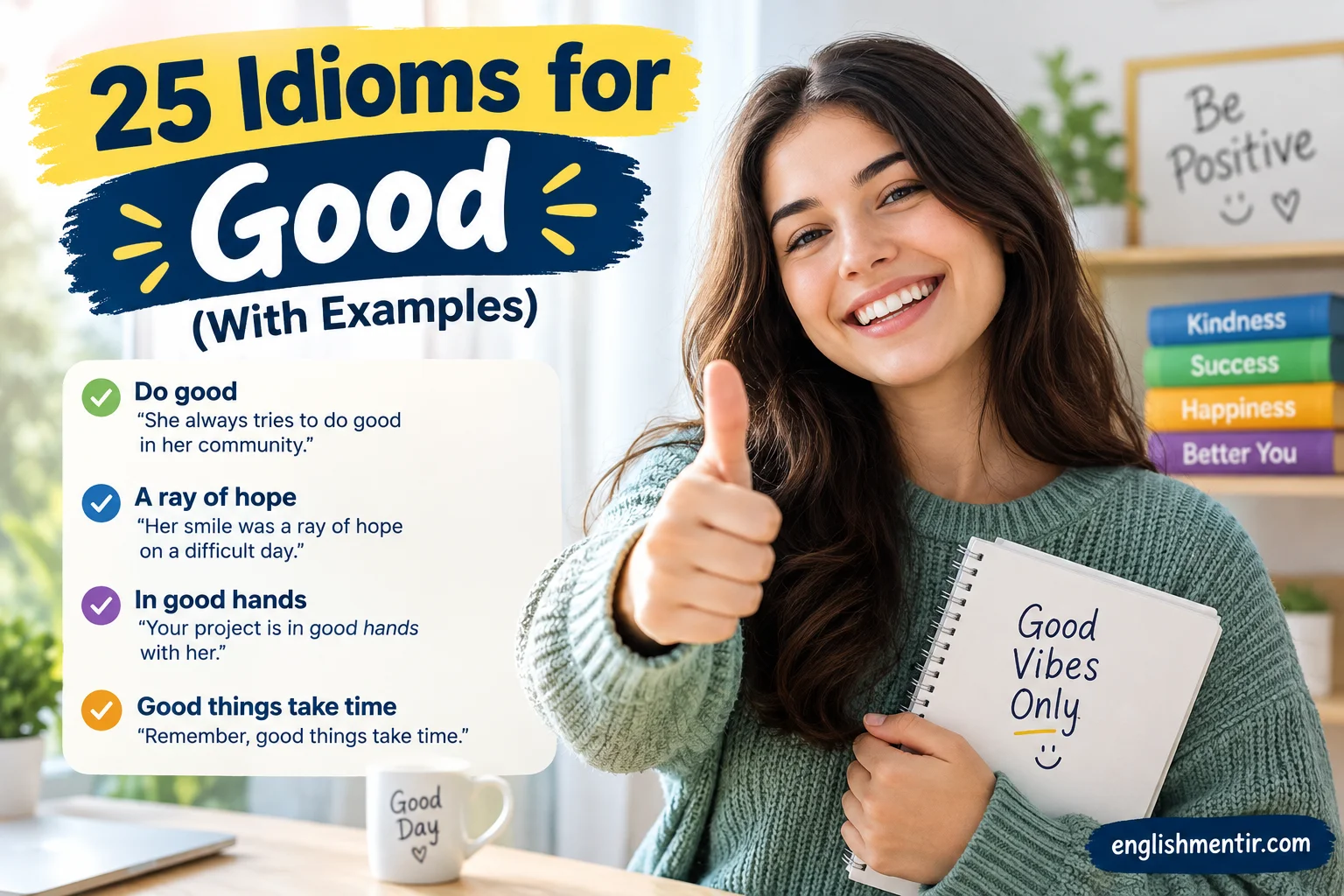
Discover 25 Idioms for Good (With Examples), learn their meanings, and use them naturally to improve your English fluency and communication!
An idiom is a group of words in a fixed order with a particular meaning, so the meanings of each word may not be understood individually. There are an estimated 25,000 different idioms in English, including 25 common idiomatic expressions. Learning them alongside grammar and vocabulary can help when you learn English effectively, understand common idioms, common phrases, and expressions used by native English speakers in daily conversation, writing, and the media. Mastering English is essential for achieving fluency, sounding like a native speaker, and improving your English language skills.
Since idioms are often literal in neither form nor meaning and may contain cultural connotations, they can confuse non-native speakers, but knowing their correct uses can help you become fluent and significantly boost your language abilities. This blog post includes 50 common English idioms and phrases, with their meaning and examples, plus tips to work out meaning when you come across an unfamiliar expression. If you are preparing for an English proficiency test or want to improve your conversational skills, practising can help you learn quickly. Read a text, guess what an idiom might mean from its context, and then check the definition. A box with 10 idiomatic expressions in bold can provide useful practice, while a short quiz at the end helps you practise your idiom-solving skills. These activities can help you remember useful idioms and phrases.
1. On the Right Track
Meaning:
“On the right track” means you are moving in the correct direction toward a desired result.
In a Sentence:
After reviewing your project, your teacher said you were on the right track.
Other Ways to Say:
- Heading in the right direction
- Making progress
- Moving forward
- Going the right way
This idiom is especially useful when you want to encourage someone without suggesting that the work is already finished. It gives reassurance while leaving room for further improvement.
2. Hit the Nail on the Head
Meaning:
“Hit the nail on the head” means to identify or describe something exactly and accurately.
In a Sentence:
You hit the nail on the head when you said the team needed better communication.
Other Ways to Say:
- Get it exactly right
- Identify the real issue
- Be spot-on
- Nail the point
This expression fits situations where someone makes a precise observation or gives an answer that perfectly matches the situation.
3. A Piece of Cake
Meaning:
“A piece of cake” describes something that is very easy to do.
In a Sentence:
Once I understood the instructions, the assignment was a piece of cake.
Other Ways to Say:
- Very easy
- Simple as anything
- No trouble at all
- A breeze
The phrase has a light and cheerful tone, making it useful in casual conversations when you want to reassure someone about a task.
4. Go the Extra Mile
Meaning:
“Go the extra mile” means to make additional effort beyond what people normally expect.
In a Sentence:
Maria always goes the extra mile to help new employees feel welcome.
Other Ways to Say:
- Make an extra effort
- Do more than expected
- Give your all
- Put in extra work
This idiom is excellent when you want to recognize someone’s care, dedication, or willingness to help.
5. Get the Ball Rolling
Meaning:
“Get the ball rolling” means to start an activity, project, or process.
In a Sentence:
Let’s get the ball rolling by discussing the first step of the plan.
Other Ways to Say:
- Get started
- Begin the process
- Set things in motion
- Take the first step
Use this phrase when you want to encourage people to stop waiting and begin making progress.
6. Break New Ground
Meaning:
“Break new ground” means to do something innovative or different that has not been done before.
In a Sentence:
The researchers broke new ground with their approach to renewable energy.
Other Ways to Say:
- Pioneer something
- Try something new
- Lead the way
- Create a new path
This idiom works particularly well in academic, professional, scientific, and creative contexts.
7. Come Out on Top
Meaning:
“Come out on top” means to succeed or achieve the best result, especially after competition or difficulty.
In a Sentence:
After months of preparation, our team came out on top in the final competition.
Other Ways to Say:
- Win
- Succeed
- Finish first
- Prevail
The expression carries a sense of achievement after effort, making it useful when describing a successful outcome.
8. In the Pink
Meaning:
“In the pink” traditionally means being in excellent condition, especially in terms of health or well-being.
In a Sentence:
After a few quiet days at home, Grandpa was in the pink again.
Other Ways to Say:
- Feeling great
- In excellent shape
- Full of energy
- Doing very well
This is a somewhat old-fashioned but colorful idiom, so it can add personality to storytelling and informal writing.
9. A Breath of Fresh Air
Meaning:
“A breath of fresh air” describes someone or something that feels refreshing, pleasant, and different.
In a Sentence:
Her creative ideas were a breath of fresh air during the long meeting.
Other Ways to Say:
- Refreshing
- A welcome change
- A pleasant surprise
- A new perspective
This phrase is especially helpful when you want to express appreciation for something refreshing or inspiring.
Read More: 25 Idioms for Going Crazy (With Examples)
10. Have the World at Your Feet
Meaning:
“Have the world at your feet” means to have many opportunities and a strong chance of achieving great things.
In a Sentence:
With her talent and determination, she seemed to have the world at her feet.
Other Ways to Say:
- Have endless opportunities
- Have a bright future
- Be full of potential
- Have exciting possibilities ahead
This expression often carries an optimistic and encouraging feeling, particularly when talking about someone’s future.
11. Keep Your Chin Up
Meaning:
“Keep your chin up” means to remain positive, confident, and hopeful during a difficult period.
In a Sentence:
Keep your chin up; this setback doesn’t define your future.
Other Ways to Say:
- Stay positive
- Remain hopeful
- Stay strong
- Don’t lose heart
It is a caring expression that can help you comfort and encourage someone who is facing disappointment.
12. Every Cloud Has a Silver Lining
Meaning:
“Every cloud has a silver lining” means that even a difficult situation may contain something positive or hopeful.
In a Sentence:
Losing that job was painful, but every cloud has a silver lining because it led her to a career she loves.
Other Ways to Say:
- Look for the positive
- Something positive may come from it
- There is hope in difficulty
- Find the lesson in the setback
This idiom doesn’t deny that problems can hurt. Instead, it encourages you to look for possibility when circumstances feel discouraging.
13. When One Door Closes, Another Opens
Meaning:
“When one door closes, another opens” means that losing one opportunity can create space for a new opportunity.
In a Sentence:
I was disappointed when the position disappeared, but when one door closes, another opens.
Other Ways to Say:
- New opportunities will come
- A new path may appear
- There are other possibilities
- Something else may be waiting
This expression can bring hope and perspective to conversations about change, rejection, or unexpected endings.
14. Go From Strength to Strength
Meaning:
“Go from strength to strength” means to continue becoming more successful or capable over time.
In a Sentence:
Since launching her business, she has gone from strength to strength.
Other Ways to Say:
- Keep improving
- Continue to succeed
- Grow stronger
- Build on your success
This phrase is ideal for celebrating steady progress and long-term achievement.
15. In Full Swing
Meaning:
“In full swing” means an activity has reached a busy, active, or energetic stage.
In a Sentence:
By Saturday afternoon, the festival was in full swing.
Other Ways to Say:
- Fully underway
- In full operation
- At its busiest
- Going strongly
Use this idiom when describing an event, project, celebration, or activity that has become lively and active.
16. Make a Splash
Meaning:
“Make a splash” means to attract a lot of attention, usually because of something impressive, exciting, or unusual.
In a Sentence:
The young designer made a splash with her first collection.
Other Ways to Say:
- Attract attention
- Make an impression
- Stand out
- Create excitement
This phrase works particularly well when discussing new products, performances, achievements, or public appearances.
17. Put Your Best Foot Forward
Meaning:
“Put your best foot forward” means to make the best possible impression or give your strongest effort.
In a Sentence:
Before the interview, he prepared carefully so he could put his best foot forward.
Other Ways to Say:
- Make a strong impression
- Show your best side
- Give your best effort
- Present yourself well
This is a useful idiom for interviews, first meetings, applications, presentations, and important social situations.
18. Have a Lot Going for You
Meaning:
“Have a lot going for you” means to possess many positive qualities, advantages, skills, or opportunities.
In a Sentence:
You have a lot going for you, including talent, determination, and valuable experience.
Other Ways to Say:
- Have many advantages
- Have strong qualities
- Have plenty of potential
- Have many things in your favor
This phrase is particularly supportive when you want to remind someone of their strengths.
19. The Best of Both Worlds
Meaning:
“The best of both worlds” describes a situation that combines two desirable advantages.
In a Sentence:
Working remotely gives her the best of both worlds: flexibility and time with her family.
Other Ways to Say:
- A perfect combination
- Two advantages at once
- The ideal balance
- The benefits of both options
This idiom is helpful when explaining why a particular choice offers multiple benefits at the same time.
20. Strike Gold
Meaning:
“Strike gold” means to discover or achieve something highly successful, valuable, or rewarding.
In a Sentence:
The small company struck gold when it launched its innovative app.
Other Ways to Say:
- Find success
- Hit the jackpot
- Discover something valuable
- Achieve a major breakthrough
The phrase often suggests that someone has found an unexpectedly valuable opportunity or idea.
Quick Guide: Choosing the Right Idiom
Choosing an idiom depends on the message, audience, and situation. Here is a simple guide:
| Situation | Useful Idiom |
| Encouraging someone | Keep your chin up |
| Describing progress | On the right track |
| Praising extra effort | Go the extra mile |
| Describing an easy task | A piece of cake |
| Celebrating success | Come out on top |
| Describing innovation | Break new ground |
| Discussing new opportunities | When one door closes, another opens |
| Describing a refreshing change | A breath of fresh air |
| Talking about balance | The best of both worlds |
| Describing major success | Strike gold |
Why Use Idioms for Positive Communication?
Idioms can make your language more expressive and natural. Instead of saying that someone is making progress, you can say they are on the right track. Rather than simply telling a friend to remain hopeful, you can gently say, “Keep your chin up.”
The key is to use these expressions naturally. Don’t force an idiom into every sentence. Choose one when it adds emotion, clarity, or personality to what you want to say.
They can also help you sound more confident in everyday conversations, creative writing, professional communication, presentations, and English-learning exercises.
Exercise to Practice
Choose the best idiom for each sentence.
1. The project has started successfully, so we’re finally ______.
A. striking gold
B. getting the ball rolling
C. in the pink
D. making a splash
2. Your explanation was exactly right. You really ______.
A. hit the nail on the head
B. broke new ground
C. went the extra mile
D. came out on top
3. Don’t worry about the test. Once you understand the method, it’ll be ______.
A. a breath of fresh air
B. a piece of cake
C. in full swing
D. the best of both worlds
4. She always helps customers beyond what they expect. She really ______.
A. strikes gold
B. goes the extra mile
C. comes out on top
D. keeps her chin up
5. Even after losing the competition, he stayed hopeful and ______.
A. put his best foot forward
B. kept his chin up
C. made a splash
D. broke new ground
6. The scientist introduced a completely new method and ______.
A. broke new ground
B. went from strength to strength
C. got the ball rolling
D. was a piece of cake
7. After several difficult months, the company is now ______.
A. on the right track
B. a breath of fresh air
C. in the pink
D. the best of both worlds
8. Her new design attracted attention immediately. She really ______.
A. made a splash
B. kept her chin up
C. hit the nail on the head
D. went the extra mile
9. Remote work gives him flexibility while allowing him to stay close to his family. He has ______.
A. struck gold
B. the best of both worlds
C. broken new ground
D. come out on top
10. After the company improved its service, it continued to ______.
A. go from strength to strength
B. be a piece of cake
C. get the ball rolling
D. make a splash
11. Losing that opportunity was disappointing, but ______.
A. every cloud has a silver lining
B. we’re in full swing
C. he struck gold
D. she hit the nail on the head
12. She prepared carefully for her interview so she could ______.
A. strike gold
B. put her best foot forward
C. break new ground
D. come out on top
13. The festival was already ______ when we arrived.
A. in full swing
B. on the right track
C. a piece of cake
D. in the pink
14. You have strong skills and plenty of experience. You ______.
A. have a lot going for you
B. make a splash
C. strike gold
D. get the ball rolling
15. The company discovered a highly successful product and ______.
A. kept its chin up
B. struck gold
C. put its best foot forward
D. went the extra mile
Answers
- B — Getting the ball rolling
- A — Hit the nail on the head
- B — A piece of cake
- B — Go the extra mile
- B — Keep your chin up
- A — Break new ground
- A — On the right track
- A — Make a splash
- B — The best of both worlds
- A — Go from strength to strength
- A — Every cloud has a silver lining
- B — Put your best foot forward
- A — In full swing
- A — Have a lot going for you
- B — Strike gold
FAQs
1. What is an idiom?
An idiom is a group of words with a meaning that may differ from the literal meaning of each word.
2. Why should I learn English idioms?
Learning English idioms can improve your fluency, vocabulary, and ability to understand native speakers in everyday conversation.
3. Are idioms difficult for non-native speakers?
Some idioms can confuse non-native speakers because their meanings are not always literal and may have cultural connotations.
4. How can I remember idioms easily?
You can practise idioms by reading examples, understanding their context, and using them in conversation and writing.
5. How many idioms should I learn?
Start with common idioms and learn them gradually. Understanding their meaning, correct use, and examples is more useful than memorising many expressions at once.
Conclusion
Learning 25 Idioms for Good (With Examples) can make English learning more practical and enjoyable. By understanding the meaning, context, and correct use of each expression, you can improve your fluency, vocabulary, and everyday communication.
Regular practice is the key to remembering idioms. Read them in context, use them in conversation and writing, and review their meanings regularly to become more confident with English idiomatic expressions.














1 thought on “25 Idioms for Good (With Examples)”