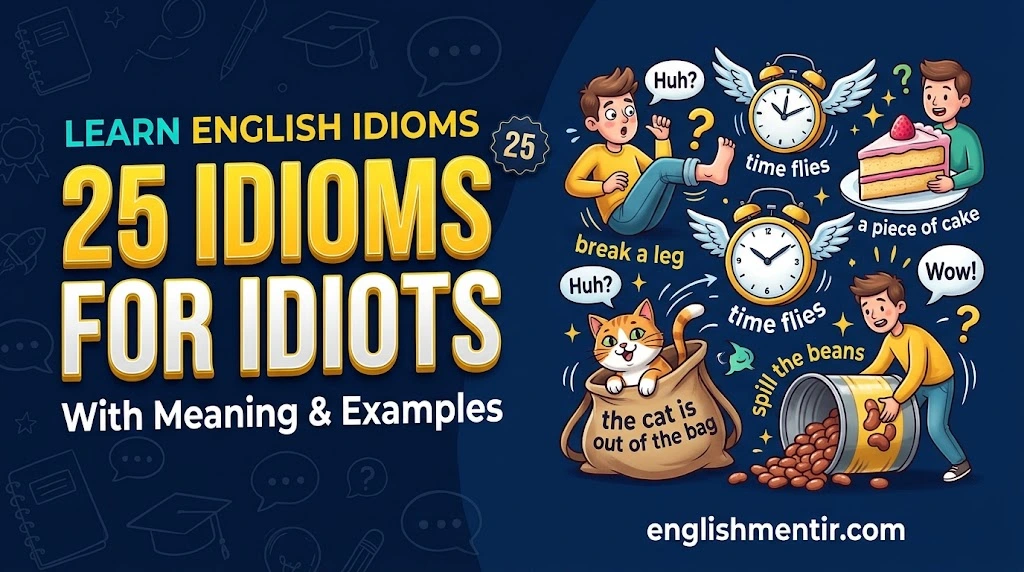
25 Idioms for Idiots (With Examples) helps you understand and describe foolish behavior, poor judgment, and misunderstandings in simple, natural English. These expressions make it easier to talk about silly mistakes, confusing situations, and decisions made without thinking carefully.
English idioms such as not the sharpest tool in the shed, a few sandwiches short of a picnic, and missing a few marbles add color to your language. They help you describe someone’s actions humorously or express frustration without repeating the same basic words. However, some expressions can sound rude, so it is important to consider the situation and the feelings of others.
Learning these idioms can improve your English vocabulary, writing skills, and everyday conversations. Whether you are writing stories, preparing essays, or speaking with friends, these expressions can make your English sound more natural and engaging. Understanding their meanings also helps you choose the right words for different situations and communicate your thoughts more effectively.
1. A Few Sandwiches Short of a Picnic
Meaning: Someone who seems confused, foolish, or not very sensible.
In a Sentence: He thought the computer would work without electricity; he is a few sandwiches short of a picnic.
Other Ways to Say: Not very bright, a little confused, lacking common sense.
2. Not the Sharpest Tool in the Shed
Meaning: A humorous expression for someone who is not very intelligent or quick to understand something.
In a Sentence: He tried to open the door by pushing when the sign clearly said pull; he is not the sharpest tool in the shed.
Other Ways to Say: Slow to understand, not very sharp, easily confused.
3. A Few Bricks Short of a Load
Meaning: Someone who appears to lack good judgment or common sense.
In a Sentence: She believed that putting ice in a hot oven would cool the kitchen, which made her seem a few bricks short of a load.
Other Ways to Say: Not thinking clearly, lacking sense, a little confused.
4. Not Playing with a Full Deck
Meaning: Behaving as though one does not have all the information or good judgment needed to make a sensible decision.
In a Sentence: He invested all his savings in a scheme he had never researched, so his friends joked that he was not playing with a full deck.
Other Ways to Say: Making poor decisions, acting irrationally, lacking judgment.
5. One Sandwich Short of a Picnic
Meaning: A lighthearted way to suggest that someone is behaving foolishly or seems confused.
In a Sentence: I think my brother is one sandwich short of a picnic if he believes his phone can charge itself without a battery.
Other Ways to Say: A little absent-minded, not thinking clearly, acting silly.
6. Thick as Two Short Planks
Meaning: A British expression describing someone as very slow to understand something.
In a Sentence: He kept making the same mistake despite several explanations, so his impatient teammate called him thick as two short planks.
Other Ways to Say: Slow to catch on, struggling to understand, not very perceptive.
7. A Dim Bulb
Meaning: A person who is not quick to understand or recognize something.
In a Sentence: I felt like a dim bulb when everyone understood the puzzle before I did.
Other Ways to Say: Slow learner, easily confused, not quick to grasp things.
8. A Few Cards Short of a Deck
Meaning: Someone who seems to lack common sense or makes unusual decisions.
In a Sentence: He wore a winter coat in the middle of summer because he thought it would protect him from the sun; he seemed a few cards short of a deck.
Other Ways to Say: Lacking common sense, acting strangely, making questionable decisions.
9. Missing a Few Marbles
Meaning: Behaving in a strange, silly, or irrational way.
In a Sentence: You must be missing a few marbles if you think you can finish a month-long project in one afternoon.
Other Ways to Say: Acting strangely, being unreasonable, thinking unclearly.
10. Not the Brightest Crayon in the Box
Meaning: Someone who does not seem particularly intelligent or quick to understand.
In a Sentence: He tried to dry his wet clothes by putting them in the freezer, proving he was not the brightest crayon in the box.
Other Ways to Say: Not very clever, slow to understand, lacking practical sense.
11. Can’t See Beyond the End of One’s Nose
Meaning: To lack foresight or fail to understand the wider consequences of one’s actions.
In a Sentence: He spent his entire paycheck on entertainment and forgot about rent; he couldn’t see beyond the end of his nose.
Other Ways to Say: Lacking foresight, short-sighted, unable to think ahead.
12. All Brawn and No Brains
Meaning: Someone who relies on physical strength but lacks thoughtful judgment or intelligence.
In a Sentence: He tried to force the broken machine open instead of reading the instructions, acting like someone who was all brawn and no brains.
Other Ways to Say: Acting without thinking, relying on strength, lacking careful judgment.
13. A Blunt Instrument
Meaning: A person or approach that lacks subtlety, sensitivity, or careful thought.
In a Sentence: His blunt instrument approach to solving the disagreement only made everyone more upset.
Other Ways to Say: Heavy-handed, insensitive, lacking tact.
14. Barking Up the Wrong Tree
Meaning: To make a wrong assumption or blame the wrong person.
In a Sentence: If you think I deleted your document, you’re barking up the wrong tree; I never opened your computer.
Other Ways to Say: Mistaken, blaming the wrong person, looking in the wrong place.
15. Jumping to Conclusions
Meaning: Making a judgment without having enough information.
In a Sentence: She accused her friend of ignoring her, but she was jumping to conclusions because his phone had run out of battery.
Other Ways to Say: Making assumptions, judging too quickly, reaching an unsupported conclusion.
16. Putting One’s Foot in One’s Mouth
Meaning: Saying something embarrassing, inappropriate, or foolish without thinking first.
In a Sentence: I put my foot in my mouth when I congratulated him on his promotion before realizing he had actually resigned.
Other Ways to Say: Saying the wrong thing, speaking carelessly, making an awkward remark.
17. Act Before You Think
Meaning: To do something impulsively without considering the consequences.
In a Sentence: He bought an expensive gaming system without checking his budget, showing that he tends to act before he thinks.
Other Ways to Say: Acting impulsively, rushing into things, failing to consider consequences.
18. Make a Fool of Yourself
Meaning: To behave in a way that makes you look silly, careless, or embarrassing.
In a Sentence: He tried to impress everyone by pretending to know the answer, but he made a fool of himself when the truth came out.
Other Ways to Say: Embarrass yourself, look silly, behave foolishly.
19. Out of One’s Depth
Meaning: Being in a situation that is too difficult for one’s current knowledge, skills, or experience.
In a Sentence: I felt out of my depth when I was asked to manage a complicated project without any training.
Other Ways to Say: Unprepared, inexperienced, struggling to cope.
20. Not Have a Clue
Meaning: To have little or no knowledge about something.
In a Sentence: I didn’t have a clue how to repair the printer, so I asked a technician for help.
Other Ways to Say: Be completely unaware, know nothing about it, be unsure.
21. Get the Wrong End of the Stick
Meaning: To misunderstand a situation or interpret information incorrectly.
In a Sentence: I got the wrong end of the stick and thought the meeting had been canceled when it had only been postponed.
Other Ways to Say: Misunderstand, get the wrong idea, misinterpret something.
22. Miss the Point
Meaning: To fail to understand the main idea or purpose of something.
In a Sentence: He focused on the color of the presentation instead of its message and completely missed the point.
Other Ways to Say: Misunderstand the main idea, overlook the purpose, fail to grasp the meaning.
23. Learn the Hard Way
Meaning: To learn a lesson through an unpleasant experience or the consequences of a mistake.
In a Sentence: I learned the hard way that leaving important work until the last minute creates unnecessary stress.
Other Ways to Say: Learn from mistakes, gain experience through failure, discover through experience.
24. Look Before You Leap
Meaning: To think carefully about the risks and consequences before taking action.
In a Sentence: Before accepting the job offer, she decided to look before she leaped and research the company’s working conditions.
Other Ways to Say: Think before acting, consider the risks, plan carefully.
25. Fool Me Once, Shame on You; Fool Me Twice, Shame on Me
Meaning: If someone tricks you once, the responsibility lies with them, but repeating the mistake without learning from it is your responsibility.
In a Sentence: He trusted the same dishonest seller twice, but after losing money again, he remembered, “Fool me once, shame on you; fool me twice, shame on me.”
Other Ways to Say: Learn from experience, avoid repeating mistakes, be more cautious next time.
Exercise: Practice These Idioms
Choose the correct answer for each question. There are 15 multiple-choice questions (MCQs) to help you remember the meanings and usage of the idioms.
Multiple-Choice Questions
1. What does “not the sharpest tool in the shed” mean?
A. Very hardworking
B. Not very intelligent
C. Extremely wealthy
D. Physically strong
2. If someone is “barking up the wrong tree,” they are:
A. Searching in the wrong place or blaming the wrong person
B. Making a wise decision
C. Asking a helpful question
D. Celebrating an achievement
3. What does “jumping to conclusions” mean?
A. Planning carefully
B. Waiting for evidence
C. Judging without enough information
D. Solving a problem correctly
4. If you “put your foot in your mouth,” you:
A. Exercise regularly
B. Say something embarrassing or inappropriate
C. Win an argument
D. Keep a secret
5. Which idiom means failing to understand the main idea?
A. Look before you leap
B. Learn the hard way
C. Miss the point
D. A dim bulb
6. What does “out of one’s depth” mean?
A. Being in a situation that is too difficult for your skills
B. Being physically underwater
C. Feeling very confident
D. Having plenty of free time
7. Which expression advises someone to think carefully before acting?
A. Missing a few marbles
B. Look before you leap
C. Make a fool of yourself
D. Not have a clue
8. What does “not have a clue” mean?
A. Know everything
B. Understand perfectly
C. Have little or no knowledge
D. Explain something clearly
9. Someone who is “all brawn and no brains” is described as:
A. Strong but lacking thoughtful judgment
B. Quiet and shy
C. Clever and patient
D. Helpful and generous
10. What does “learn the hard way” mean?
A. Learn without studying
B. Learn through an unpleasant experience
C. Teach another person
D. Avoid every mistake
11. If someone “makes a fool of themselves,” they:
A. Impress everybody
B. Behave in an embarrassing or silly way
C. Complete a difficult task
D. Give useful advice
12. What does “get the wrong end of the stick” mean?
A. Win a competition
B. Make a correct prediction
C. Misunderstand a situation
D. Refuse to listen
13. Which idiom describes someone who acts strangely or irrationally?
A. Missing a few marbles
B. Look before you leap
C. Learn the hard way
D. Barking up the wrong tree
14. What is the main lesson of “Fool me once, shame on you; fool me twice, shame on me”?
A. Never trust anyone
B. Always agree with others
C. Learn from experience and avoid repeating mistakes
D. Ignore every warning
15. Which is the most respectful way to describe someone who does not understand a topic?
A. They are an idiot.
B. They are not the brightest crayon in the box.
C. They are still learning about this topic.
D. They have no brains.
Answer Key
- B — Not very intelligent
- A — Searching in the wrong place or blaming the wrong person
- C — Judging without enough information
- B — Say something embarrassing or inappropriate
- C — Miss the point
- A — Being in a situation that is too difficult for your skills
- B — Look before you leap
- C — Have little or no knowledge
- A — Strong but lacking thoughtful judgment
- B — Learn through an unpleasant experience
- B — Behave in an embarrassing or silly way
- C — Misunderstand a situation
- A — Missing a few marbles
- C — Learn from experience and avoid repeating mistakes
- C — They are still learning about this topic.
Practice tip: Try writing one original sentence for each idiom you find useful. This will help you remember its meaning and use it naturally in conversation.
Conclusion:
Learning idioms for idiots can help you recognize humorous, critical, and figurative expressions in English conversations, books, and online content. Idioms such as “not the sharpest tool in the shed,” “missing a few marbles,” and “not have a clue” describe different kinds of confusion or poor judgment. However, the meaning and tone of an expression depend on its context.
When speaking with friends, humorous expressions may be acceptable if everyone is comfortable with them. In professional settings or sensitive conversations, choose respectful alternatives such as “still learning,” “needs more information,” or “could use some guidance.” Improving your English is not only about learning new phrases; it is also about knowing when and how to use them thoughtfully.
FAQs:
1. What are idioms for idiots?
Idioms for idiots are informal expressions used to describe foolish behavior, poor judgment, or a lack of understanding. Examples include “not the sharpest tool in the shed,” “missing a few marbles,” and “not playing with a full deck.”
2. What is a polite alternative to calling someone an idiot?
You can say “they may have misunderstood,” “they are still learning,” or “they made a poor decision.” These phrases communicate your point without directly insulting someone.
3. What is an idiom for someone who is not very intelligent?
“Not the sharpest tool in the shed” is a common informal idiom for someone who seems slow to understand something. It can sound insulting, so use it carefully.
4. What idiom describes someone who makes decisions without thinking?
“Act before you think” describes impulsive behavior. Another useful expression is “look before you leap,” which advises people to consider the consequences before acting.
5. Can I use these idioms in academic writing or professional communication?
Most expressions on this list are informal and are better suited to casual conversations or creative writing. In academic and professional writing, use precise language such as “poor judgment,” “misunderstanding,” or “insufficient knowledge.”