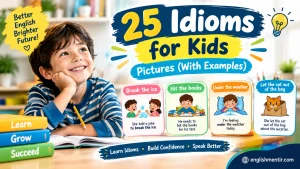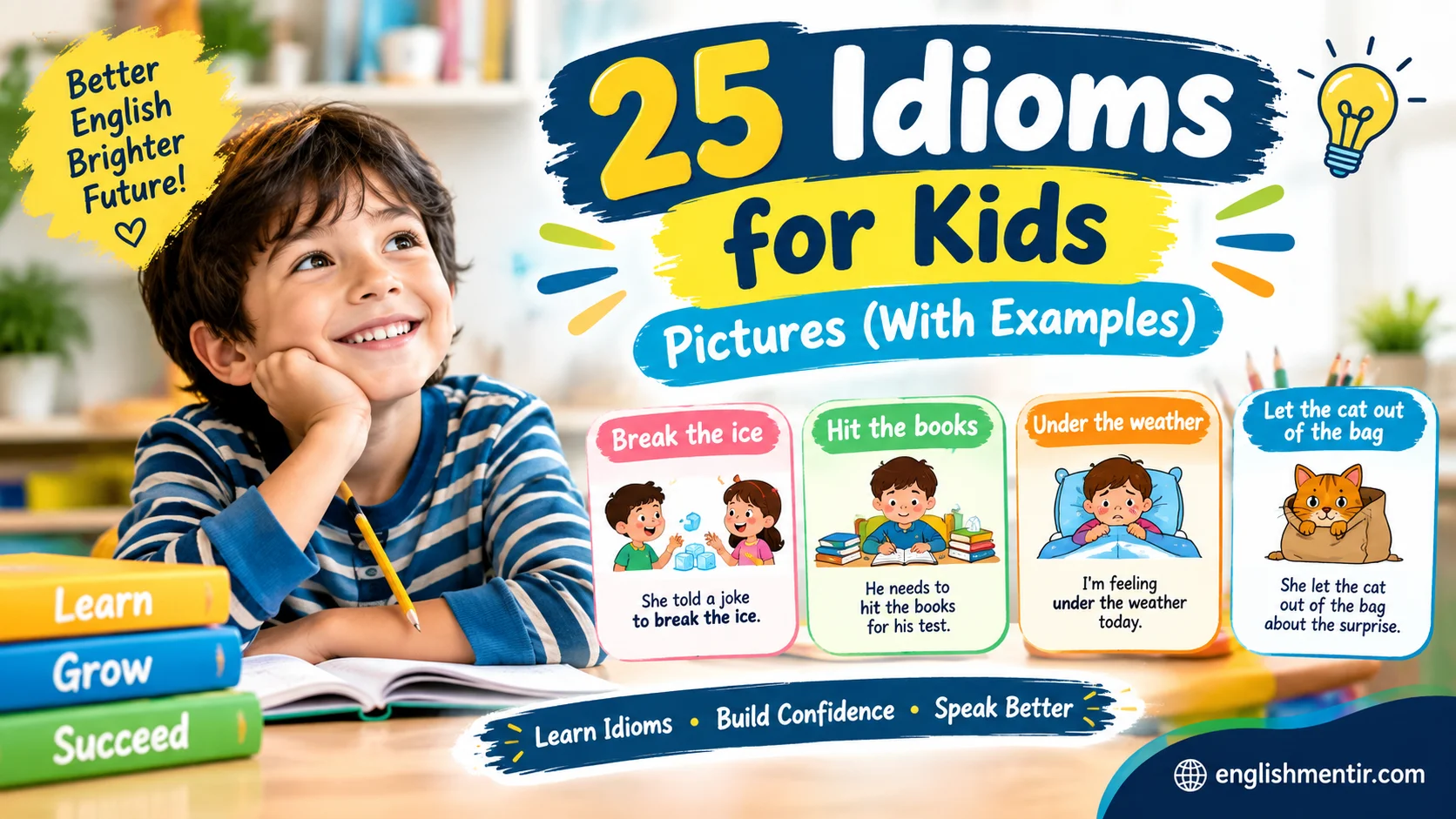
25 Idioms for Kids Pictures (With Examples) make learning English more fun and visual for kids. When idioms and phrases have no literal sense, a picture or drawing can help children understand their meanings through visual context. This approach makes learning more memorable, helps aid memory, and lets a kid remember new expressions easily.
For example, a cat stuck in a tree can help explain curiosity killed the cat, showing how curiosity may lead to trouble. Likewise, raining cats and dogs can show pouring rain without suggesting that animals are falling from the sky. These real-life examples can make idioms stick better than a textbook definition.
It is crucial to teach Learning English idioms in an exciting and interactive way. Idioms for kids help children express ideas and express themselves through creative writing, writing, and stories that come alive. This guide offers popular idioms, kid-friendly explanations, examples, helpful tips, cultural insights, and exercises to make learning idioms more natural and enjoyable.
1. A Piece of Cake
Meaning: Something that is very easy to do.
In a Sentence:
The math quiz was a piece of cake for Mia.
Other Ways to Say:
- Very easy
- Simple
- No trouble
- Easy as pie
Picture Idea: Show a child finishing an easy worksheet beside a delicious slice of cake.
2. Break the Ice
Meaning: To make people feel more comfortable when they first meet.
In a Sentence:
Tom told a funny joke to break the ice at the new club.
Other Ways to Say:
- Start a conversation
- Make people comfortable
- Get things started
- Make friends
Picture Idea: Show two children meeting for the first time and laughing together.
3. Hold Your Horses
Meaning: Wait or slow down before doing something.
In a Sentence:
Hold your horses! We need to put on our shoes before going outside.
Other Ways to Say:
- Wait a moment
- Slow down
- Be patient
- Take your time
Picture Idea: Show a child waiting beside a friendly cartoon horse.
4. Let the Cat Out of the Bag
Meaning: To accidentally reveal a secret.
In a Sentence:
Lily let the cat out of the bag and told Dad about his surprise party.
Other Ways to Say:
- Reveal a secret
- Give away the secret
- Tell accidentally
- Spill the secret
Picture Idea: Show a cat jumping out of a colorful bag while a child looks surprised.
5. Spill the Beans
Meaning: To tell a secret or reveal information.
In a Sentence:
Ben spilled the beans about the class surprise.
Other Ways to Say:
- Tell the secret
- Reveal something
- Give away information
- Let someone know
Picture Idea: Show beans falling from a bowl while a child whispers a secret.
6. When Pigs Fly
Meaning: Something that is very unlikely or probably will never happen.
In a Sentence:
I’ll clean my room tomorrow—when pigs fly!
Other Ways to Say:
- Never
- Probably not
- Not likely
- Almost impossible
Picture Idea: Show a cute pig flying through the sky with tiny wings.
7. Raining Cats and Dogs
Meaning: It is raining very heavily.
In a Sentence:
We stayed inside because it was raining cats and dogs.
Other Ways to Say:
- Pouring rain
- Heavy rain
- Rainstorm
- Bucketing down
Picture Idea: Show a funny cartoon sky with cats, dogs, and lots of raindrops.
8. The Ball Is in Your Court
Meaning: It is your turn to make a decision or take action.
In a Sentence:
I gave Sam two choices, so the ball is in his court now.
Other Ways to Say:
- Your turn
- Your decision
- It’s up to you
- You need to act
Picture Idea: Show two children playing tennis with one child waiting for the other to hit the ball.
9. Hit the Nail on the Head
Meaning: To be exactly right about something.
In a Sentence:
You hit the nail on the head when you said the puppy was hungry.
Other Ways to Say:
- Be exactly right
- Get it right
- Find the answer
- Say the right thing
Picture Idea: Show a child safely using a toy hammer to hit a nail directly on its head.
10. Under the Weather
Meaning: To feel unwell or sick.
In a Sentence:
Jake stayed home because he was feeling under the weather.
Other Ways to Say:
- Feel sick
- Feel unwell
- Not feel good
- Be poorly
Picture Idea: Show a child resting in bed underneath a cartoon cloud.
11. Keep an Eye On
Meaning: To watch or look after someone or something carefully.
In a Sentence:
Please keep an eye on my backpack while I get some water.
Other Ways to Say:
- Watch
- Look after
- Keep watch
- Take care of
Picture Idea: Show a large friendly eye watching over a school backpack.
12. In Hot Water
Meaning: To be in trouble because of something you did.
In a Sentence:
Sam was in hot water after he forgot to do his homework.
Other Ways to Say:
- In trouble
- In difficulty
- Facing a problem
- In a difficult situation
Picture Idea: Show a cartoon child sitting beside a bathtub filled with warm water and looking worried.
13. Once in a Blue Moon
Meaning: Something that happens very rarely.
In a Sentence:
We eat ice cream for breakfast once in a blue moon.
Other Ways to Say:
- Rarely
- Hardly ever
- Very seldom
- Not often
Picture Idea: Show a bright blue moon above a child holding an ice cream cone.
14. Cost an Arm and a Leg
Meaning: Something is very expensive.
In a Sentence:
That giant toy robot cost an arm and a leg.
Other Ways to Say:
- Very expensive
- Cost a lot
- Be pricey
- Cost a fortune
Picture Idea: Show a child looking at an expensive toy with cartoon arms and legs beside a price tag.
15. A Fish Out of Water
Meaning: Someone who feels uncomfortable or out of place in a situation.
In a Sentence:
I felt like a fish out of water at my first dance class.
Other Ways to Say:
- Feel uncomfortable
- Feel out of place
- Feel awkward
- Not fit in
Picture Idea: Show a little fish sitting outside a fishbowl while looking confused.
16. Bite the Bullet
Meaning: To face something difficult or unpleasant with courage.
In a Sentence:
I didn’t want to clean my messy room, but I decided to bite the bullet and start.
Other Ways to Say:
- Face it
- Be brave
- Get it done
- Deal with it
Picture Idea: For younger children, show a brave cartoon character facing a mountain of toys instead of showing an actual bullet.
17. See Eye to Eye
Meaning: To agree with someone.
In a Sentence:
Emma and Noah see eye to eye about which game to play.
Other Ways to Say:
- Agree
- Have the same opinion
- Think alike
- Be in agreement
Picture Idea: Show two children looking at each other with matching thought bubbles.
18. Two Heads Are Better Than One
Meaning: Working together can help you solve a problem better.
In a Sentence:
We solved the puzzle quickly because two heads are better than one.
Other Ways to Say:
- Work together
- Teamwork helps
- Share ideas
- Cooperate
Picture Idea: Show two children putting puzzle pieces together.
19. A Picture Is Worth a Thousand Words
Meaning: A picture can communicate a lot of information without using many words.
In a Sentence:
The photo of our camping trip was beautiful because a picture is worth a thousand words.
Other Ways to Say:
- Pictures tell stories
- Images can explain a lot
- A picture can speak for itself
- Images communicate ideas
Picture Idea: Show a colorful family camping picture surrounded by many tiny speech bubbles.
20. Actions Speak Louder Than Words
Meaning: What you do can show your feelings or intentions more clearly than what you say.
In a Sentence:
Ella helped her friend carry the books because actions speak louder than words.
Other Ways to Say:
- Show it through actions
- Deeds matter
- Actions reveal feelings
- What you do matters
Picture Idea: Show one child helping another pick up fallen books.
21. Practice Makes Perfect
Meaning: Practicing regularly helps you improve at something.
In a Sentence:
Keep playing the piano because practice makes perfect.
Other Ways to Say:
- Keep practicing
- Practice helps
- Work on your skills
- Repetition improves ability
Picture Idea: Show a child practicing piano with music notes floating around.
22. The Early Bird Catches the Worm
Meaning: People who act early often have better opportunities.
In a Sentence:
Maya arrived early and got the best seat because the early bird catches the worm.
Other Ways to Say:
- Start early
- Be prepared
- Act quickly
- Get ahead
Picture Idea: Show a cheerful bird finding a worm early in the morning.
23. Don’t Put All Your Eggs in One Basket
Meaning: Don’t depend completely on one plan or one option.
In a Sentence:
I packed two pencils because you shouldn’t put all your eggs in one basket.
Other Ways to Say:
- Have a backup plan
- Keep other options
- Don’t depend on one thing
- Be prepared
Picture Idea: Show a child carrying several small baskets of colorful eggs.
24. Every Cloud Has a Silver Lining
Meaning: Even when something goes wrong, there may be something positive to find.
In a Sentence:
Our picnic was canceled, but we had a fun movie night instead. Every cloud has a silver lining.
Other Ways to Say:
- Look for the positive
- Find the good side
- Something good can come from trouble
- Stay hopeful
Picture Idea: Show a gray cloud with a bright silver edge shining over a happy family.
25. Go the Extra Mile
Meaning: To make an extra effort to help or achieve something.
In a Sentence:
Liam went the extra mile by helping his classmate finish the project.
Other Ways to Say:
- Make extra effort
- Try harder
- Do more
- Give your best
Picture Idea: Show a child walking an extra mile on a colorful path toward a finish line.
Exercise to Practice: 15 Multiple-Choice Questions
Test your understanding of these 25 idioms for kids. Choose the best answer for each question.
1. What does “a piece of cake” mean?
A. Something delicious
B. Something very easy
C. Something expensive
D. Something difficult
2. If someone says “hold your horses,” what should you do?
A. Run faster
B. Buy a horse
C. Wait or slow down
D. Start eating
3. What does “spill the beans” mean?
A. Drop your food
B. Cook dinner
C. Reveal a secret
D. Clean the kitchen
4. What does “raining cats and dogs” describe?
A. A sunny day
B. Very heavy rain
C. A cloudy morning
D. Snowfall
5. If something happens “once in a blue moon,” how often does it happen?
A. Every day
B. Every week
C. Often
D. Very rarely
6. What does “under the weather” mean?
A. Standing outside
B. Feeling unwell
C. Enjoying sunshine
D. Watching clouds
7. What does “see eye to eye” mean?
A. Look at someone’s eyes
B. Agree with someone
C. Wear glasses
D. Watch television
8. What does “practice makes perfect” teach us?
A. Never try anything new
B. Stop when something is difficult
C. Practice helps you improve
D. Always work alone
9. What does “the ball is in your court” mean?
A. You lost a ball
B. It is your turn to decide or act
C. You should play basketball
D. You need to buy a ball
10. What does “a fish out of water” describe?
A. A happy swimmer
B. A hungry fish
C. Someone who feels out of place
D. Someone who loves fishing
11. What does “go the extra mile” mean?
A. Walk somewhere slowly
B. Make an extra effort
C. Stop working
D. Travel by car
12. What does “actions speak louder than words” mean?
A. Speak loudly
B. Talk all day
C. What you do can show more than what you say
D. Never speak
13. What does “every cloud has a silver lining” encourage us to do?
A. Avoid clouds
B. Be negative
C. Look for something positive
D. Stay indoors
14. What does “two heads are better than one” mean?
A. Two people cannot work together
B. Working together can help solve problems
C. One person should always work alone
D. You need two hats
15. What does “a picture is worth a thousand words” mean?
A. Pictures are expensive
B. Words are better than pictures
C. A picture can communicate a lot of information
D. Pictures should have exactly 1,000 words
Answers to the Exercise
- B — Something very easy
- C — Wait or slow down
- C — Reveal a secret
- B — Very heavy rain
- D — Very rarely
- B — Feeling unwell
- B — Agree with someone
- C — Practice helps you improve
- B — It is your turn to decide or act
- C — Someone who feels out of place
- B — Make an extra effort
- C — What you do can show more than what you say
- C — Look for something positive
- B — Working together can help solve problems
- C — A picture can communicate a lot of information
FAQs:
1. What are idioms for kids?
Idioms for kids are common phrases whose meanings are different from their literal words. Simple explanations and pictures can make them easier for children to understand.
2. Why are pictures helpful for learning idioms?
Pictures provide visual context and help children connect an expression with its meaning. This can make learning English idioms more memorable and enjoyable.
3. What is an example of a kid-friendly idiom?
Raining cats and dogs is a fun example. It does not mean animals are falling from the sky. It means that it is raining very heavily.
4. How can children practice idioms?
Children can practice by reading stories, looking at pictures, creating sentences, and using new expressions in creative writing. Short exercises can also help reinforce their understanding.
5. How many idioms should kids learn at once?
It is better to introduce a few popular idioms at a time. Using examples, pictures, and repetition can help children remember their meanings without feeling overwhelmed.
Conclusion:
Idioms for kids’ pictures make learning English more fun, creative, and easier to remember. Visual examples help children understand phrases that may seem confusing when taken literally, while familiar stories and situations make their meanings clearer.
With regular practice, kid-friendly explanations, examples, and simple exercises, children can gradually become confident using idioms. Learning these colorful expressions can also help them express themselves, improve their vocabulary, and make their writing and conversations more interesting.