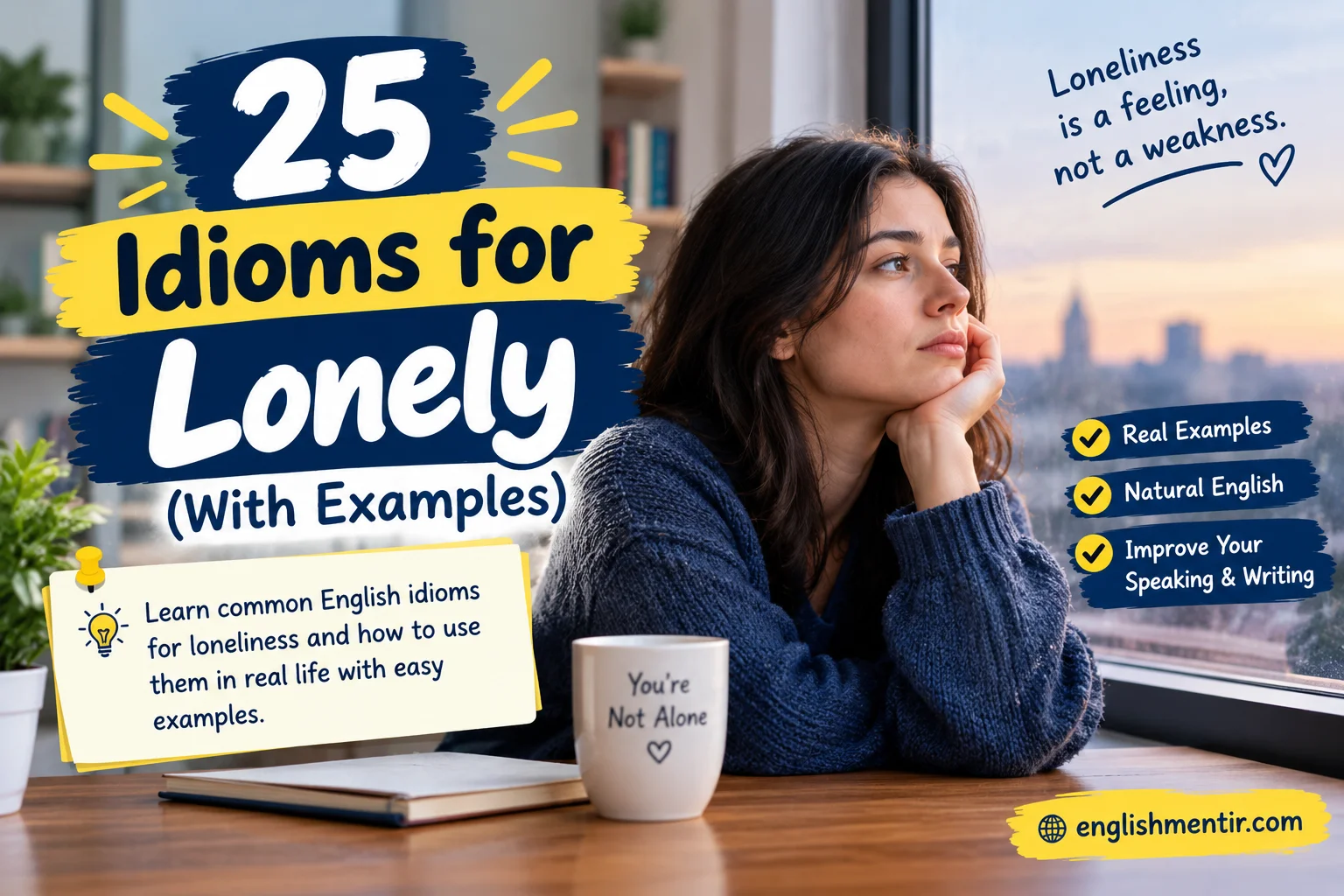
25 Idioms for Lonely (With Examples) help English learners, students, and professionals express loneliness, isolation, and the feeling of being alone in everyday conversations. These idioms for lonely feelings help you describe emotions naturally instead of simply saying, “I feel lonely.” They are useful for improving English speaking, writing, and vocabulary.
English idioms add depth and emotion to everyday language. Expressions such as feel left out, be on your own, and feel like a fish out of water help describe feeling disconnected, missing companionship, or struggling to fit in. Learning these phrases can help you communicate more clearly, sound more fluent, and understand native English speakers.
This guide covers 25 useful idioms for loneliness, with simple meanings, example sentences, and alternative expressions. It also includes 15 multiple-choice questions with answers to help you practice these expressions and improve your English vocabulary.
Think
To pick up a draggable item, press the space bar. While dragging, use the arrow keys to move the item. Press space again to drop the item in its new position, or press escape to cancel.
1. Feel Like a Fish Out of Water
Meaning: To feel uncomfortable, out of place, or disconnected from the people and environment around you.
In a Sentence: After moving to a new city, Sarah felt like a fish out of water because she did not know anyone.
Other Ways to Say:
- Feel out of place
- Feel like an outsider
- Feel uncomfortable in a group
2. Be Left Out in the Cold
Meaning: To feel excluded, ignored, or unsupported by other people.
In a Sentence: When her friends planned a weekend trip without inviting her, Emma felt left out in the cold.
Other Ways to Say:
- Feel excluded
- Be left behind
- Feel unwanted
3. Be a Lone Wolf
Meaning: To be someone who prefers to spend time alone or usually works independently.
In a Sentence: Although Daniel was friendly, he was a lone wolf who enjoyed hiking and reading by himself.
Other Ways to Say:
- Be independent
- Prefer one’s own company
- Keep to oneself
4. Stand Alone
Meaning: To be by yourself without the support or companionship of others.
In a Sentence: During a difficult period in her life, Maria felt she had to stand alone because nobody seemed to understand her struggles.
Other Ways to Say:
- Be on your own
- Face things alone
- Have no one to rely on
5. Be All Alone
Meaning: To be completely by yourself without anyone nearby for company or support.
In a Sentence: He sat all alone in the quiet house, wishing someone would call to ask how he was doing.
Other Ways to Say:
- Be by yourself
- Have no company
- Spend time alone
6. Feel Like an Outsider
Meaning: To feel that you do not belong to a particular group or community.
In a Sentence: On her first day at university, Ayesha felt like an outsider because everyone else already seemed to know one another.
Other Ways to Say:
- Feel out of place
- Feel disconnected
- Feel like you do not belong
7. Be Out on Your Own
Meaning: To live, work, or manage life independently without regular help or companionship.
In a Sentence: After moving away from home, Jack was out on his own and sometimes missed having his family nearby.
Other Ways to Say:
- Live independently
- Be on your own
- Manage by yourself
8. Have No One to Turn To
Meaning: To feel that there is nobody available to offer help, comfort, or advice.
In a Sentence: During her hardest days, Lily felt she had no one to turn to when she needed someone to talk to.
Other Ways to Say:
- Have nobody to rely on
- Feel unsupported
- Lack emotional support
9. Be on the Outside Looking In
Meaning: To feel excluded from a group or situation in which you wish you could participate.
In a Sentence: Watching her classmates laugh together, Nina felt like she was on the outside looking in.
Other Ways to Say:
- Feel left out
- Be excluded from a group
- Feel disconnected from others
10. Keep to Yourself
Meaning: To spend time alone and avoid sharing much with other people.
In a Sentence: Since changing schools, Amir had started keeping to himself and rarely joined conversations with his classmates.
Other Ways to Say:
- Stay quiet
- Avoid socializing
- Spend time alone
11. Be a Stranger in a Strange Land
Meaning: To feel unfamiliar, isolated, or uncomfortable in a place where you do not know the people or customs.
In a Sentence: When she moved abroad for work, Priya felt like a stranger in a strange land until she made new friends.
Other Ways to Say:
- Feel unfamiliar with your surroundings
- Feel like an outsider
- Feel out of place
12. Be Lost in Your Own World
Meaning: To be so absorbed in your thoughts or emotions that you become disconnected from the people around you.
In a Sentence: During lunch, Michael was lost in his own world, thinking about the friends he had left behind.
Other Ways to Say:
- Be absorbed in your thoughts
- Withdraw into yourself
- Feel mentally distant
13. Have the Blues
Meaning: To feel sad, low, or emotionally down, sometimes because of loneliness.
In a Sentence: Since her best friend moved away, Olivia had the blues and missed their daily conversations.
Other Ways to Say:
- Feel down
- Feel sad
- Be in low spirits
14. Feel Blue
Meaning: To experience sadness or a low mood.
In a Sentence: I felt blue on my birthday because I could not spend the day with the people I loved.
Other Ways to Say:
- Feel unhappy
- Feel gloomy
- Feel downhearted
15. Be Cut Off from the World
Meaning: To have little contact with other people or feel disconnected from society.
In a Sentence: Living alone in a remote village, he sometimes felt cut off from the world.
Other Ways to Say:
- Feel isolated
- Be disconnected from others
- Have little social contact
16. Be a Fish Out of Water
Meaning: To feel awkward or uncomfortable in an unfamiliar social setting.
In a Sentence: At the family gathering, where everyone knew each other except him, Peter felt like a fish out of water.
Other Ways to Say:
- Feel awkward
- Feel out of place
- Struggle to fit in
17. Have a Heavy Heart
Meaning: To feel deep sadness, emotional pain, or sorrow.
In a Sentence: She left her hometown with a heavy heart because she knew she would miss her friends and family.
Other Ways to Say:
- Feel deeply saddened
- Feel heartbroken
- Carry emotional pain
18. Be Miles Apart
Meaning: To be physically far away from someone or, figuratively, to feel emotionally distant.
In a Sentence: Although the two sisters loved each other, they felt miles apart after years of living in different countries.
Other Ways to Say:
- Be far away from each other
- Feel emotionally distant
- Be separated by distance
19. Miss Someone Like Crazy
Meaning: To miss someone very deeply and wish they were with you.
In a Sentence: Since her brother left for college, Maya had missed him like crazy.
Other Ways to Say:
- Miss someone terribly
- Long to see someone
- Wish someone were nearby
20. Long for Company
Meaning: To strongly wish for the presence, conversation, or companionship of another person.
In a Sentence: After spending several weekends alone, James began to long for company.
Other Ways to Say:
- Want someone to talk to
- Crave companionship
- Wish for company
21. Feel the Absence of Someone
Meaning: To notice and emotionally miss someone’s presence when they are no longer nearby.
In a Sentence: Every family gathering reminded Sara how much she felt the absence of her grandmother.
Other Ways to Say:
- Miss someone’s presence
- Notice someone’s absence
- Long for someone
22. Be Left to Your Own Devices
Meaning: To be left alone to manage your activities or decisions without much guidance or supervision.
In a Sentence: During the holidays, the children were left to their own devices while their parents worked.
Other Ways to Say:
- Be left alone
- Manage by yourself
- Act independently
23. Have a Hole in Your Heart
Meaning: To feel a deep emotional emptiness caused by loss, separation, or the absence of someone important.
In a Sentence: After her closest friend moved away, she felt as though there were a hole in her heart.
Other Ways to Say:
- Feel emotionally empty
- Experience deep sadness
- Feel a painful sense of loss
24. Be at a Loose End
Meaning: To have nothing particular to do and feel uncertain about how to spend your time.
In a Sentence: With all his friends away for the weekend, Ben was at a loose end and wished he had someone to spend time with.
Other Ways to Say:
- Have nothing to do
- Feel unoccupied
- Have no plans
25. Feel Like Nobody Understands You
Meaning: To feel emotionally isolated because you believe other people do not understand your thoughts or feelings.
In a Sentence: During a difficult time at school, Emily felt like nobody understood her, even though several classmates wanted to help.
Other Ways to Say:
- Feel misunderstood
- Feel emotionally isolated
- Feel unheard
Exercise: Practice Idioms for Loneliness
Choose the correct answer for each question. These 15 multiple-choice questions (MCQs) will help you understand the meanings and uses of the idioms in this article.
1. What does “feel like an outsider” mean?
A. Feel welcome everywhere
B. Feel that you do not belong
C. Feel extremely excited
D. Feel physically tired
2. If someone “has the blues,” how do they feel?
A. Happy and energetic
B. Confused about directions
C. Sad or down
D. Angry with everyone
3. What does “have no one to turn to” mean?
A. Have nobody to ask for help
B. Have many friends
C. Be ready to travel
D. Want to lead a group
4. Which idiom describes someone who prefers to be independent?
A. Have a heavy heart
B. Be a lone wolf
C. Have the blues
D. Be miles apart
5. What does “on the outside looking in” describe?
A. Watching the weather
B. Looking through a window
C. Feeling excluded from a group
D. Searching for a lost object
6. Which expression describes deep sadness?
A. Have a heavy heart
B. Be at a loose end
C. Keep to yourself
D. Be out on your own
7. What does “miss someone like crazy” mean?
A. Feel annoyed by someone
B. Miss someone very much
C. Forget someone’s name
D. Avoid meeting someone
8. If you “keep to yourself,” what do you usually do?
A. Talk to everyone constantly
B. Travel to new places
C. Avoid socializing much
D. Organize a party
9. What does “cut off from the world” suggest?
A. Being socially disconnected
B. Being very successful
C. Feeling physically stronger
D. Being excited about travel
10. Which expression describes feeling uncomfortable in an unfamiliar situation?
A. Have a hole in your heart
B. Feel like a fish out of water
C. Miss someone like crazy
D. Have the blues
11. What does “be at a loose end” mean?
A. Have plenty of important work
B. Feel physically ill
C. Have nothing particular to do
D. Feel proud of an achievement
12. Which idiom describes being emotionally distant from someone?
A. Be miles apart
B. Keep to yourself
C. Have the blues
D. Be left to your own devices
13. What does “have a hole in your heart” describe?
A. Physical pain from an injury
B. Deep emotional emptiness
C. Excitement about the future
D. A lack of physical strength
14. Which expression means wishing for someone’s presence or companionship?
A. Be a stranger in a strange land
B. Stand alone
C. Long for company
D. Feel like an outsider
15. What does “be left to your own devices” mean?
A. Be left to manage things yourself
B. Receive many presents
C. Be invited to a celebration
D. Be surrounded by friends
Answers to the Exercise
- B — Feel that you do not belong
- C — Sad or down
- A — Have nobody to ask for help
- B — Be a lone wolf
- C — Feeling excluded from a group
- A — Have a heavy heart
- B — Miss someone very much
- C — Avoid socializing much
- A — Being socially disconnected
- B — Feel like a fish out of water
- C — Have nothing particular to do
- A — Be miles apart
- B — Deep emotional emptiness
- C — Long for company
- A — Be left to manage things yourself
Practice tip: Review the idioms you found difficult and write one original sentence for each. This will help you remember their meanings and use them naturally in everyday English.
Conclusion:
Idioms for loneliness help us express emotions that ordinary words sometimes struggle to capture. Expressions such as feel like an outsider, have a heavy heart, and have no one to turn to describe different aspects of being alone, from social exclusion to emotional sadness.
Remember that being alone and feeling lonely are not always the same thing. Some people enjoy solitude, while others long for connection and understanding. Choosing the right idiom can help you explain your feelings more accurately and communicate with greater empathy.
Try using these idioms in your conversations, journal entries, stories, and English-writing exercises. Most importantly, if someone shares feelings of loneliness with you, listening with patience and kindness can make a meaningful difference.
FAQs:
1. What are the most common idioms for lonely feelings?
Some common expressions are feel like an outsider, be a lone wolf, have a heavy heart, have the blues, and be on the outside looking in. Each describes a different experience related to isolation or sadness.
2. What idiom describes feeling lonely in a crowd?
Be on the outside looking in describes feeling excluded while other people interact or enjoy themselves together. For example, Even at the party, she felt like she was on the outside looking in.
3. What is an idiom for feeling alone without support?
Have no one to turn to describes feeling that nobody is available to offer comfort, help, or advice.
4. What is the difference between being alone and being lonely?
Being alone means having no one physically present, while being lonely means experiencing a sense of emotional or social disconnection. A person can enjoy being alone without feeling lonely.
5. How can I use loneliness idioms in everyday English?
Use them when their meanings fit your situation. For example, say “I have the blues” when you feel sad, or “I feel like an outsider” when you feel excluded from a group. Practice by writing your own sentences with each expression.