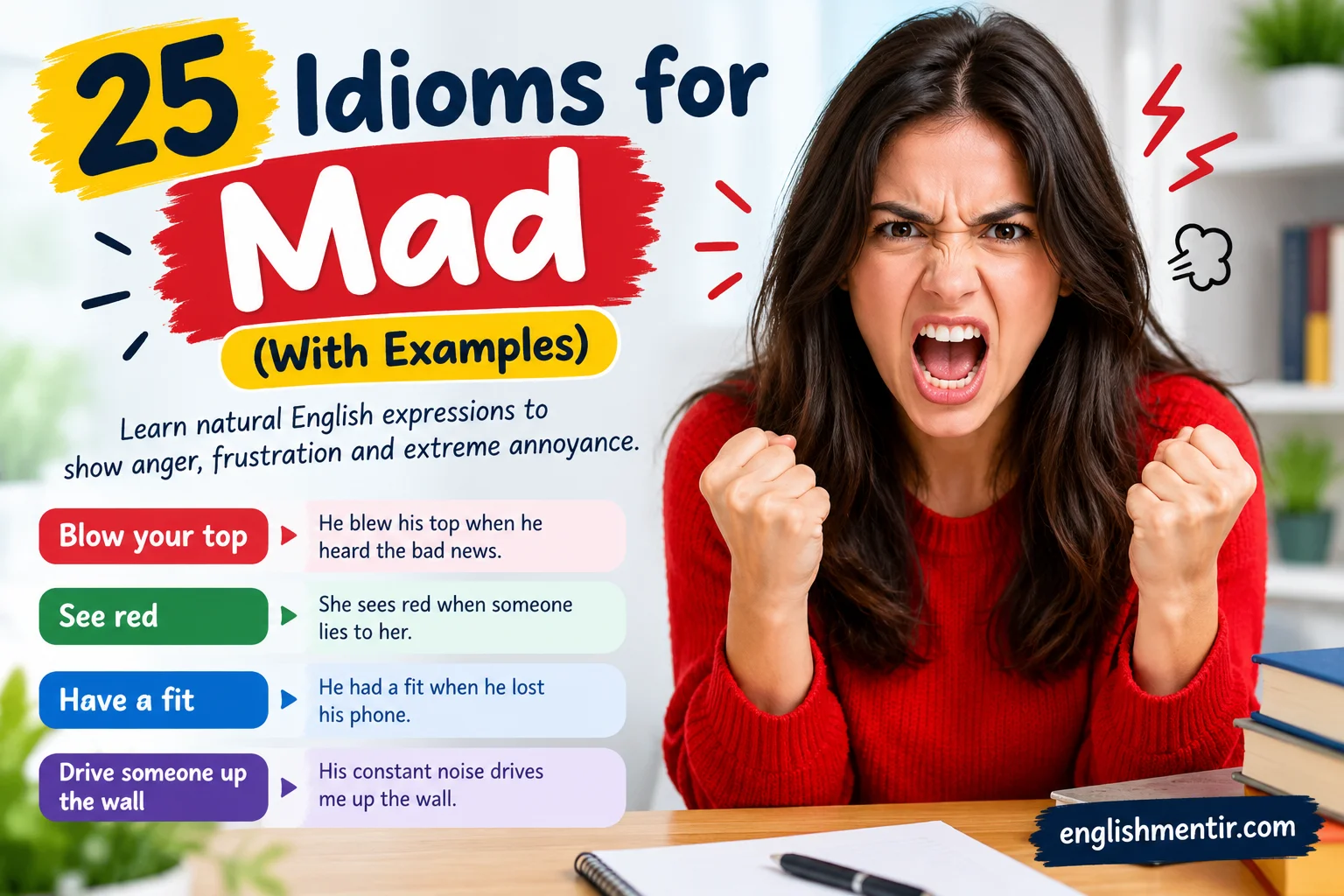
25 Idioms for Mad (With Examples) helps you learn common English expressions used to describe anger, frustration, and irritation. These idioms make everyday conversations more natural and help you express your feelings clearly in different situations.
English idioms often have a figurative meaning that differs from their literal meaning. You may hear them in movies, at school, at work, or during daily conversations. For example, “drive someone up the wall” means to annoy someone greatly, while “blow your top” means to become extremely angry. Learning these expressions can improve your English vocabulary, speaking, writing, and listening skills while helping you understand natural English conversations.
This guide covers 25 useful idioms for being mad, including their meanings, example sentences, and alternative expressions. Whether you want to describe mild irritation or intense anger, these phrases can help you communicate more confidently and naturally. You can also practice with 15 multiple-choice questions (MCQs) to test your understanding and strengthen your English communication skills.
1. See Red
Meaning: To become extremely angry about something.
In a Sentence: I saw red when I discovered that someone had damaged my car.
Other Ways to Say: Become furious, lose your temper, get very angry.
2. Hit the Roof
Meaning: To become suddenly and extremely angry.
In a Sentence: My father hit the roof when he found out that I had broken his favorite watch.
Other Ways to Say: Blow up, become furious, fly into a rage.
3. Blow a Fuse
Meaning: To lose your temper suddenly because of anger.
In a Sentence: Our manager blew a fuse when the team missed another important deadline.
Other Ways to Say: Lose your temper, explode with anger, snap.
4. Fly Off the Handle
Meaning: To become angry very quickly, often without thinking carefully.
In a Sentence: Try not to fly off the handle when someone disagrees with your opinion.
Other Ways to Say: Lose control, overreact, get worked up.
5. Lose Your Cool
Meaning: To stop remaining calm and become angry or upset.
In a Sentence: She lost her cool when the customer accused her of making a mistake.
Other Ways to Say: Lose your temper, get angry, become upset.
6. Get Hot Under the Collar
Meaning: To become annoyed, embarrassed, or angry about something.
In a Sentence: He got hot under the collar when his colleague criticized his work in front of everyone.
Other Ways to Say: Get irritated, feel angry, become worked up.
7. Blow Your Top
Meaning: To express anger suddenly and intensely.
In a Sentence: Dad blew his top when he realized that nobody had cleaned the kitchen.
Other Ways to Say: Lose your temper, explode, become furious.
8. Have a Short Fuse
Meaning: To become angry easily and quickly.
In a Sentence: Our coach has a short fuse, so we try to communicate with him respectfully.
Other Ways to Say: Be quick-tempered, get angry easily, have a bad temper.
9. Fly Into a Rage
Meaning: To suddenly become extremely angry.
In a Sentence: The customer flew into a rage when the airline canceled his flight without warning.
Other Ways to Say: Become furious, go into a fury, explode with anger.
10. Go Ballistic
Meaning: To become extremely angry and react strongly.
In a Sentence: My brother went ballistic when he discovered that someone had deleted his project.
Other Ways to Say: Go to exasperate with anger, blow up, become furious.
11. Be Up in Arms
Meaning: To be very angry or upset about something, especially when protesting against it.
In a Sentence: Residents were up in arms about the sudden increase in electricity prices.
Other Ways to Say: Be outraged, protest angrily, strongly object.
12. Have a Bone to Pick
Meaning: To have a complaint or disagreement that you want to discuss with someone.
In a Sentence: I have a bone to pick with you about the way you handled our meeting yesterday.
Other Ways to Say: Have a complaint, raise an issue, confront someone about a problem.
13. Get on Someone’s Nerves
Meaning: To annoy or irritate someone repeatedly.
In a Sentence: The constant noise from the construction site is getting on my nerves.
Other Ways to Say: Irritate someone, annoy someone, drive someone to exasperate.
14. Drive Someone Up the Wall
Meaning: To make someone extremely annoyed or frustrated.
In a Sentence: My little brother’s habit of interrupting every conversation drives me up the wall.
Other Ways to Say: Make someone furious, irritate someone, drive someone to exasperate.
15. Have Steam Coming Out of Your Ears
Meaning: To appear extremely angry or frustrated.
In a Sentence: She looked like she had steam coming out of her ears when she saw the mess in her office.
Other Ways to Say: Be furious, look enraged, be boiling with anger.
16. Be at the End of Your Rope
Meaning: To feel unable to tolerate a difficult or frustrating situation any longer.
In a Sentence: After dealing with repeated complaints all day, I was at the end of my rope.
Other Ways to Say: Reach your limit, run out of patience, feel overwhelmed.
17. Make Someone’s Blood Boil
Meaning: To make someone feel extremely angry.
In a Sentence: Seeing people treated unfairly makes my blood boil.
Other Ways to Say: Enrage someone, infuriate someone, make someone furious.
18. Have a Chip on Your Shoulder
Meaning: To behave as if you are easily offended or ready to argue because you feel unfairly treated.
In a Sentence: He seems to have a chip on his shoulder whenever someone offers him advice.
Other Ways to Say: Be defensive, feel resentful, be easily offended.
19. Get Bent Out of Shape
Meaning: To become unnecessarily upset, annoyed, or angry about something.
In a Sentence: Don’t get bent out of shape over a small mistake; we can fix it together.
Other Ways to Say: Get upset, become irritated, overreact.
20. Ruffle Someone’s Feathers
Meaning: To annoy, offend, or upset someone.
In a Sentence: His careless remarks ruffled a few feathers during the team meeting.
Other Ways to Say: Offend someone, upset someone, rub someone the wrong way.
21. Take Offense
Meaning: To feel hurt or angry because you believe something is insulting.
In a Sentence: Please don’t take offense at my suggestion; I only want to help.
Other Ways to Say: Feel insulted, become offended, feel hurt.
22. Give Someone a Piece of Your Mind
Meaning: To speak angrily to someone because you strongly disapprove of their behavior.
In a Sentence: She decided to give the landlord a piece of her mind about the repeated water shortages.
Other Ways to Say: Tell someone off, express your anger, give someone a talking-to.
23. Be Boiling Mad
Meaning: To be extremely angry.
In a Sentence: He was boiling mad when he learned that his personal information had been shared without permission.
Other Ways to Say: Be furious, be enraged, be livid.
24. Blow Up at Someone
Meaning: To suddenly express anger toward another person.
In a Sentence: I shouldn’t have blown up at my friend just because I was having a difficult day.
Other Ways to Say: Snap at someone, lash out, lose your temper with someone.
25. Be Mad as a Hornet
Meaning: To be extremely angry or irritated.
In a Sentence: The shop owner was mad as a hornet when he discovered that someone had damaged the front window.
Other Ways to Say: Be furious, be hopping mad, be extremely annoyed.
Exercise to Practice: 15 Multiple-Choice Questions
Choose the correct answer for each question to test your understanding of the idioms.
1. What does “see red” mean?
A. Become embarrassed
B. Become extremely angry
C. Feel sleepy
D. Become excited
2. If someone “hits the roof,” they:
A. Start laughing
B. Leave the house
C. Become suddenly furious
D. Feel relaxed
3. Which idiom describes someone who gets angry very easily?
A. Have a short fuse
B. Be on cloud nine
C. Break the ice
D. Give someone a hand
4. What does “get on someone’s nerves” mean?
A. Help someone relax
B. Make someone feel proud
C. Encourage someone
D. Annoy someone
5. If you “lose your cool,” you:
A. Forget your belongings
B. Stop remaining calm
C. Feel cold
D. Become more confident
6. Which idiom means to become suddenly and intensely angry?
A. Fly off the handle
B. Call it a day
C. See eye to eye
D. Get cold feet
7. What does “have a bone to pick” mean?
A. Want to eat something
B. Have a complaint to discuss
C. Need to exercise
D. Want to make a new friend
8. If a situation “makes your blood boil,” it makes you feel:
A. Extremely angry
B. Very tired
C. Extremely happy
D. Confused about directions
9. What does “give someone a piece of your mind” mean?
A. Offer someone advice kindly
B. Share your favorite book
C. Tell someone angrily what you think
D. Help someone solve a puzzle
10. Which expression describes someone who is easily offended or defensive?
A. Have a chip on your shoulder
B. Be over the moon
C. Keep an eye on
D. Be in hot water
11. If you are “at the end of your rope,” you feel that:
A. You have unlimited energy
B. You cannot tolerate the situation much longer
C. You are ready for a celebration
D. You have solved every problem
12. What does “ruffle someone’s feathers” mean?
A. Make someone feel sleepy
B. Help someone succeed
C. Annoy or offend someone
D. Make someone laugh
13. Which idiom means to become extremely angry and react strongly?
A. Go ballistic
B. Hit the books
C. Learn the ropes
D. Spill the beans
14. If you “blow up at someone,” you:
A. Give them a present
B. Suddenly express anger toward them
C. Invite them to dinner
D. Explain something calmly
15. What does “get bent out of shape” mean?
A. Become physically stronger
B. Change your plans happily
C. Become upset or annoyed
D. Feel proud of an achievement
Answers to the Exercise
- B — Become extremely angry
- C — Become suddenly furious
- A — Have a short fuse
- D — Annoy someone
- B — Stop remaining calm
- A — Fly off the handle
- B — Have a complaint to discuss
- A — Extremely angry
- C — Tell someone angrily what you think
- A — Have a chip on your shoulder
- B — You cannot tolerate the situation much longer
- C — Annoy or offend someone
- A — Go ballistic
- B — Suddenly express anger toward them
- C — Become upset or annoyed
Practice tip: Try writing one original sentence for each idiom you find difficult. This will help you remember its meaning and use it naturally in everyday English.
Conclusion:
Learning these 25 idioms for mad can help you describe anger, frustration, and irritation in more natural English. Expressions such as “see red,” “lose your cool,” and “hit the roof” make conversations more vivid, while phrases such as “have a bone to pick” help you explain disagreements.
Remember that not every idiom is suitable for every situation. Some expressions are informal and work best with friends or family, while others are appropriate for describing serious disagreements. Choosing your words carefully can help you express strong feelings without making a difficult situation worse.
Practice these idioms in your own sentences, pay attention to how native English speakers use them, and gradually add your favorites to your everyday vocabulary.
FAQs:
1. What are idioms for mad?
Idioms for mad are expressions that describe anger, irritation, or frustration in a figurative way. Examples include “see red,” “blow a fuse,” and “hit the roof.”
2. What is the most common idiom for being angry?
Common expressions include “lose your cool,” “see red,” and “hit the roof.” The best choice depends on how intense the anger is and the situation being described.
3. What is an idiom for someone who gets angry easily?
“Have a short fuse” describes someone who becomes angry quickly, often over relatively small problems.
4. What is a polite way to express anger in English?
You can say “I’m frustrated,” “I’m upset about what happened,” or “I’d like to discuss a concern.” These phrases communicate your feelings without sounding unnecessarily aggressive.
5. How can I learn idioms for anger effectively?
Learn each idiom’s meaning, context, and example sentence. Then write your own examples, practice speaking them aloud, and review the expressions regularly.