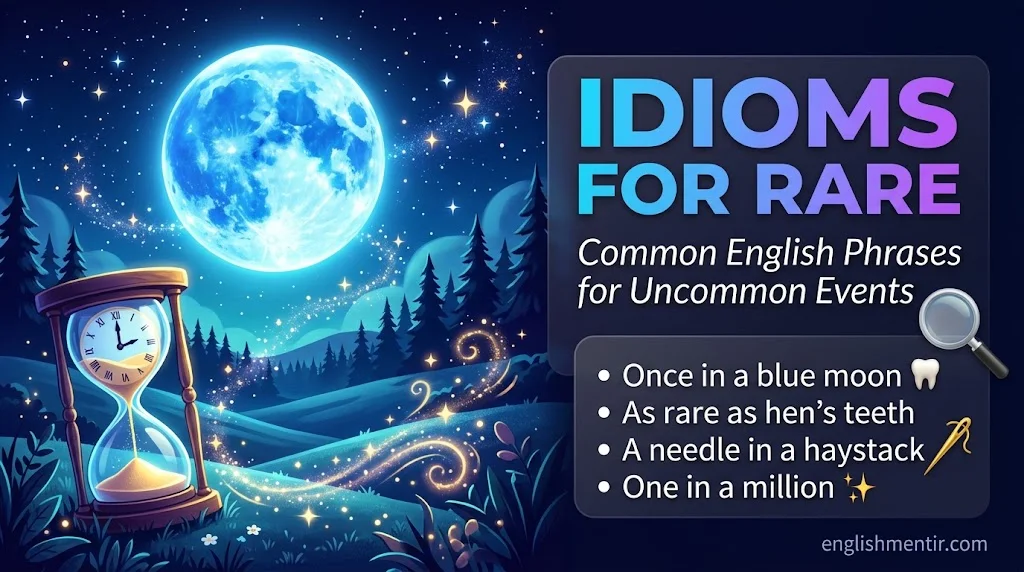
25 Idioms for Rare (With Examples) helps you describe unusual events, special moments, and rare experiences using simple, natural English expressions.
Idioms such as once in a blue moon, few and far between, and hard to come by make descriptions more colorful and meaningful. They help explain unique opportunities, precious moments, and extraordinary events without repeating basic words.
Learning these expressions improves vocabulary, writing skills, storytelling, and everyday communication. Idioms such as one-of-a-kind, out of the ordinary, and a diamond in the rough help English learners describe uncommon situations naturally and confidently.
What Are Idioms for Rare?
Idioms for rare are expressions that help describe something unusual, uncommon, infrequent, or difficult to find. Some are traditional idioms, while others are common figurative expressions and phrases used in everyday English.
For example, “once in a blue moon” describes something that happens very rarely, while “one of a kind” describes something unique and unlike anything else.
25 Idioms for Rare (With Examples)
1. Once in a Blue Moon
Meaning: Something that happens very rarely or only on unusual occasions.
In a Sentence: My brother visits our hometown once in a blue moon because he lives abroad.
Other Ways to Say:
- Very rarely
- Almost never
- Once in a while
- On rare occasions
2. Few and Far Between
Meaning: Something that is rare, uncommon, or difficult to find.
In a Sentence: Honest people who admit their mistakes without hesitation can sometimes seem few and far between.
Other Ways to Say:
- Hard to find
- Uncommon
- Scarce
- In short supply
3. One of a Kind
Meaning: Someone or something that is unique and unlike anything else.
In a Sentence: Her grandmother’s handmade jewelry is one of a kind, with every piece featuring a different design.
Other Ways to Say:
- Unique
- Unmatched
- Special
- Unlike anything else
4. Like Gold Dust
Meaning: Something that is extremely difficult to find or obtain.
In a Sentence: Experienced mechanics who specialize in vintage cars are like gold dust in our small town.
Other Ways to Say:
- Extremely scarce
- Hard to come by
- In great demand
- Difficult to obtain
5. A Rare Breed
Meaning: A person or type of person with unusual qualities or characteristics that make them stand out.
In a Sentence: Someone who remains patient and kind during every disagreement is a rare breed.
Other Ways to Say:
- An unusual person
- A special kind
- An exceptional individual
- A distinctive type
6. Few and Far Between as Hen’s Teeth
Meaning: Extremely rare or practically impossible to find. This expression is often used humorously.
In a Sentence: Affordable apartments in the city center are as rare as hen’s teeth these days.
Other Ways to Say:
- Extremely uncommon
- Almost impossible to find
- Scarce
- Hardly ever available
7. Like Finding a Needle in a Haystack
Meaning: Something that is extremely difficult to locate because it is hidden among many other things.
In a Sentence: Finding the original document among thousands of unsorted files was like finding a needle in a haystack.
Other Ways to Say:
- Very hard to locate
- Difficult to track down
- Almost impossible to find
- Hidden among many things
8. A Dying Breed
Meaning: A type of person, tradition, or practice that is becoming increasingly rare.
In a Sentence: People who still write long, handwritten letters are becoming a dying breed.
Other Ways to Say:
- Becoming uncommon
- Disappearing tradition
- A vanishing group
- Increasingly rare
9. Few and Far Between in a Million
Meaning: An informal, emphatic way to describe something as exceptionally rare or unusual. The more established expression is “one in a million.”
In a Sentence: Finding a mentor who supports your growth without expecting anything in return feels like finding one in a million.
Other Ways to Say:
- One in a million
- Exceptionally rare
- Truly unusual
- Remarkably special
10. A Diamond in the Rough
Meaning: A person or thing with great potential or hidden qualities that are not immediately obvious.
In a Sentence: The young artist’s early paintings were unpolished, but her teacher recognized a diamond in the rough.
Other Ways to Say:
- Hidden talent
- Undiscovered gem
- A person with potential
- An overlooked treasure
11. Once in a Lifetime
Meaning: Something so unusual or special that it may happen only once during a person’s life.
In a Sentence: Seeing the northern lights dance across the sky was a once-in-a-lifetime experience for our family.
Other Ways to Say:
- A unique opportunity
- A rare experience
- A special occasion
- An unforgettable event
12. Out of the Ordinary
Meaning: Something that is different from what is usual or expected.
In a Sentence: The restaurant’s unusual combination of traditional spices and modern cooking made the meal out of the ordinary.
Other Ways to Say:
- Unusual
- Unexpected
- Different
- Extraordinary
13. Stand Out from the Crowd
Meaning: To be noticeably different from others because of distinctive qualities, abilities, or achievements.
In a Sentence: Her thoughtful approach to solving problems helps her stand out from the crowd.
Other Ways to Say:
- Be distinctive
- Be exceptional
- Be different from others
- Make a strong impression
14. A Needle in a Haystack
Meaning: A person or thing that is extremely difficult to find among many possibilities.
In a Sentence: Locating the original photograph in the enormous archive was a needle in a haystack.
Other Ways to Say:
- Difficult to discover
- Hard to identify
- Almost impossible to locate
- Very elusive
15. Few and Far Between Opportunities
Meaning: Opportunities that are limited and do not occur often.
In a Sentence: Scholarships for this specialized course are few and far between, so students prepare their applications carefully.
Other Ways to Say:
- Limited opportunities
- Rare chances
- Infrequent openings
- Scarce possibilities
16. A Sight for Sore Eyes
Meaning: Someone or something that is wonderful to see, especially after a long absence or a difficult experience.
In a Sentence: After months away from home, seeing my family waiting at the airport was a sight for sore eyes.
Other Ways to Say:
- A welcome sight
- A delightful view
- A comforting presence
- A pleasure to see
17. Like Gold in a Mine
Meaning: A figurative expression for something valuable and difficult to discover. This is not a fixed, widely established idiom, but it can work as a creative comparison.
In a Sentence: Reliable information in an outdated archive can feel like gold in a mine.
Other Ways to Say:
- A valuable discovery
- A hidden treasure
- Difficult to uncover
- Precious and uncommon
18. Few in Number
Meaning: Existing in small quantities or in a limited group.
In a Sentence: Specialists who can restore these ancient manuscripts are few in number.
Other Ways to Say:
- Limited in number
- Scarce
- Not many
- Uncommon
19. A Class Apart
Meaning: Someone or something that is noticeably superior or different in quality from others.
In a Sentence: Her attention to detail and dedication make her work a class apart.
Other Ways to Say:
- Exceptional
- In a league of its own
- Outstanding
- Distinctive
20. A Rare Find
Meaning: Someone or something that is uncommon and especially valuable or desirable.
In a Sentence: A secondhand bookstore with affordable first editions is a rare find.
Other Ways to Say:
- An unusual discovery
- A hidden gem
- A valuable find
- Something special
21. Few and Far Between Chances
Meaning: Chances that occur infrequently, making them worth careful consideration.
In a Sentence: Chances to study directly under such an experienced historian are few and far between.
Other Ways to Say:
- Rare chances
- Limited possibilities
- Infrequent opportunities
- Uncommon occasions
22. A Flash in the Pan
Meaning: Someone or something that experiences brief success but does not maintain it.
In a Sentence: The singer’s first viral song was a huge success, but some critics wondered whether it was a flash in the pan.
Other Ways to Say:
- Short-lived success
- Temporary popularity
- Brief achievement
- A passing sensation
Usage note: This expression describes temporary success, not simply something rare.
23. Few and Far Between Encounters
Meaning: Encounters that happen infrequently.
In a Sentence: Because they work in different countries, their face-to-face meetings are few and far between.
Other Ways to Say:
- Rare meetings
- Infrequent encounters
- Occasional meetings
- Uncommon reunions
24. Beyond Compare
Meaning: So exceptional or outstanding that nothing else seems equally good.
In a Sentence: The beauty of the ancient city’s architecture was beyond compare.
Other Ways to Say:
- Unmatched
- Incomparable
- Extraordinary
- Second to none
25. Like a Unicorn
Meaning: An informal, imaginative comparison for someone or something extremely unusual or seemingly impossible to find.
In a Sentence: A quiet café that serves excellent coffee, stays open late, and has plenty of comfortable seating is like a unicorn in this neighborhood.
Other Ways to Say:
- Extremely rare
- Almost impossible to find
- Unusually special
- A remarkable rarity
Usage note: This is a creative comparison rather than a traditional fixed idiom.
How to Use Idioms for Rare in Everyday English
Choosing the right expression depends on what you want to describe.
- For something that happens infrequently: Use “once in a blue moon.”
- For something difficult to find: Use “few and far between” or “like finding a needle in a haystack.”
- For a unique person: Use “one of a kind” or “a rare breed.”
- For a valuable discovery: Use “a rare find” or “a diamond in the rough.”
- For something that is becoming less common: Use “a dying breed.”
- For brief success: Use “a flash in the pan.”
Remember that not every expression in this list is a traditional idiom. Some are common expressions, and others are creative comparisons. Using them accurately will make your English sound more natural, precise, and engaging.
Exercise: Practice Idioms for Rare
Test your understanding with these 15 multiple-choice questions (MCQs). Choose the best answer for each sentence before checking the answer key.
Multiple-Choice Questions
1. Which idiom describes something that happens very rarely?
A. Out of the ordinary
B. Once in a blue moon
C. A flash in the pan
D. Beyond compare
2. The phrase “few and far between” means:
A. Easy to discover
B. Extremely expensive
C. Rare or uncommon
D. Happening every day
3. If someone is described as “one of a kind,” they are:
A. Exactly like everyone else
B. Unique and special
C. Frequently absent
D. Difficult to understand
4. Which expression describes a tradition that is gradually disappearing?
A. A dying breed
B. A sight for sore eyes
C. A rare find
D. Beyond compare
5. Finding a particular file among thousands of documents is like:
A. A class apart
B. Once in a lifetime
C. Finding a needle in a haystack
D. A flash in the pan
6. A person with hidden talent or potential can be described as:
A. A diamond in the rough
B. A dying breed
C. A sight for sore eyes
D. Few in number
7. Which expression refers to something that happens only once or perhaps only once in a person’s life?
A. Out of the ordinary
B. Once in a lifetime
C. Like gold dust
D. Few in number
8. An experienced specialist who is extremely difficult to find is:
A. A flash in the pan
B. A class apart
C. Like gold dust
D. A sight for sore eyes
9. What does “a flash in the pan” mean?
A. Lasting success over many years
B. Brief success that does not last
C. Something that is impossible to see
D. A valuable historical object
10. Which expression describes someone or something that is exceptionally different in quality?
A. A class apart
B. Few and far between
C. Once in a blue moon
D. A dying breed
11. If you call an old friend you have not seen for years “a sight for sore eyes,” you mean:
A. The friend looks tired
B. The friend is difficult to recognize
C. Seeing the friend is a welcome pleasure
D. The friend appears only rarely
12. Which expression best describes an unusual and valuable discovery?
A. A rare find
B. A flash in the pan
C. A dying breed
D. Out of the ordinary
13. What does “stand out from the crowd” mean?
A. To avoid meeting people
B. To be noticeably different from others
C. To disappear from view
D. To arrive late
14. Which expression means that something is different from what is usual or expected?
A. One of a kind
B. Beyond compare
C. Out of the ordinary
D. Like gold dust
15. Which idiom describes something so exceptional that nothing else seems equally good?
A. A needle in a haystack
B. Beyond compare
C. Once in a blue moon
D. A dying breed
Answers to the Exercise
MCQ Answer Key
Question 1
B
Question 2
C
Question 3
B
Question 4
A
Question 5
C
Question 6
A
Question 7
B
Question 8
C
Question 9
B
Question 10
A
Question 11
C
Question 12
A
Question 13
B
Question 14
C
Question 15
B
FAQs;
1. What are the most common idioms for rare things?
Some of the most common expressions are “once in a blue moon,” “few and far between,” “one of a kind,” “like gold dust,” and “a rare find.” They describe things that happen infrequently, are difficult to find, or are unusually special.
2. What is an idiom for something that happens very rarely?
“Once in a blue moon” is a common idiom for something that happens very rarely.
Example: We eat at that restaurant once in a blue moon because it is far from home.
3. What is another way to say rare?
Depending on the context, you can use uncommon, scarce, unusual, exceptional, infrequent, unique, or hard to find. For example, “a rare opportunity” can also be called an uncommon opportunity.
4. What idiom describes a person who is rare or special?
“One of a kind” describes a person who is unique, while “a rare breed” describes someone with unusual or uncommon qualities.
Example: Her willingness to help others without expecting anything in return makes her one of a kind.
5. Can I use idioms for rare in essays and formal writing?
Yes, but choose expressions that suit your topic and tone. “Once in a blue moon” works well in conversational writing, while “rare,” “uncommon,” “scarce,” and “infrequent” may be more suitable for formal academic writing. Always consider your audience and the meaning you want to communicate.
Conclusion:
Learning 25 idioms for rare gives you more ways to describe unusual experiences, exceptional people, and things that are difficult to find. Expressions such as “once in a blue moon,” “few and far between,” “one of a kind,” and “a diamond in the rough” can make your English more vivid and expressive.
The key is to understand each expression and use it in the right context. Practice by writing your own sentences, using these idioms in conversations, and including them in your essays when appropriate. With regular practice, you will become more confident in choosing words that communicate your ideas clearly and naturally.