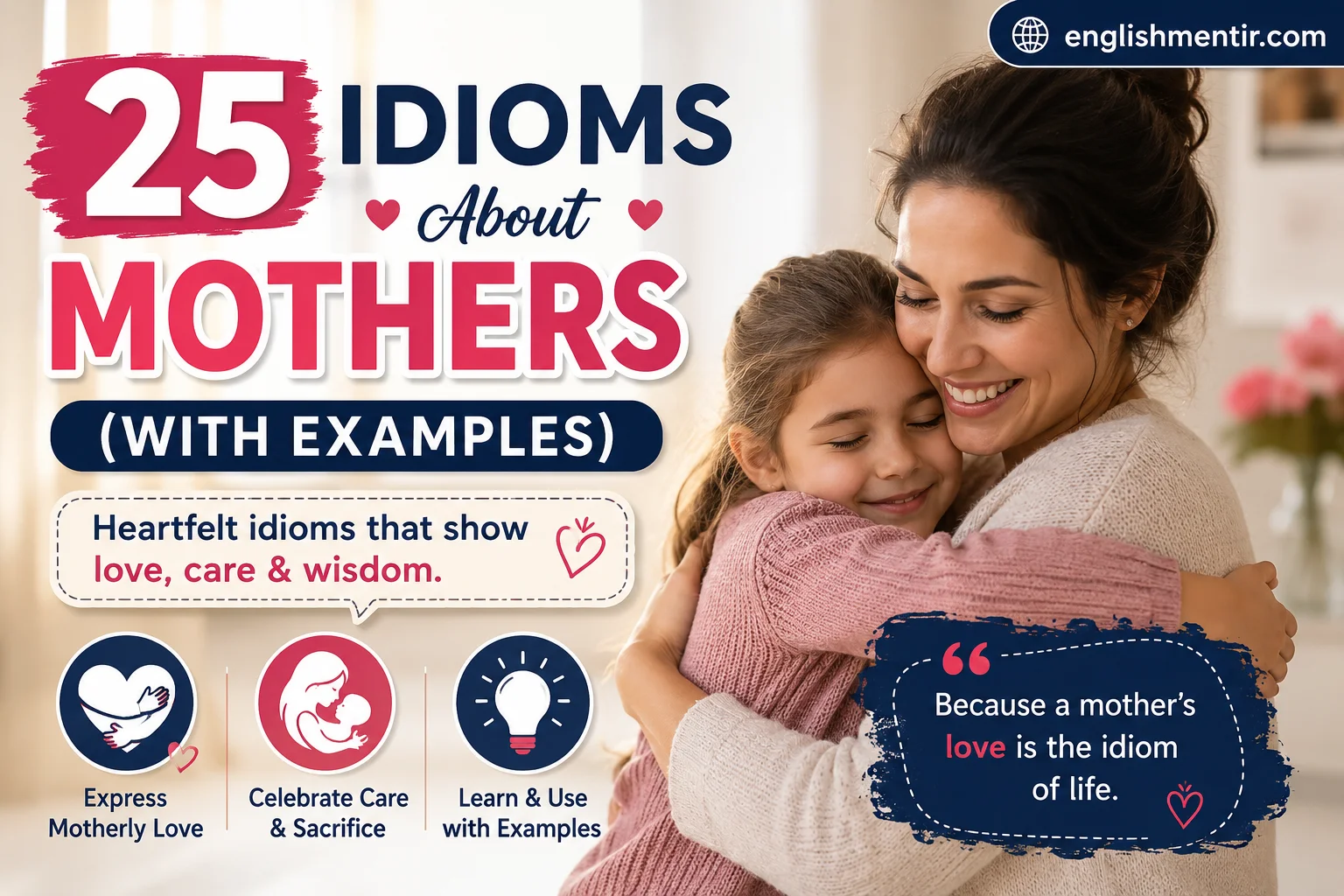
Discover 25 Idioms About Mothers (With Examples) that beautifully capture a mother’s love, wisdom, and strength perfect for learning and sharing!
Idioms about mothers are phrases and expressions with hidden meanings that can show love, care, and the important place mothers have in our lives. In English, people use these sayings in fun, interesting, and sometimes funny ways. They may come from figurative, cultural, or historical contexts and often reflect the special role mothers play. From preparing meals and giving hugs to offering guidance and support, mothers do many things that shape our everyday lives. These expressions can also highlight the valuable lessons mothers teach and the lasting influence they have on their children.
Whether used in daily conversations or as a tribute on Mother’s Day, idioms about mothers can express appreciation in unique and memorable ways. Learning these expressions helps readers understand what they mean, how they are used, and why they remain meaningful in English. Some idioms describe the close bond between a mother and child, while others relate to familiar actions, care, wisdom, or lessons associated with mothers. By seeing each phrase in context, readers can understand its figurative meaning more easily and appreciate the mothers and mother figures who make life better.
1. Like Mother, Like Daughter
Meaning: This expression means that a daughter often shares personality traits, habits, or behavior with her mother.
In a Sentence: “Maria loves gardening just as much as her mother does. Like mother, like daughter.”
Other Ways to Say:
- She takes after her mother.
- They are very much alike.
- She has her mother’s personality.
2. Like Mother, Like Son
Meaning: This phrase suggests that a son may develop similar qualities, habits, or interests to those of his mother.
In a Sentence: “Daniel is patient and kind, just like his mother. Like mother, like son.”
Other Ways to Say:
- He takes after his mother.
- He is just like his mom.
- He inherited her personality.
3. Mother Hen
Meaning: A mother hen is someone who constantly watches over and protects people, much like a hen protecting her chicks.
In a Sentence: “My aunt becomes a mother hen whenever the whole family travels together.”
Other Ways to Say:
- Protective person
- Caring guardian
- Someone who watches over everyone
4. Mama’s Boy
Meaning: A mama’s boy is a son who has a very close relationship with his mother and may depend heavily on her.
In a Sentence: “Although he lives on his own, everyone still calls him a mama’s boy because he talks to his mother every day.”
Other Ways to Say:
- Very attached to his mother
- Close to his mom
- Mother-dependent
5. Necessity Is the Mother of Invention
Meaning: This famous saying means that difficult situations often inspire people to create new solutions.
In a Sentence: “When her old cooking tool broke, she created a simple replacement herself. Necessity is the mother of invention.”
Other Ways to Say:
- Need inspires creativity.
- Problems can lead to inventions.
- Necessity encourages innovation.
6. Mother Nature
Meaning: Mother Nature refers to the natural world and its forces, such as weather, plants, animals, and the changing seasons.
In a Sentence: “We planned an outdoor picnic, but Mother Nature had other plans when the storm arrived.”
Other Ways to Say:
- The natural world
- Nature
- Natural forces
7. At Your Mother’s Knee
Meaning: To learn something at your mother’s knee means to learn it from childhood, often through family teaching and experience.
In a Sentence: “She learned traditional cooking at her mother’s knee.”
Other Ways to Say:
- Learned in childhood
- Raised with that knowledge
- Learned from her family
8. The Mother Tongue
Meaning: Your mother tongue is the first language you learn naturally while growing up.
In a Sentence: “Punjabi is his mother tongue, although he speaks several other languages.”
Other Ways to Say:
- First language
- Native language
- First spoken language
9. Mother Wit
Meaning: Mother wit refers to natural common sense or practical intelligence that a person develops without formal training.
In a Sentence: “She used her mother’s wit to solve the problem when everyone else was confused.”
Other Ways to Say:
- Common sense
- Natural intelligence
- Practical wisdom
Read More: 25 Idioms About Mind (With Examples)
10. Mother’s Milk
Meaning: Mother’s milk can describe something considered essential, deeply familiar, or naturally absorbed from an early age.
In a Sentence: “For the experienced chef, patience in the kitchen is like mother’s milk.”
Other Ways to Say:
- Second nature
- Deeply familiar
- Learned from the beginning
11. Every Mother’s Son
Meaning: Every mother’s son means every person in a particular group, often emphasizing that nobody is excluded.
In a Sentence: “Every mother’s son in the village came out to celebrate the festival.”
Other Ways to Say:
- Everyone
- Every single person
- Each and every person
12. Mother of All
Meaning: Mother of all is used to describe something that is the largest, most important, most extreme, or most impressive example of its kind.
In a Sentence: “That was the mother of all storms, with powerful winds lasting for hours.”
Other Ways to Say:
- The biggest of all
- The ultimate example
- The most extreme
13. Mother Lode
Meaning: A mother lode is a major source of valuable material. Figuratively, it can mean a rich or abundant source of something desirable.
In a Sentence: “The old archive turned out to be a mother lode of family photographs.”
Other Ways to Say:
- Rich source
- Treasure trove
- Abundant supply
14. Experience Is the Mother of Wisdom
Meaning: This expression suggests that people gain wisdom by living through situations, learning from mistakes, and gaining experience.
In a Sentence: “She became more patient after years of working with children. Experience is the mother of wisdom.”
Other Ways to Say:
- Experience teaches wisdom.
- Life teaches valuable lessons.
- Wisdom comes through experience.
15. Mother Earth
Meaning: Mother Earth is a personification of the Earth as a nurturing and life-giving force.
In a Sentence: “The community planted trees to show respect for Mother Earth.”
Other Ways to Say:
- The Earth
- Our planet
- The natural world
16. Mother of Mercy
Meaning: Mother of mercy is an emotional expression used to show surprise, concern, shock, or a plea for compassion.
In a Sentence: “Mother of mercy! I didn’t expect the road to be this difficult.”
Other Ways to Say:
- Oh my goodness!
- Good grief!
- Have mercy!
17. Mother’s Little Helper
Meaning: Mother’s little helper traditionally refers to something that helps a mother manage her responsibilities. In modern use, it can also be used humorously for a convenient aid.
In a Sentence: “The automatic dishwasher became her mother’s little helper after the family grew.”
Other Ways to Say:
- Helpful assistant
- Little helper
- Useful support
18. A Mother’s Love
Meaning: A mother’s love refers to the deep, protective, and often unconditional affection associated with the relationship between a mother and her child.
In a Sentence: “Even after her son moved across the country, a mother’s love remained a constant source of comfort.”
Other Ways to Say:
- Unconditional love
- Maternal love
- Deep parental affection
19. Mother’s Heart
Meaning: A mother’s heart describes the compassion, tenderness, concern, and emotional connection a mother may feel toward her children.
In a Sentence: “A mother’s heart can worry about a child even when everything seems perfectly fine.”
Other Ways to Say:
- Maternal compassion
- A caring heart
- Deep parental concern
20. Mother’s Instinct
Meaning: Mother’s instinct refers to a strong natural feeling that helps a mother sense when her child needs attention, comfort, or protection.
In a Sentence: “Her mother’s instinct told her that something was troubling her daughter.”
Other Ways to Say:
- Natural intuition
- Maternal instinct
- Protective intuition
21. Motherly Love
Meaning: Motherly love describes the tender, protective, patient, and nurturing affection associated with a mother.
In a Sentence: “The child felt safe because of the motherly love she received from her grandmother.”
Other Ways to Say:
- Nurturing affection
- Maternal love
- Protective affection
22. Motherly Care
Meaning: Motherly care means providing someone with the kind of attention, comfort, protection, and support traditionally associated with a mother.
In a Sentence: “The nurse treated the frightened child with motherly care.”
Other Ways to Say:
- Tender care
- Nurturing support
- Gentle protection
23. A Mother’s Touch
Meaning: A mother’s touch refers to a special kind of comfort, tenderness, or healing care associated with a mother.
In a Sentence: “The homemade meal had a mother’s touch that made everyone feel at home.”
Other Ways to Say:
- Personal touch
- Tender care
- Comforting presence
24. Motherly Instinct
Meaning: Motherly instinct describes an intuitive urge to protect, comfort, guide, or care for someone, especially a child.
In a Sentence: “Her motherly instinct kicked in when she saw the lost child standing alone.”
Other Ways to Say:
- Protective instinct
- Nurturing instinct
- Natural urge to care
25. A Mother’s Wisdom
Meaning: A mother’s wisdom refers to the practical advice, life lessons, patience, and understanding that people often associate with a mother’s guidance.
In a Sentence: “I still remember my mother’s wisdom whenever I face a difficult decision.”
Other Ways to Say:
- Parental wisdom
- Wise advice
- Life lessons from Mom
Why Mother-Related Idioms Matter
Words about mothers often carry more emotion than ordinary descriptions. An expression such as “mother hen” immediately creates an image of someone protective and attentive. “Mother’s wisdom” suggests experience, patience, and guidance.
These expressions can make your writing feel more vivid because they connect an idea with a familiar image or emotion. Whether you’re writing about your own mother, describing a character, preparing a speech, or creating a heartfelt message, choosing the right phrase can make your words more memorable and sincere.
How to Use These Idioms Naturally
The best idioms fit the situation instead of feeling forced. If you’re describing someone who constantly worries about others, “mother hen” may fit perfectly. If you’re talking about a language learned during childhood, “mother tongue” is the natural choice.
For emotional writing, expressions such as “a mother’s love,” “a mother’s touch,” and “a mother’s wisdom” can add warmth. In more casual writing, phrases such as “mama’s boy” or “mother of all” may sound more natural.
Always consider your audience, tone, and context before choosing an expression.
Exercise to Practice
Choose the correct answer for each question.
1. What does “mother hen” describe?
A. Someone who avoids people
B. Someone who is very protective
C. Someone who dislikes children
D. Someone who travels often
2. What does “mother tongue” mean?
A. A secret language
B. A second language
C. Your first language
D. A formal language
3. What does “like mother, like daughter” suggest?
A. They never agree
B. They share similar qualities
C. They live together
D. They have the same job
4. What does “Mother Nature” refer to?
A. A family member
B. A teacher
C. The natural world
D. A business owner
5. What does “mother wit” mean?
A. Formal education
B. Natural common sense
C. Artistic talent
D. Physical strength
6. What does “mother lode” describe?
A. A small amount
B. A difficult journey
C. A rich source of something valuable
D. A family argument
7. What does “necessity is the mother of invention” mean?
A. Mothers invent everything
B. Need can inspire creative solutions
C. Inventions are always expensive
D. Problems should be ignored
8. What does “every mother’s son” mean?
A. Only young men
B. Only family members
C. Everyone in a particular group
D. Mothers and sons together
9. What does “mother of all” usually emphasize?
A. Something ordinary
B. Something extremely large or important
C. Something invisible
D. Something forgotten
10. What does “at your mother’s knee” suggest?
A. Learning while traveling
B. Learning at school
C. Learning something during childhood
D. Learning from strangers
11. Which expression means natural intuition related to caring for a child?
A. Mother lode
B. Mother tongue
C. Mother’s instinct
D. Mother Nature
12. Which expression describes deep affection from a mother?
A. Mother wit
B. A mother’s love
C. Mother lode
D. Mother of all
13. What does “Mother Earth” represent?
A. A particular person
B. The Earth as a life-giving force
C. A family tradition
D. A language
14. Which phrase refers to practical guidance gained from a mother?
A. Mother Nature
B. Mother lode
C. A mother’s wisdom
D. Mother’s milk
15. Which expression describes someone who is strongly attached to his mother?
A. Mother Nature
B. Mother wit
C. Mama’s boy
D. Mother lode
Answers
- B — Someone who is very protective
- C — Your first language
- B — They share similar qualities
- C — The natural world
- B — Natural common sense
- C — A rich source of something valuable
- B — Need can inspire creative solutions
- C — Everyone in a particular group
- B — Something extremely large or important
- C — Learning something during childhood
- C — Mother’s instinct
- B — A mother’s love
- B — The Earth as a life-giving force
- C — A mother’s wisdom
- C — Mama’s boy
FAQs
1. What are idioms about mothers?
Idioms about mothers are common expressions that describe a mother’s love, care, guidance, and sacrifices. They are often used to express strong feelings in a creative way.
2. Why are mother-related idioms important?
These idioms help us express gratitude, affection, respect, and appreciation for mothers. They also make everyday language more interesting and meaningful.
3. Can these idioms be used in everyday conversations?
Yes, most of these idioms can be used in daily conversations, essays, speeches, and social media posts. However, the meaning should always fit the context.
4. Are all idioms about mothers positive?
Not necessarily. While many mother-related idioms express love and wisdom, some may describe strictness, protection, or family relationships in a humorous or figurative way.
5. How can I learn mother-related idioms easily?
You can learn them by understanding their meaning, reading their examples, and using them in your own sentences. Practicing regularly makes idioms easier to remember and use correctly.
Conclusion
Idioms about mothers provide a beautiful way to describe the love, care, wisdom, strength, and sacrifices associated with motherhood. The 25 idioms discussed in this article show how different expressions can capture the special bond between mothers and their children.
Learning these idioms can improve your English vocabulary and help you express your feelings more naturally. Whether you are writing an essay, giving a speech, or having a conversation, these expressions can add depth, emotion, and creativity to your language.











1 thought on “25 Idioms About Mothers (With Examples) ”