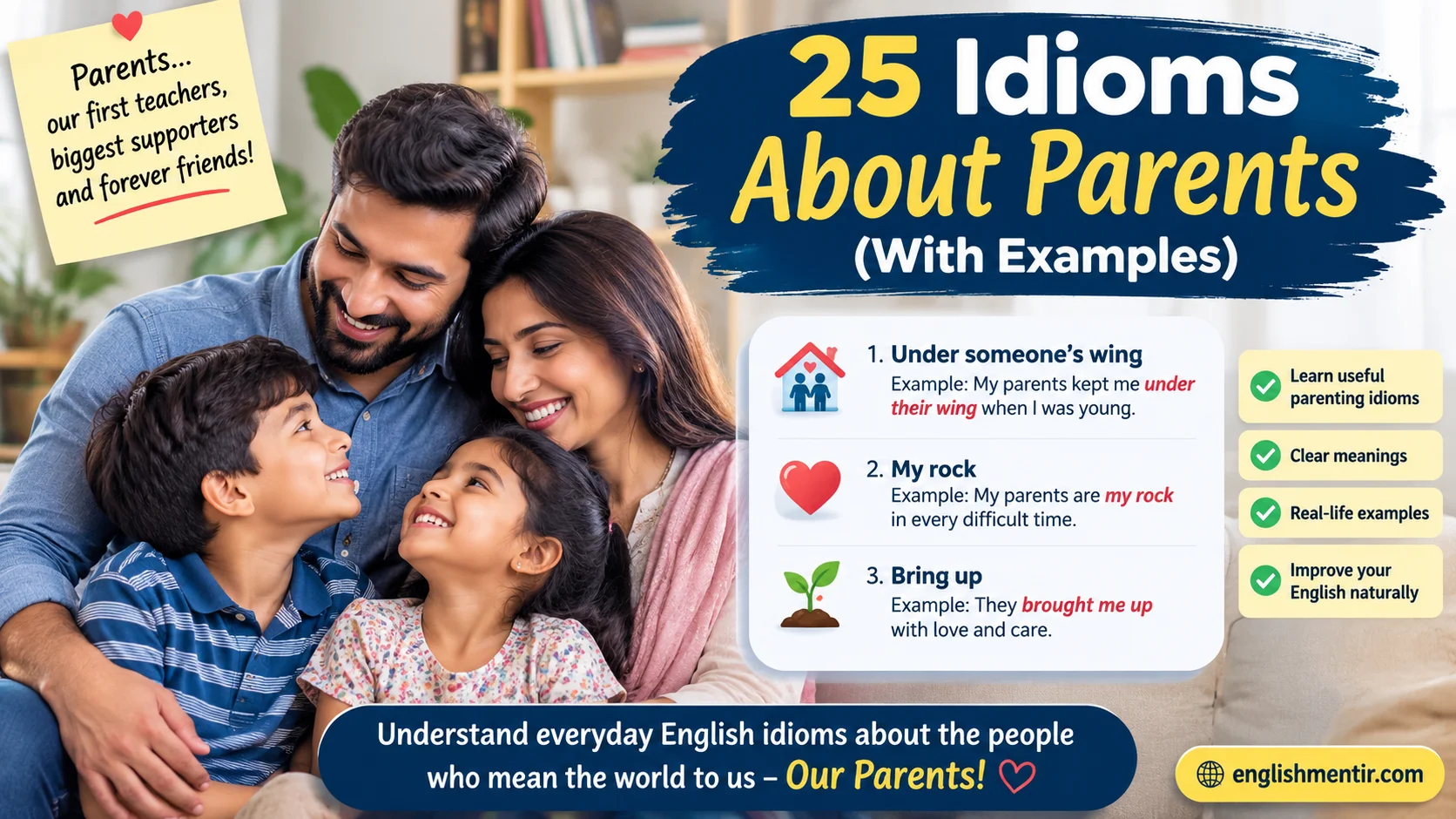
Discover 25 Idioms About Parents (With Examples) and learn fun, meaningful expressions about family, parenting, love, and relationships today!
Parents have a special role in our lives, and they guide, support, and teach children through many important lessons. In the English language and other languages, idioms, phrases, and expressions offer a great way to make speech more interesting and fun to learn. Idioms for parents, meaningful idioms, and parenting idioms often reflect love, responsibility, guidance, and the everyday experiences of raising children. Many common idioms have a different meaning from their individual words, but they help people describe relationships, family life, parenting, and the bond between parents and children. With clear examples, learners can understand how to use expressions in English naturally in sentences.
A Family, whether a big family, small family, traditional family, or modern family, shapes who we are, our view, and our world view of the world. It is no surprise that well-known family idioms, family expressions, and family idioms are related to family and are commonly used in everyday conversations, family discussions, writing, and writing and conversations. This article and blog explore and explain their meaning, meanings, and examples, including relationships with children, family relationships, parenting experiences, and parental guidance connected to love and responsibility. Learning these expressions can improve vocabulary, vocabulary skills, communication, and communication skills, helping readers begin to use expressions with confidence from beginning to end. Traditional, modern, big, small, everyday, common, important, special, and great ideas, along with lessons, raising, experiences, conversations, and discussions, give useful context when we explore the use of these phrases and idioms in English.
1. Like Father, Like Son
Meaning:
“Like father, like son” means a son shares similar habits, personality traits, interests, or behavior with his father. The expression can also be adapted for daughters or other parent-child relationships.
In a Sentence:
“Marcus loves fixing old cars just like his father, so like father, like son really fits.”
Other Ways to Say:
- He takes after his father.
- They are very much alike.
- He inherited his father’s traits.
2. The Apple Doesn’t Fall Far From the Tree
Meaning:
This expression means that children often resemble their parents in personality, behavior, talents, or interests.
In a Sentence:
“Emma is just as artistic as her mother. The apple doesn’t fall far from the tree.”
Other Ways to Say:
- She takes after her mother.
- She is very similar to her parents.
- She inherited her mother’s talent.
3. A Chip Off the Old Block
Meaning:
A chip off the old block describes someone, especially a child, who strongly resembles a parent in personality, appearance, or behavior.
In a Sentence:
“James has the same sense of humor as his dad. He’s definitely a chip off the old block.”
Other Ways to Say:
- He takes after his dad.
- He is just like his father.
- He resembles his parents.
4. Blood Is Thicker Than Water
Meaning:
This well-known expression suggests that family relationships can carry a powerful emotional bond that may be stronger than many outside relationships.
In a Sentence:
“Even after years apart, the siblings supported one another because blood is thicker than water.”
Other Ways to Say:
- Family comes first.
- Family bonds run deep.
- Relatives share a strong connection.
5. Follow in Someone’s Footsteps
Meaning:
To follow in a parent’s footsteps means to choose a similar career, lifestyle, passion, or path.
In a Sentence:
“After watching his father work as a teacher, Daniel decided to follow in his footsteps.”
Other Ways to Say:
- Follow the same path.
- Continue the family tradition.
- Pursue a similar career.
6. Take After Someone
Meaning:
When a child takes after a parent, the child resembles that person in looks, personality, habits, or talents.
In a Sentence:
“Lily really takes after her mother because both of them love gardening.”
Other Ways to Say:
- Resemble someone.
- Be similar to someone.
- Inherit someone’s traits.
7. Spitting Image
Meaning:
The spitting image of someone is a person who looks remarkably similar to them, often a child who strongly resembles a parent.
In a Sentence:
“Tom is the spitting image of his father when he was young.”
Other Ways to Say:
- Look exactly like someone.
- Be the double of someone.
- Closely resemble someone.
8. Rule the Roost
Meaning:
To rule the roost means to be the person who makes the important decisions or has the most authority in a household.
In a Sentence:
“My mother rules the roost at home because everyone listens when she makes a decision.”
Other Ways to Say:
- Be in charge.
- Run the household.
- Call the shots.
9. Wear the Pants
Meaning:
When someone wears the pants in a family, that person is seen as having strong authority or decision-making power in the household.
In a Sentence:
“Everyone jokes that Dad wears the pants in the family when it comes to major decisions.”
Other Ways to Say:
- Be in charge.
- Make the decisions.
- Have the final say.
10. Bring Home the Bacon
Meaning:
To bring home the bacon means to earn money or provide financially for a household.
In a Sentence:
“Both parents work hard to bring home the bacon and support their children.”
Other Ways to Say:
- Earn a living.
- Provide for the family.
- Support the household financially.
11. Keep the Home Fires Burning
Meaning:
To keep the home fires burning means to maintain a warm, stable, and welcoming home while someone else is away.
In a Sentence:
“While her husband traveled for work, Maria kept the home fires burning and cared for their children.”
Other Ways to Say:
- Maintain the household.
- Keep the family together.
- Look after the home.
Read More: 25 Idioms About Mothers (With Examples)
12. Raise a Child
Meaning:
To raise a child means to care for, guide, teach, and support a child as they grow toward adulthood.
In a Sentence:
“It takes patience and commitment to raise a child with confidence and kindness.”
Other Ways to Say:
- Bring up a child.
- Parent a child.
- Care for a child.
13. Bring Someone Up
Meaning:
To bring someone up means to raise a child and teach them values, manners, skills, and social behavior.
In a Sentence:
“My grandparents brought me up to respect others and take responsibility for my actions.”
Other Ways to Say:
- Raise someone.
- Teach someone.
- Care for someone while they grow.
14. Have Someone’s Back
Meaning:
To have someone’s back means to support and protect them when they need help. Parents often have their children’s backs during difficult moments.
In a Sentence:
“No matter how difficult life became, her parents always had her back.”
Other Ways to Say:
- Support someone.
- Stand by someone.
- Protect someone.
15. Stand By Someone
Meaning:
To stand by someone means to remain loyal and supportive, especially when that person faces trouble or uncertainty.
In a Sentence:
“His parents stood by him when he struggled to choose a career.”
Other Ways to Say:
- Remain supportive.
- Stay loyal to someone.
- Be there for someone.
16. A Shoulder to Cry On
Meaning:
A shoulder to cry on is someone who listens, comforts, and provides emotional support during a difficult time.
In a Sentence:
“When I felt overwhelmed, my mother was always a shoulder to cry on.”
Other Ways to Say:
- A source of comfort.
- Someone who listens.
- An emotional support.
17. Lean on Someone
Meaning:
To lean on someone means to depend on them for emotional, practical, or personal support.
In a Sentence:
“During difficult periods, children often lean on their parents for reassurance.”
Other Ways to Say:
- Depends on someone.
- Rely on someone.
- Turn to someone for support.
18. A Safe Pair of Hands
Meaning:
A safe pair of hands describes someone reliable, responsible, and capable of taking care of people or important responsibilities.
In a Sentence:
“The children were in a safe pair of hands with their experienced mother.”
Other Ways to Say:
- A reliable person.
- Someone trustworthy.
- A dependable caregiver.
19. The Head of the Family
Meaning:
The head of the family traditionally refers to the person who carries major responsibility or authority within a household.
In a Sentence:
“Her father was considered the head of the family, but both parents shared important decisions.”
Other Ways to Say:
- Family leader.
- Person in charge.
- Primary decision-maker.
20. Helicopter Parent
Meaning:
A helicopter parent is a parent who watches a child very closely and becomes heavily involved in the child’s activities, decisions, and problems.
In a Sentence:
“Being a helicopter parent can sometimes prevent children from learning how to solve problems independently.”
Other Ways to Say:
- Overprotective parents.
- Highly involved parent.
- Controlling parents.
21. Tiger Parent
Meaning:
A tiger parent is a parent who expects children to achieve highly and often uses strict rules, discipline, and demanding standards.
In a Sentence:
“His tiger parents pushed him to practice the piano every evening.”
Other Ways to Say:
- Strict parents.
- Demanding parent.
- Highly disciplined parent.
22. Empty Nest
Meaning:
An empty nest describes a home where children have grown up and moved away, leaving their parents living without them.
In a Sentence:
“After her youngest daughter left for college, Linda began adjusting to empty-nest life.”
Other Ways to Say:
- Children have left home.
- A child-free household.
- Life after children move out.
23. A Mother’s Love
Meaning:
A mother’s love refers to the deep affection, care, protection, and emotional connection a mother feels toward her child.
In a Sentence:
“Through every challenge, a mother’s love gave him courage to keep moving forward.”
Other Ways to Say:
- Maternal affection.
- A mother’s devotion.
- Unconditional maternal care.
24. A Father’s Pride
Meaning:
A father’s pride describes the happiness, admiration, and sense of achievement a father feels because of his child.
In a Sentence:
“You could see a father’s pride on his face when his daughter received her diploma.”
Other Ways to Say:
- A father’s joy.
- Parental pride.
- A parent’s sense of achievement.
25. Family Comes First
Meaning:
“Family comes first” expresses the idea that family relationships and responsibilities deserve a high place among a person’s priorities.
In a Sentence:
“When his parents needed help, he rearranged his plans because family comes first.”
Other Ways to Say:
- Put family first.
- Prioritize your loved ones.
- Family is a top priority.
15 MCQs
Test your understanding of these parent-related idioms and expressions. Choose the best answer for each question.
1. What does “like father, like son” mean?
A. A father controls his son
B. A son resembles his father
C. A son dislikes his father
D. A father teaches his son
Answer: B. A son resembles his father
2. If someone is “a chip off the old block,” what does it mean?
A. They are very different from their parent
B. They have no family connection
C. They strongly resemble a parent
D. They live far from their family
Answer: C. They strongly resemble a parent
3. What does “follow in someone’s footsteps” mean?
A. Walk behind someone
B. Choose a similar path
C. Avoid someone’s career
D. Copy someone’s clothes
Answer: B. Choose a similar path
4. If a child “takes after” their mother, the child:
A. Avoids their mother
B. Resembles their mother
C. Works for their mother
D. Travels with their mother
Answer: B. Resembles their mother
5. What does “rule the roost” mean?
A. Clean the house
B. Feed the family
C. Be in charge
D. Leave the house
Answer: C. Be in charge
6. What does “bring home the bacon” usually refer to?
A. Cooking breakfast
B. Earning money
C. Buying groceries
D. Preparing dinner
Answer: B. Earning money
7. Someone who “has your back” will:
A. Ignore you
B. Criticize you
C. Support you
D. Compete with you
Answer: C. Support you
8. What is “a shoulder to cry on”?
A. A person who offers emotional support
B. A place to sleep
C. A strict parent
D. A family celebration
Answer: A. A person who offers emotional support
9. What does “lean on someone” mean?
A. Physically push someone
B. Depend on someone for support
C. Argue with someone
D. Follow someone secretly
Answer: B. Depend on someone for support
10. What is a “helicopter parent”?
A. A parent who travels often
B. A parent who watches a child very closely
C. A parent who dislikes school
D. A parent who works from home
Answer: B. A parent who watches a child very closely
11. What does “tiger parent” describe?
A. A relaxed parent
B. A parent who avoids responsibility
C. A strict and demanding parent
D. A parent who travels frequently
Answer: C. A strict and demanding parent
12. What is an “empty nest”?
A. A house without furniture
B. A home after grown children move away
C. A house under construction
D. A family vacation
Answer: B. A home after grown children move away
13. What does “stand by someone” mean?
A. Remain supportive
B. Leave immediately
C. Disagree with someone
D. Ignore someone’s problem
Answer: A. Remain supportive
14. What does “family comes first” communicate?
A. Family should be avoided
B. Family has no responsibilities
C. Family should be treated as a major priority
D. Friends are always more important
Answer: C. Family should be treated as a major priority
15. What does “the apple doesn’t fall far from the tree” suggest?
A. Children often resemble their parents
B. Children should live alone
C. Parents dislike their children
D. Families should move frequently
Answer: A. Children often resemble their parents
MCQs Answer Key
- B — A son resembles his father
- C — They strongly resemble a parent
- B — Choose a similar path
- B — Resembles their mother
- C — Be in charge
- B — Earning money
- C — Support you
- A — A person who offers emotional support
- B — Depend on someone for support
- B — A parent who watches a child very closely
- C — A strict and demanding parent
- B — A home after grown children move away
- A — Remain supportive
- C — Family should be treated as a major priority
- A — Children often resemble their parents
FAQs
1. What are idioms about parents?
Idioms about parents are common expressions used to describe parenting, family relationships, love, guidance, and the experience of raising children.
2. Why should I learn parenting idioms?
Learning parenting idioms can improve your vocabulary, communication skills, and understanding of natural English conversations.
3. Can I use these idioms in everyday conversations?
Yes, many family idioms are commonly used in everyday conversations, making your speech sound more natural and interesting.
4. Do idioms always have a direct meaning?
No, an idiom usually has a different meaning from the individual words used in the phrase.
5. How can idioms about parents help English learners?
These expressions help learners understand family life, relationships, and parenting experiences while improving their ability to use English confidently.
Conclusion
Learning 25 Idioms About Parents (With Examples) is a fun and useful way to understand how people talk about parents, children, and family relationships. These expressions can help you explore ideas about love, responsibility, guidance, and parenting in a more natural way.
By understanding the meaning and use of these idioms, you can improve your vocabulary, make your communication more interesting, and use English expressions more confidently in everyday conversations.














1 thought on “25 Idioms About Parents (With Examples)”