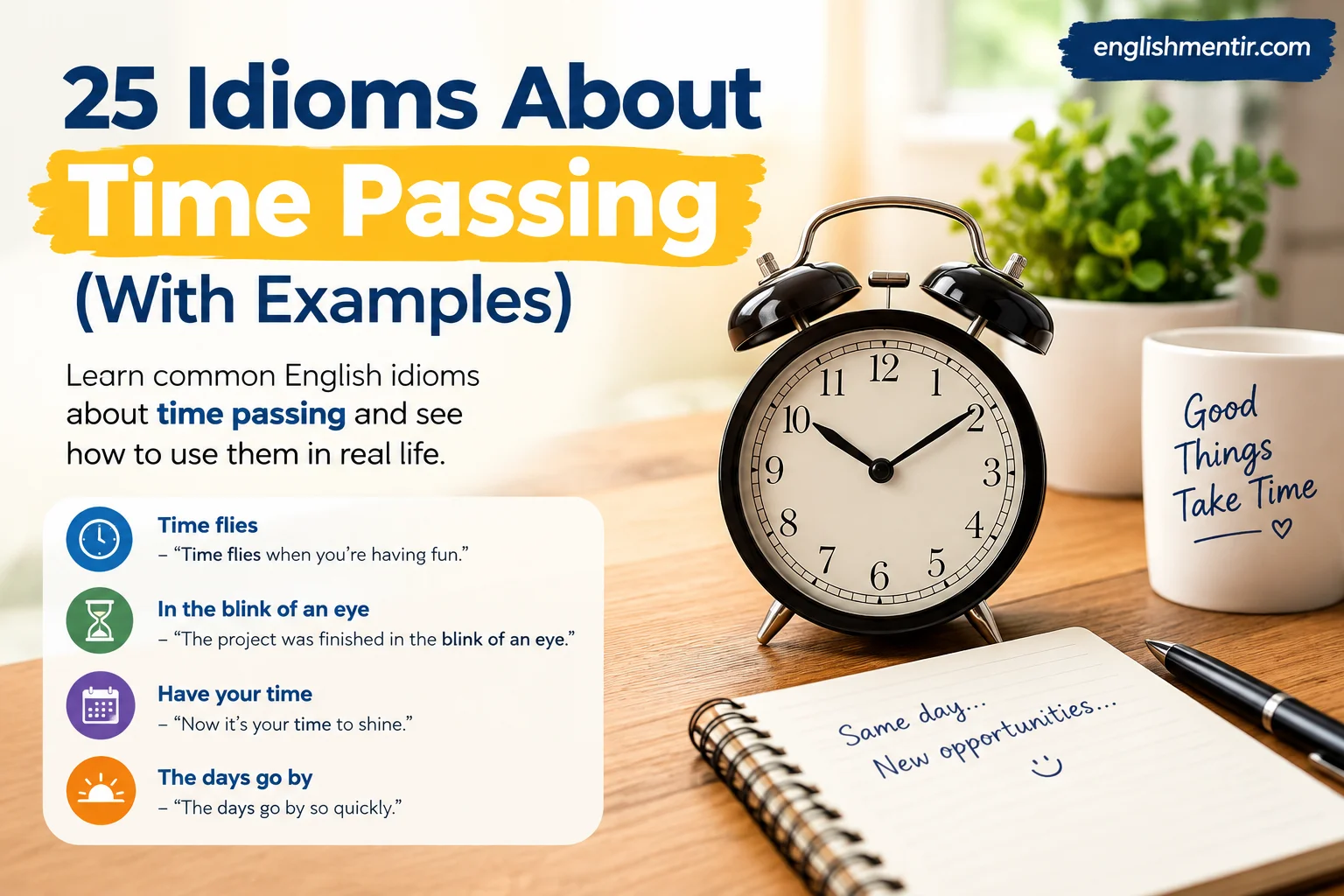
Discover 25 Idioms About Time Passing (With Examples) and learn natural expressions to make your English conversations more fluent today!
25 Idioms About Time Passing (With Examples) helps language learners explore time idioms and common expressions used in everyday conversations. Time can be tricky to describe, but people commonly use special expressions, phrases, and common idioms to talk about time passing, how time moves, and how they experience time in different situations. These useful expressions help native English speakers express ideas, urgency, patience, efficiency, availability, and the passage of time in simple and creative ways.
This comprehensive guide provides meanings, examples, and contextual examples to build English fluency through speaking and writing. Understanding proper context, appropriate formality levels, and precise ways to use phrases can prevent incorrect phrasing, overuse, and other pitfalls. Through learning idioms, practice, and each simple exercise, learners can start using time expressions more confidently in personal communication, professional communication, and their own conversations, while gaining cultural competence, linguistic competence, and a better idea of how English speakers naturally think, say, share ideas, and describe time.
1. Time Flies
Meaning: This idiom means that time seems to pass very quickly, especially when you’re enjoying yourself or staying busy.
In a Sentence: Time flies when you’re spending time with people you love.
Other Ways to Say:
- Time passes quickly
- The days go by quickly
- Time moves fast
- The years pass quickly
2. In the Blink of an Eye
Meaning: Something happens or a period of time passes extremely quickly.
In a Sentence: The summer passed in the blink of an eye.
Other Ways to Say:
- Very quickly
- In an instant
- In no time
- Almost immediately
3. Before You Know It
Meaning: Used when something happens so quickly that you barely notice the time passing.
In a Sentence: Keep working steadily, and before you know it, your exams will be over.
Other Ways to Say:
- Very soon
- Before long
- In no time
- Sooner than expected
4. Around the Clock
Meaning: To continue for 24 hours or without stopping, emphasizing a long period of continuous activity.
In a Sentence: The medical team worked around the clock during the emergency.
Other Ways to Say:
- All day and night
- Twenty-four hours a day
- Continuously
- Without stopping
5. Day in, Day Out
Meaning: Something happens every day repeatedly, often over a long period.
In a Sentence: She practiced the piano day in, day out for years.
Other Ways to Say:
- Every day
- Daily
- Day after day
- Regularly
6. Day After Day
Meaning: Something continues to happen repeatedly over a period of time.
In a Sentence: He waited day after day for news from his friend.
Other Ways to Say:
- Every day
- Day by day
- Repeatedly
- For many days
7. Year After Year
Meaning: Something continues or happens repeatedly for many years.
In a Sentence: The family returned to the same seaside town year after year.
Other Ways to Say:
- Every year
- For years
- Yearly
- Over many years
8. As Time Goes By
Meaning: Used to describe something that happens gradually as time passes.
In a Sentence: As time goes by, you may understand why that experience was important.
Other Ways to Say:
- As time passes
- Over time
- As the years go by
- With time
9. With the Passage of Time
Meaning: Something changes or becomes different as more time passes.
In a Sentence: With the passage of time, old memories can take on new meaning.
Other Ways to Say:
- Over time
- As time passes
- As years go by
- Gradually
10. In Due Course
Meaning: Something will happen at the appropriate or expected time, even if it takes some waiting.
In a Sentence: In due course, you’ll receive an answer to your application.
Other Ways to Say:
- Eventually
- In time
- When the time is right
- Sooner or later
11. In the Long Run
Meaning: When considering the long-term effects or results of something rather than what happens immediately.
In a Sentence: Studying consistently will help you in the long run.
Other Ways to Say:
- Eventually
- Over the long term
- In the future
- Ultimately
Read More: 25 Idioms About the Past (With Examples)
12. Over the Years
Meaning: Used to describe something that has happened or changed during a number of years.
In a Sentence: Over the years, our friendship has grown stronger.
Other Ways to Say:
- Throughout the years
- As the years passed
- With time
- Over time
13. The Sands of Time
Meaning: A poetic expression referring to the gradual passing of time.
In a Sentence: The sands of time continue to move forward, carrying us into new stages of life.
Other Ways to Say:
- The passage of time
- Time passing
- The years going by
- The flow of time
14. Time Marches On
Meaning: This expression means that time continues to move forward, regardless of what happens.
In a Sentence: We may wish we could stay young forever, but time marches on.
Other Ways to Say:
- Time moves forward
- Life goes on
- The years continue
- Time keeps moving
15. The Clock Is Ticking
Meaning: This expression means that time is running out, usually before a deadline or important event.
In a Sentence: The clock is ticking, so we need to finish the project today.
Other Ways to Say:
- Time is running out
- The deadline is approaching
- There’s little time left
- Time is getting short
16. Time Is of the Essence
Meaning: This means that acting quickly is extremely important because delay could cause problems.
In a Sentence: Time is of the essence when responding to an emergency.
Other Ways to Say:
- Time is critical
- Act quickly
- Speed is important
- Don’t delay
17. At the Eleventh Hour
Meaning: Something happens at the last possible moment before a deadline or event.
In a Sentence: She submitted her assignment at the eleventh hour.
Other Ways to Say:
- At the last minute
- Just in time
- At the final moment
- Right before the deadline
18. Once in a Blue Moon
Meaning: Something happens very rarely, so a long time may pass between occurrences.
In a Sentence: We only see each other once in a blue moon because we live in different countries.
Other Ways to Say:
- Very rarely
- Once in a while
- Seldom
- Almost never
19. In No Time
Meaning: Something will happen or be completed very quickly.
In a Sentence: Don’t worry about the assignment; you’ll finish it in no time.
Other Ways to Say:
- Very quickly
- Soon
- In a moment
- Before long
20. Before Long
Meaning: Something will happen soon or after only a short period of time.
In a Sentence: Before long, the leaves began to change color.
Other Ways to Say:
- Soon
- Shortly
- In a little while
- In the near future
21. Sooner or Later
Meaning: Something is expected to happen eventually, even though the exact time is unknown.
In a Sentence: Sooner or later, everyone has to make difficult decisions.
Other Ways to Say:
- Eventually
- At some point
- One day
- In time
22. From Time to Time
Meaning: Something happens occasionally rather than regularly.
In a Sentence: I still call my old teacher from time to time.
Other Ways to Say:
- Occasionally
- Sometimes
- Every now and then
- Once in a while
23. Every Now and Then
Meaning: Something happens occasionally, with periods of time between each occurrence.
In a Sentence: Every now and then, I look through my old school photographs.
Other Ways to Say:
- Occasionally
- From time to time
- Once in a while
- Sometimes
24. Live on Borrowed Time
Meaning: To continue existing or functioning even though you expect that the situation may end soon.
In a Sentence: After the company lost its main investor, many employees felt it was living on borrowed time.
Other Ways to Say:
- Have limited time left
- Be close to the end
- Have a short future
- Continue temporarily
25. A Long Time Coming
Meaning: Something has taken a long time to happen, especially after being expected or anticipated.
In a Sentence: Her graduation was a long time coming, but she finally reached her goal.
Other Ways to Say:
- Long-awaited
- Years in the making
- Long overdue
- Finally happening
Exercise to Practice
Choose the best answer for each question.
1. What does “time flies” mean?
A. Time stops
B. Time passes quickly
C. Time becomes slower
D. Time disappears
2. What does “in the blink of an eye” mean?
A. Very slowly
B. Extremely quickly
C. Every day
D. Once a year
3. If something happens “before you know it,” it happens:
A. After many years
B. Very soon or quickly
C. Without warning forever
D. At a fixed time
4. What does “day in, day out” mean?
A. Occasionally
B. Once a month
C. Every day repeatedly
D. Only during weekends
5. What does “year after year” describe?
A. Something happening once
B. Something continuing for many years
C. Something happening suddenly
D. Something ending immediately
6. What does “as time goes by” mean?
A. Before time starts
B. As time passes
C. When time stops
D. At the last minute
7. “The sands of time” refers to:
A. A beach
B. An hourglass only
C. The passing of time
D. A vacation
8. What does “time marches on” suggest?
A. Time moves backward
B. Time continues moving forward
C. Time stops completely
D. Time becomes unpredictable
9. What does “the clock is ticking” mean?
A. There is plenty of time
B. Time is running out
C. The clock is broken
D. The work is finished
10. What does “at the eleventh hour” mean?
A. Very early
B. The next day
C. At the last possible moment
D. Every eleven hours
11. What does “once in a blue moon” mean?
A. Every night
B. Very rarely
C. Every month
D. Very quickly
12. What does “from time to time” mean?
A. Constantly
B. Never
C. Occasionally
D. Every minute
13. What does “sooner or later” mean?
A. Never
B. Eventually
C. Immediately
D. Yesterday
14. What does “live on borrowed time” mean?
A. To borrow someone’s watch
B. To continue despite expecting an end soon
C. To waste time
D. To travel frequently
15. What does “a long time coming” mean?
A. Something happened immediately
B. Something happens every day
C. Something took a long time to happen
D. Something will never happen
Answers
- B — Time passes quickly
- B — Extremely quickly
- B — Very soon or quickly
- C — Every day repeatedly
- B — Something continuing for many years
- B — As time passes
- C — The passing of time
- B — Time continues moving forward
- B — Time is running out
- C — At the last possible moment
- B — Very rarely
- C — Occasionally
- B — Eventually
- B — To continue despite expecting an end soon
- C — Something took a long time to happen
FAQs
1. What are idioms about time passing?
Idioms about time passing are common expressions used to describe how quickly or slowly time moves. Their meanings are often different from the literal words, making them useful in everyday English conversations.
2. Why should I learn time idioms?
Learning time idioms can improve your English fluency and help you sound more natural. They also make your speaking and writing more interesting and expressive.
3. Are time idioms commonly used by native English speakers?
Yes, native English speakers commonly use time-related expressions in conversations about deadlines, patience, urgency, and everyday situations.
4. How can I remember idioms about time passing?
The best way is through practice, examples, and regular use. Try adding one or two time expressions to your own conversations and writing each day.
5. Can I use time idioms in professional communication?
Yes, many time idioms can be used in professional communication, but it is important to understand the proper context and appropriate level of formality.
Conclusion
Learning these 25 idioms about time passing can help you better understand how English speakers describe the passage of time. With regular practice and attention to context, these expressions can make your English communication more natural, confident, and engaging.
As you continue using these time idioms in everyday conversations, focus on their meanings rather than memorizing words alone. Over time, you will become more comfortable choosing the right expression for different situations and improving both your speaking and writing.














1 thought on “25 Idioms About Time Passing (With Examples)”