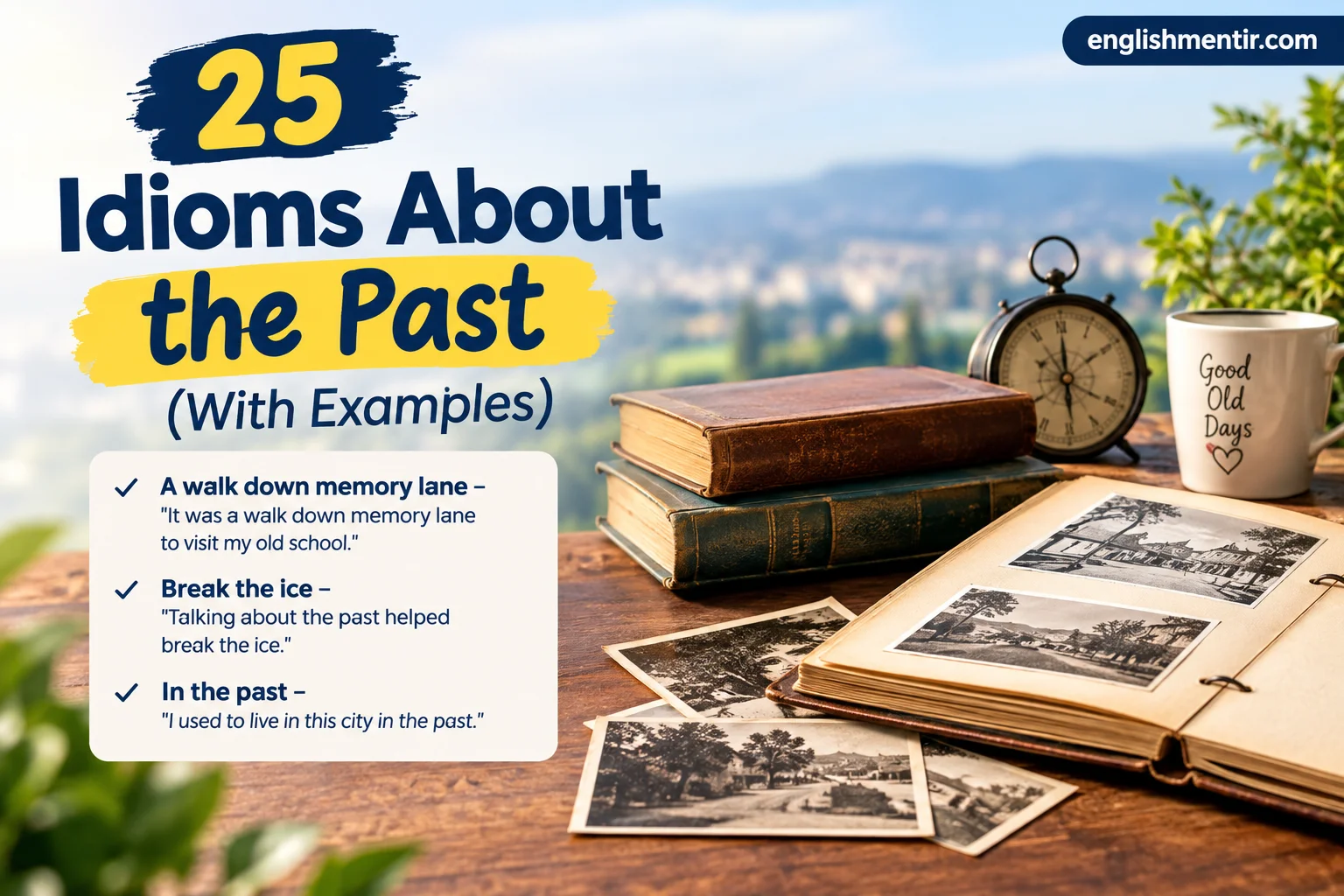
Explore 25 Idioms About the Past (With Examples), learn their meanings, and use these timeless expressions naturally in everyday English with ease.
These star-related idioms are inspired by stars, the night sky, and celestial imagery. In everyday English, phrases such as reach for the stars, have stars in your eyes, born under a lucky star, thank your lucky stars, and shoot for the stars bring vivid imagery to motivational writing, books, media, and conversations.
They can describe ambition, opportunity, exceptional people, and exceptional situations, while helping learners understand the meanings of expressions and their examples. From my experience in teaching and writing, these phrases make learning vocabulary and figurative language easier because native English speakers use them naturally. A student, teacher, writer, or English learner can use this guide for English idioms about stars, clear meanings, practical examples, and usage tips, then use these expressions confidently.
1. In the Past
Meaning:
In the past refers to something that happened or was true at an earlier time.
In a Sentence:
In the past, I used to spend every weekend visiting my grandparents.
Other Ways to Say:
- Previously
- Earlier
- Long ago
- Before now
This is one of the simplest expressions for discussing something that happened before the present.
2. Once Upon a Time
Meaning:
Once upon a time refers to a period long ago, especially when telling a story or remembering an earlier stage of life.
In a Sentence:
Once upon a time, this quiet village was a busy trading center.
Other Ways to Say:
- Long ago
- Years ago
- In earlier times
- Back then
This phrase has a storytelling quality and often appears at the beginning of traditional tales.
3. Back in the Day
Meaning:
Back in the day means during a particular period in the past, usually one remembered with familiarity or nostalgia.
In a Sentence:
Back in the day, people often wrote letters instead of sending instant messages.
Other Ways to Say:
- Back then
- In those days
- Years ago
- In earlier times
It’s common in casual conversations when someone is remembering how life used to be.
4. In Days Gone By
Meaning:
In days gone by refers to a time in the past that has now ended.
In a Sentence:
In days gone by, families gathered around the radio for evening entertainment.
Other Ways to Say:
- In the old days
- Long ago
- In earlier times
- Years past
This expression has a slightly nostalgic and reflective tone.
5. Once in a Blue Moon
Meaning:
Once in a blue moon means something happens very rarely.
In a Sentence:
I only visit that old neighborhood once in a blue moon, but I still remember it fondly.
Other Ways to Say:
- Very rarely
- Almost never
- Once in a while
- On rare occasions
Although this idiom doesn’t specifically mean “in the past,” it can describe something that happened only occasionally over a long period.
6. Water Under the Bridge
Meaning:
Water under the bridge describes a past problem or disagreement that no longer matters.
In a Sentence:
We had an argument years ago, but it’s water under the bridge now.
Other Ways to Say:
- It’s in the past
- Let bygones be bygones
- Forget about it
- Move on
This expression is useful when you want to show that you’ve forgiven someone or accepted what happened.
7. Let Bygones Be Bygones
Meaning:
Let bygones be bygones means to stop focusing on past disagreements and move forward.
In a Sentence:
We both made mistakes, so let’s let bygones be bygones.
Other Ways to Say:
- Put the past behind you
- Move on
- Forgive and forget
- Leave old conflicts alone
It can be a gentle way to encourage forgiveness and peace.
8. Put the Past Behind You
Meaning:
To put the past behind you means to stop dwelling on previous events and focus on the future.
In a Sentence:
After losing the competition, she decided to put the past behind her and try again.
Other Ways to Say:
- Move forward
- Move on
- Leave the past behind
- Start fresh
This expression is especially useful when discussing personal growth and new beginnings.
9. A Thing of the Past
Meaning:
A thing of the past is something that no longer exists, happens, or remains common.
In a Sentence:
With modern technology, handwritten business letters have become a thing of the past.
Other Ways to Say:
- Outdated
- No longer common
- Gone
- Obsolete
The phrase is useful when comparing older habits or traditions with modern life.
Raed More: 25 Idioms About Stars (With Examples)
10. Live in the Past
Meaning:
To live in the past means to think too much about earlier times instead of focusing on the present.
In a Sentence:
You can’t live in the past forever; sometimes you have to accept change.
Other Ways to Say:
- Dwell on the past
- Look backward
- Hold on to old memories
- Fail to move forward
The expression can sound critical, but it may also describe someone who deeply misses an earlier period.
11. Dwell on the Past
Meaning:
To dwell on the past means to keep thinking or talking about previous events, especially negative ones.
In a Sentence:
It’s understandable to feel disappointed, but there’s no need to dwell on the past.
Other Ways to Say:
- Keep looking backward
- Brood over old events
- Focus on what happened
- Remain stuck in the past
This phrase often appears when encouraging someone to focus on healing and moving forward.
12. Look Back
Meaning:
To look back means to think about or remember something that happened in the past.
In a Sentence:
When I look back, I realize how much I learned from that experience.
Other Ways to Say:
- Remember
- Reflect
- Think back
- Recall
Unlike “dwell on the past,” look back can have a positive, neutral, or reflective meaning.
13. Think Back
Meaning:
To think back means to remember or consider something that happened earlier.
In a Sentence:
When I think back to my school years, I remember spending hours with my closest friends.
Other Ways to Say:
- Remember
- Recall
- Reflect on
- Look back on
This phrase is natural in everyday conversation and works well when sharing personal memories.
14. Cast Your Mind Back
Meaning:
To cast your mind back means to deliberately remember or consider something from the past.
In a Sentence:
If you cast your mind back ten years, you’ll remember how different the town looked.
Other Ways to Say:
- Think back
- Recall
- Remember
- Reflect on the past
This expression is more common in British English and has a reflective tone.
15. A Blast from the Past
Meaning:
A blast from the past is a person, object, song, or experience that suddenly reminds you of an earlier period.
In a Sentence:
Hearing that old song was a blast from the past.
Other Ways to Say:
- Nostalgic reminder
- Trip down memory lane
- Old memory
- Reminder of earlier times
It’s especially common when something unexpectedly brings back pleasant memories.
16. Down Memory Lane
Meaning:
To take a trip down memory lane means to spend time remembering experiences from the past.
In a Sentence:
Looking through our childhood photographs took us on a trip down memory lane.
Other Ways to Say:
- Recall old memories
- Remember the past
- Reminisce
- Reflect on earlier times
This expression usually has a warm and nostalgic feeling.
17. The Good Old Days
Meaning:
The good old days refers to a period in the past that someone remembers as happier or better.
In a Sentence:
My father often talks about the good old days when the whole family lived nearby.
Other Ways to Say:
- Better times
- Happy memories
- Earlier days
- The old days
The phrase often expresses nostalgia, although it can sometimes be used humorously.
18. Old Habits Die Hard
Meaning:
Old habits die hard means that habits developed over a long period can be difficult to change.
In a Sentence:
She still checks the clock before bed because old habits die hard.
Other Ways to Say:
- Habits are hard to break
- Old routines are difficult to change
- Change takes time
- Familiar habits persist
This idiom reminds us that past behavior can continue influencing the present.
19. History Repeats Itself
Meaning:
History repeats itself means that similar events or patterns can happen again.
In a Sentence:
If we ignore the lessons of previous mistakes, history may repeat itself.
Other Ways to Say:
- The same pattern happens again
- Past events recur
- Old mistakes return
- The past repeats itself
The phrase is often used when discussing mistakes, social patterns, or historical events.
20. Learn from the Past
Meaning:
To learn from the past means to use previous experiences and mistakes as lessons for future decisions.
In a Sentence:
We should learn from the past rather than repeat the same mistakes.
Other Ways to Say:
- Take a lesson from experience
- Use past experience
- Grow from mistakes
- Apply what you’ve learned
This expression emphasizes growth rather than regret.
21. Have a Skeleton in the Closet
Meaning:
To have a skeleton in the closet means to have a secret or embarrassing event from the past that someone wants to keep hidden.
In a Sentence:
The politician worried that someone might reveal a skeleton in his closet.
Other Ways to Say:
- Have a hidden secret
- Have a dark secret
- Hide something from the past
- Have an embarrassing secret
The expression is usually used when the hidden past could affect someone’s reputation or relationships.
22. Bury the Hatchet
Meaning:
To bury the hatchet means to end a disagreement and make peace after a conflict.
In a Sentence:
After years of arguing, the two brothers decided to bury the hatchet.
Other Ways to Say:
- Make peace
- End the conflict
- Reconcile
- Settle your differences
This idiom focuses on forgiveness and reconciliation, making it useful when talking about repairing relationships.
23. History in the Making
Meaning:
History in the making describes an important event that is happening now and may be remembered in the future.
In a Sentence:
Millions watched the championship match because they knew they were witnessing history in the making.
Other Ways to Say:
- A historic moment
- An important event
- A landmark moment
- A moment worth remembering
The phrase connects the present with the future, suggesting that today’s events may become tomorrow’s history.
24. Old School
Meaning:
Old school describes a traditional approach, style, or method associated with an earlier period.
In a Sentence:
My grandfather prefers an old-school approach to repairing household items.
Other Ways to Say:
- Traditional
- Classic
- Old-fashioned
- Conventional
Depending on context, “old school” can express admiration for traditional methods rather than criticism.
25. From Way Back
Meaning:
From way back means from a very long time ago, especially when referring to a person, relationship, or memory.
In a Sentence:
She’s a friend from way back, and we’ve known each other since childhood.
Other Ways to Say:
- From long ago
- Since childhood
- From many years ago
- From earlier times
This casual expression works well when talking about long-standing relationships and memories.
Why Idioms About the Past Matter
Idioms about the past allow you to express more than simply saying “something happened before.” They can show nostalgia, regret, acceptance, forgiveness, or personal growth.
For example, “a blast from the past” suggests a pleasant memory, while “water under the bridge” shows that an old problem no longer matters. Similarly, “learn from the past” focuses on turning experience into wisdom.
The best expression depends on the emotion behind your message. If you’re remembering happy moments, choose a nostalgic phrase. If you’re discussing an old mistake, an idiom about growth or moving forward may fit better.
Quick Guide to Idioms About the Past
| Idiom | Main Meaning |
| Back in the day | During an earlier period |
| Once upon a time | Long ago |
| Water under the bridge | A past issue that no longer matters |
| Let bygones be bygones | Stop focusing on old conflicts |
| Put the past behind you | Move forward |
| A thing of the past | Something no longer common |
| Live in the past | Focus too much on earlier times |
| Dwell on the past | Keep thinking about previous events |
| A blast from the past | A reminder of earlier times |
| Trip down memory lane | Remember old experiences |
| The good old days | Happier or fondly remembered times |
| Old habits die hard | Old habits are difficult to change |
| History repeats itself | Similar events happen again |
| Bury the hatchet | Make peace |
| Learn from the past | Use experience as a lesson |
Exercise to Practice: 15 MCQs
1. What does “water under the bridge” mean?
A. A current problem
B. A past problem that no longer matters
C. A difficult journey
D. A future opportunity
2. Which phrase means “during an earlier period”?
A. History in the making
B. Back in the day
C. Bury the hatchet
D. Old habits die hard
3. What does “let bygones be bygones” encourage people to do?
A. Remember every mistake
B. Move past old disagreements
C. Create a new argument
D. Avoid new experiences
4. What does “a blast from the past” describe?
A. A future event
B. A serious problem
C. Something that reminds you of earlier times
D. A new opportunity
5. What does “live in the past” mean?
A. Study history
B. Focus too much on earlier times
C. Plan for tomorrow
D. Forget your memories
6. Which idiom means to make peace after a disagreement?
A. Think back
B. Bury the hatchet
C. Cast your mind back
D. A thing of the past
7. What does “old habits die hard” mean?
A. Habits disappear quickly
B. Long-established habits can be difficult to change
C. Old people dislike change
D. New habits are impossible
8. What does “the good old days” usually express?
A. Fear
B. Anger
C. Nostalgia for earlier times
D. Confusion
9. What does “put the past behind you” mean?
A. Remember everything
B. Move forward instead of dwelling on previous events
C. Return to an old place
D. Study history
10. Which phrase means something is no longer common or exists?
A. A thing of the past
B. Once in a blue moon
C. From way back
D. History in the making
11. What does “think back” mean?
A. Predict the future
B. Remember something from earlier
C. Ignore a memory
D. Change a decision
12. What does “history repeats itself” suggest?
A. History is forgotten
B. Similar events or patterns can happen again
C. The future is always different
D. Old books become valuable
13. Which idiom refers to a hidden secret from someone’s past?
A. Good old days
B. Skeleton in the closet
C. Down memory lane
D. Back in the day
14. What does “learn from the past” mean?
A. Forget previous experiences
B. Repeat old mistakes
C. Use past experiences as lessons for the future
D. Avoid making decisions
15. What does “trip down memory lane” mean?
A. Taking a physical trip
B. Remembering experiences from the past
C. Planning a vacation
D. Starting a new project
Answers
- B — A past problem that no longer matters
- B — Back in the day
- B — Move past old disagreements
- C — Something that reminds you of earlier times
- B — Focus too much on earlier times
- B — Bury the hatchet
- B — Long-established habits can be difficult to change
- C — Nostalgia for earlier times
- B — Move forward instead of dwelling on previous events
- A — A thing of the past
- B — Remember something from earlier
- B — Similar events or patterns can happen again
- B — Skeleton in the closet
- C — Use past experiences as lessons for the future
- B — Remembering experiences from the past
FAQs
1. What are idioms about the past?
Idioms about the past are common English expressions that describe previous experiences, memories, events, or situations in a figurative way.
2. Why should I learn idioms about the past?
Learning these idioms can improve your English vocabulary, help you understand native speakers, and make your everyday conversations more natural.
3. Are idioms about the past difficult to understand?
Some idioms can seem confusing because their literal meaning differs from their actual meaning. Clear examples make them much easier to understand.
4. How can I use past-related idioms in conversations?
You can use past-related idioms when talking about memories, experiences, old events, or things that happened before. Learning them in complete sentences is helpful.
5. What is the best way to learn these idioms?
The best approach is to learn each idiom, understand its meaning, study a practical example, and then practice using it in your own sentences.
Conclusion
Learning 25 Idioms About the Past (With Examples) can make your English vocabulary richer and your conversations more natural. These expressions help you talk about memories, experiences, previous events, and different situations in an engaging way.
With regular practice, you can understand the meaning of each idiom and learn how to use it correctly. Reading examples, creating your own sentences, and using these idioms in everyday English can gradually improve your speaking and writing skills.













1 thought on “25 Idioms About the Past (With Examples)”