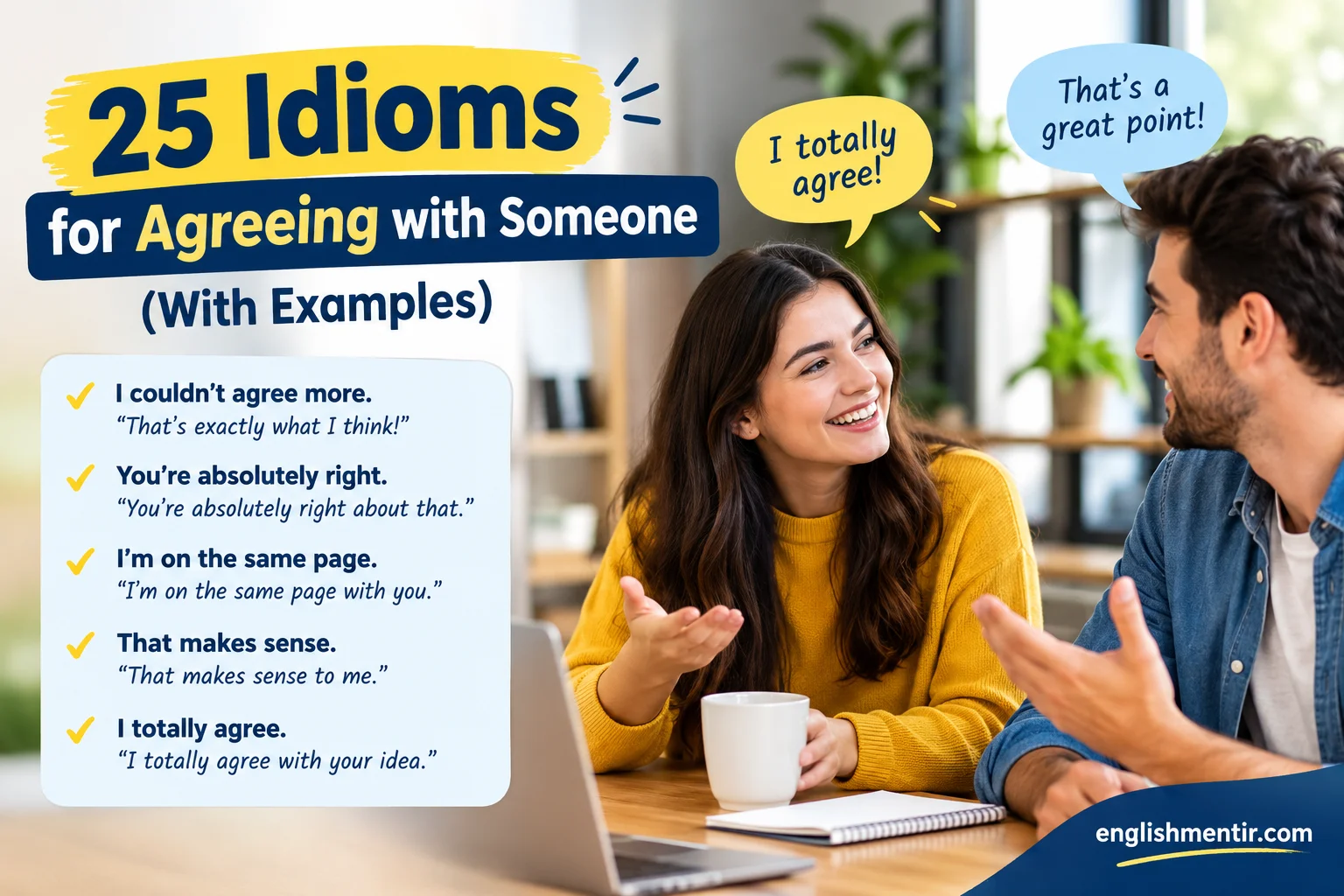
Learn 25 Idioms for Agreeing with Someone (With Examples) and discover natural, confident ways to express agreement in everyday English.
When a friend shares an opinion, you might say “I agree,” but this short phrase can sound too simple. An idiom gives you a different way to express an idea without using the exact words that explain its meaning. For an example, same page shows that someone and you have the same point of view. These idioms make language more fun, creative, colorful, and interesting, while they help people understand, connect quickly with others, and show that you agree with their ideas. In daily conversations, common idioms can help you express yourself clearly and naturally in speaking and writing. Learning these phrases helps you share ideas, support what someone says something, and react to opinions with greater understanding. This article will explore these expressions, how they show agreement, how they are used, and how to use them in sentences, conversations, and a short dialogue. By the end, you can learn and practice through a short exercise. The keyword 25 Idioms for Agreeing with Someone (With Examples) introduces useful expressions for everyday agreement and clear communication.
The alternative ways to express agreement can make your response more personal, caring, sincere, engaging, and relatable. Rather than repeating a simple natural phrase, you can convey genuine agreement while remaining fluent, polite, and confident. This works in casual and professional settings, academic learning, daily English, a meeting, a chat, work, or a meaningful conversation with a loved one. Choosing the right words can reflect connection, trust, respect, enthusiasm, and professionalism, depending on the situation. They can also show that you genuinely understand and value the other person’s viewpoint, creating a positive impression without sounding repetitive or robotic. A native speaker may choose different expressions, creative replies, diverse and diverse ways of saying the same thing, keeping the talk dynamic, fresh, and impactful. When agreeing with others, these words can communicate shared approval, stronger agreement, or quiet confidence, while keeping the conversation relaxed and friendly. With strong communication skills and communication skills, you can find just the right words, express your full sense of understanding, believe and support another view, and make your response feel natural and connected every time. Exploring these idioms helps you learn which expression fits a casual conversation and which suits firm agreement, giving you more diverse and creative choices.
What Are Idioms for Agreeing With Someone?
Idioms for agreeing with someone are common expressions people use to show that they share an opinion, support an idea, or feel the same way. Instead of repeatedly saying “I agree,” these phrases make conversations more expressive and natural.
For example, if someone says, “We should leave early to avoid traffic,” you could say, “You can say that again!” This means you strongly agree with what the person has said.
1. You Can Say That Again
Meaning: This idiom means you strongly agree with something someone has just said.
In a Sentence:
“I think we should save some money for emergencies.”
“You can say that again!”
Other Ways to Say:
- I completely agree.
- Absolutely.
- That’s exactly right.
2. Tell Me About It
Meaning: This expression shows that you strongly understand and agree with someone’s experience or opinion.
In a Sentence:
“Working late every night can be exhausting.”
“Tell me about it!”
Other Ways to Say:
- I know exactly what you mean.
- I feel the same way.
- I understand completely.
3. We’re on the Same Page
Meaning: This means that you and another person share the same understanding, opinion, or goal.
In a Sentence:
“I think customer service should come first.”
“Great, we’re on the same page.”
Other Ways to Say:
- We agree.
- We think alike.
- We have the same idea.
4. I’m With You on That
Meaning: This idiom means you support or agree with someone’s opinion.
In a Sentence:
“I think we should focus on quality instead of speed.”
“I’m with you on that.”
Other Ways to Say:
- I agree with you.
- I support that idea.
- I feel the same way.
5. You Took the Words Right Out of My Mouth
Meaning: This phrase means someone said exactly what you were thinking.
In a Sentence:
“We need to spend less and plan more carefully.”
“You took the words right out of my mouth.”
Other Ways to Say:
- That’s exactly what I was thinking.
- I was about to say the same thing.
- You said it perfectly.
6. Great Minds Think Alike
Meaning: This playful idiom means two people have reached the same idea independently.
In a Sentence:
“You brought snacks for the trip too? Great minds think alike!”
Other Ways to Say:
- We think alike.
- We had the same idea.
- We’re thinking along the same lines.
7. I Couldn’t Agree More
Meaning: This means you agree with someone as strongly as possible.
In a Sentence:
“Everyone deserves a second chance.”
“I couldn’t agree more.”
Other Ways to Say:
- I completely agree.
- I strongly agree.
- Absolutely.
8. You’re Right on the Money
Meaning: This means someone’s statement or judgment is exactly correct.
In a Sentence:
“You’re right on the money about the project needing better planning.”
Other Ways to Say:
- You’re absolutely right.
- That’s exactly correct.
- You’ve got it right.
9. Hit the Nail on the Head
Meaning: This idiom means someone has identified the exact truth or main point.
In a Sentence:
“When you said communication was the real problem, you hit the nail on the head.”
Other Ways to Say:
- You identified the main issue.
- That’s exactly right.
- You’ve pinpointed the problem.
10. That’s Just What I Was Thinking
Meaning: This phrase shows that someone’s idea matches your own thoughts.
In a Sentence:
“We should invite everyone before making a final decision.”
“That’s just what I was thinking.”
Other Ways to Say:
- I was thinking the same thing.
- I agree completely.
- That matches my thoughts.
Read More: 25 Idioms for A Lot (With Examples)
11. I’m All for It
Meaning: This means you strongly support an idea, plan, or suggestion.
In a Sentence:
“If you want to organize a team lunch, I’m all for it.”
Other Ways to Say:
- I fully support it.
- I’m in favor of it.
- Count me in.
12. Hear, Hear!
Meaning: This traditional expression shows strong agreement or approval, especially after an important statement.
In a Sentence:
“We should treat every customer with respect.”
“Hear, hear!”
Other Ways to Say:
- Absolutely!
- Well said!
- I agree completely!
13. That’s the Way I See It
Meaning: This phrase means your opinion or understanding is the same as the other person’s.
In a Sentence:
“I think patience makes difficult situations easier to handle.”
“That’s the way I see it too.”
Other Ways to Say:
- I see it the same way.
- I agree with that view.
- That’s my perspective too.
14. We See Eye to Eye
Meaning: To see eye to eye means to completely agree with someone about an issue.
In a Sentence:
“My brother and I see eye to eye when it comes to saving money.”
Other Ways to Say:
- We completely agree.
- We share the same view.
- We’re in agreement.
15. We Think Alike
Meaning: This means two people have similar opinions, ideas, or ways of thinking.
In a Sentence:
“We both chose the same solution because we think alike.”
Other Ways to Say:
- We’re on the same wavelength.
- We have similar ideas.
- We see things similarly.
16. We’re on the Same Wavelength
Meaning: This idiom means you understand something in a similar way or share the same thoughts.
In a Sentence:
“Once we discussed the project, we realized we were on the same wavelength.”
Other Ways to Say:
- We understand each other.
- We’re thinking alike.
- We share the same perspective.
17. That’s Exactly It
Meaning: This expression shows that someone has correctly identified your thought, feeling, or point.
In a Sentence:
“You don’t need more time; you need a clearer plan.”
“That’s exactly it.”
Other Ways to Say:
- Exactly.
- You’ve got it.
- That’s precisely what I mean.
18. You’ve Got a Point
Meaning: This phrase means you recognize that someone’s argument or idea is reasonable and valid.
In a Sentence:
“We should consider the long-term costs.”
“You’ve got a point.”
Other Ways to Say:
- That’s a fair point.
- I can see your reasoning.
- You make a valid argument.
19. I’m of the Same Mind
Meaning: This expression means you share the same opinion or attitude as another person.
In a Sentence:
“I’m of the same mind when it comes to improving workplace communication.”
Other Ways to Say:
- I agree with you.
- I share your view.
- I think the same way.
20. Count Me In
Meaning: This casual idiom means you agree to participate in or support a plan.
In a Sentence:
“We’re going hiking Saturday morning.”
“Count me in!”
Other Ways to Say:
- I’m in.
- I’d love to join.
- I’m happy to participate.
21. I’m on Board
Meaning: This means you agree with a plan, proposal, or decision and are willing to support it.
In a Sentence:
“If everyone agrees with the new schedule, I’m on board.”
Other Ways to Say:
- I support the plan.
- I’m in agreement.
- I’m happy to go along with it.
22. You’re Preaching to the Choir
Meaning: This humorous idiom means you’re expressing an opinion to someone who already strongly agrees with you.
In a Sentence:
“Exercise is important for staying healthy.”
“You’re preaching to the choir!”
Other Ways to Say:
- I completely agree.
- You don’t have to convince me.
- I already believe that.
23. Right You Are
Meaning: This expression means you are correct, often in a friendly or slightly playful way.
In a Sentence:
“The meeting starts at nine, not ten.”
“Right you are.”
Other Ways to Say:
- You’re right.
- Correct.
- Exactly.
24. That’s the Spirit
Meaning: This phrase shows approval and agreement with someone’s positive attitude or determination.
In a Sentence:
“I’m going to keep trying until I succeed.”
“That’s the spirit!”
Other Ways to Say:
- That’s the attitude.
- I like your approach.
- Absolutely, keep going.
25. You’ve Got It
Meaning: Depending on context, this phrase can show agreement, confirmation, or acceptance of a request or idea.
In a Sentence:
“Can we meet at three instead?”
“You’ve got it.”
Other Ways to Say:
- Absolutely.
- Sure thing.
- No problem.
Exercise to Practice: 15 MCQs
1. What does “We’re on the same page” mean?
A. We are reading the same book.
B. We share the same understanding or opinion.
C. We are in different places.
D. We disagree.
2. Which idiom means “I strongly agree”?
A. Count me out.
B. I’m not sure.
C. I couldn’t agree more.
D. I doubt it.
3. What does “Hit the nail on the head” mean?
A. To make a mistake.
B. To repair something.
C. To identify something exactly.
D. To change your opinion.
4. Which phrase means you support a plan?
A. I’m against it.
B. I’m on board.
C. I’ll pass.
D. I disagree.
5. What does “You took the words right out of my mouth” mean?
A. Someone interrupted you.
B. Someone spoke too loudly.
C. Someone expressed exactly what you were thinking.
D. Someone misunderstood you.
6. Which expression means “I want to participate”?
A. Tell me about it.
B. Hear, hear.
C. Count me in.
D. Right you are.
7. What does “see eye to eye” mean?
A. Look directly at someone.
B. Completely agree.
C. Avoid a conversation.
D. Become confused.
8. Which idiom shows that someone has made a valid argument?
A. Count me in.
B. You’ve got a point.
C. Hear, hear.
D. Great minds think alike.
9. What does “I’m all for it” mean?
A. I’m confused about it.
B. I’m leaving.
C. I strongly support it.
D. I oppose it.
10. Which phrase means two people have similar ideas?
A. Great minds think alike.
B. Tell me about it.
C. Right you are.
D. You’ve got it.
11. What does “You can say that again” usually express?
A. Confusion.
B. Surprise only.
C. Strong agreement.
D. Disapproval.
12. Which phrase can mean “I understand and agree with your experience”?
A. Tell me about it.
B. Count me out.
C. I’m against it.
D. Not really.
13. What does “We’re on the same wavelength” mean?
A. We are listening to music.
B. We think or understand things similarly.
C. We are physically close.
D. We have different opinions.
14. Which expression is often used to approve someone’s determination or attitude?
A. I’m not convinced.
B. That’s the spirit.
C. I doubt that.
D. Not at all.
15. Which idiom means someone is speaking to people who already agree with them?
A. Right you are.
B. You’re preaching to the choir.
C. Count me in.
D. We think alike.
Answers
- B — We share the same understanding or opinion.
- C — I couldn’t agree more.
- C — To identify something exactly.
- B — I’m on board.
- C — Someone expressed exactly what you were thinking.
- C — Count me in.
- B — Completely agree.
- B — You’ve got a point.
- C — I strongly support it.
- A — Great minds think alike.
- C — Strong agreement.
- A — Tell me about it.
- B — We think or understand things similarly.
- B — That’s the spirit.
- B — You’re preaching to the choir.
FAQs
1. What are idioms for agreeing with someone?
Idioms for agreeing are common expressions that help you show agreement in a more natural and interesting way than simply saying “I agree.”
2. Why should I use idioms to express agreement?
Using idioms can make your English sound more fluent, confident, and natural. They also help you communicate your ideas in different situations.
3. Are these idioms suitable for daily conversations?
Yes, many of these expressions work well in daily conversations, especially when speaking with friends, classmates, or other people in casual situations.
4. Can I use idioms for agreement in professional settings?
Some idioms are suitable for professional settings, but you should choose expressions that sound polite, clear, and appropriate for the situation.
5. How can I learn these agreement idioms?
You can learn them by reading examples, using them in sentences, practicing short dialogues, and trying to include them naturally in your everyday conversations.
Conclusion
Learning 25 Idioms for Agreeing with Someone (With Examples) can give you more natural and creative ways to express agreement. Instead of using the same phrase repeatedly, you can choose expressions that show confidence, understanding, and connection while keeping your English interesting.
With regular practice, these idioms can become easier to remember and use. Whether you are having a casual conversation, sharing an opinion, or responding in a professional setting, the right expression can help you communicate your agreement more clearly, fluently, and confidently.














1 thought on “25 Idioms for Agreeing with Someone (With Examples) ”