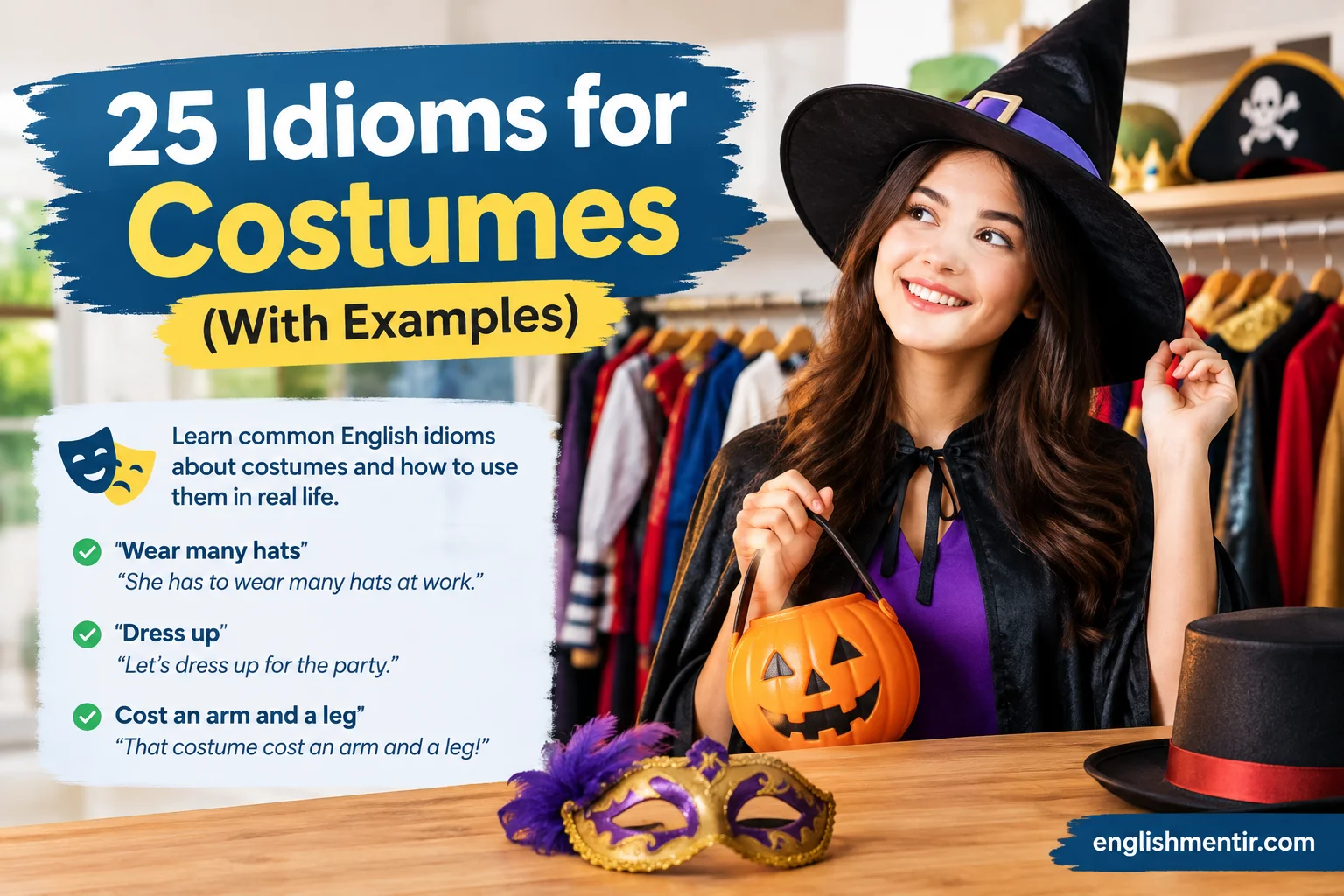
Explore 25 Idioms for Costumes (With Examples) and discover fun, clever costume ideas with simple meanings for Halloween, parties, and more!
25 Idioms for Costumes (With Examples) turns a costume party into a chance to express myself creatively through English idioms. An outfit becomes a secret wardrobe for language, helping you dress up your speech with color, humor, and personality. The perfect costume and right idiom can make a conversation unforgettable. These phrases have meanings beyond their individual words, while cultural nuance, emotion, and native speaker usage help learners understand them. Costumes, dressing up, and disguises can describe appearances, personalities, and deception in playful ways. Lisa, for example, wore a sparkly superhero costume to an office party, where her colleague said she was wearing her heart on her sleeve tonight. This simple idiom described her costume and her open, cheerful personality, creating vivid and expressive moments.
The ultimate answer for Halloween costumes is to visualize an idiom’s literal meaning. A cloud dropping stuffed animals can represent It’s Raining Cats and Dogs, making a clever, pun-filled costume that encourages people to laugh without a degree in linguistics. With 25 ideas compiled, real magic comes from turning a common saying into a wearable joke instead of choosing generic, store-bought ghosts. A Tough Cookie costume with boxing gloves and a giant cookie head can suit a costume contest, while the rain phrase is likely originated in 17th-century England and has a grim history involving heavy storms, dead animals, and streets; the costume itself can still be hilarious and educational. A boring outfit can become a walking dictionary through idiom costumes that bridge the gap between intelligence and absurdity. These fun, punny idiom costume ideas work for Halloween costume party ideas, work appropriate Halloween costumes, school spirit day, dress up days, spirit week ideas, book club ideas, a classroom party, teaching idioms, funny dress up themes, group costumes, bestie outfits, couples dress-up, parties, a solo punster, or a group theme.
What Are Idioms for Costumes?
Idioms for costumes are familiar expressions that can describe dressing up, appearances, disguises, clothing, transformation, or putting on a particular look. Some are directly connected with clothing, while others are commonly used when someone changes their appearance or presents themselves in a certain way.
For example, “dressed to kill” means dressed in a very attractive or impressive way. Meanwhile, “wear many hats” describes someone who has several roles or responsibilities.
These expressions work especially well when discussing Halloween costumes, theatrical characters, fancy-dress events, parties, fashion, and creative outfits.
1. Dressed to Kill
Meaning:
“Dressed to kill” means wearing clothes or a costume that looks extremely stylish, attractive, impressive, or glamorous.
In a Sentence:
Maya arrived at the costume party dressed to kill, wearing an elegant vintage outfit.
Other Ways to Say:
- Dressed to impress
- Looking glamorous
- Looking stunning
- Wearing an eye-catching outfit
This idiom is useful when someone’s costume immediately grabs attention. It can describe a glamorous Halloween outfit, a dramatic party costume, or even a polished formal look.
2. Dress to Impress
Meaning:
“Dress to impress” means choosing an outfit specifically to make a strong and positive impression on other people.
In a Sentence:
Everyone decided to dress to impress for the masquerade ball.
Other Ways to Say:
- Look your best
- Make an impression
- Dress smartly
- Put your best look forward
This expression works well when the goal is to look particularly polished, stylish, or memorable.
3. In Disguise
Meaning:
Being “in disguise” means changing your appearance so that people do not recognize who you really are.
In a Sentence:
The actor walked through the crowd in disguise as an old-fashioned detective.
Other Ways to Say:
- Hidden behind a costume
- Disguised
- Incognito
- In character
This is one of the most useful expressions for Halloween costumes, mystery parties, theater, and masquerades.
4. Wear Many Hats
Meaning:
“Wear many hats” means to have several different roles, duties, or responsibilities.
In a Sentence:
At the theater, Sarah wears many hats because she helps with costumes, makeup, and stage design.
Other Ways to Say:
- Have many roles
- Handle several responsibilities
- Do several jobs
- Take on different roles
Although this idiom isn’t literally about costumes, the word “hats” creates a strong connection to clothing and character roles.
5. Put on a Show
Meaning:
“Put on a show” means to create a performance or spectacle designed to entertain or attract attention.
In a Sentence:
The dancers put on a fantastic show while wearing colorful carnival costumes.
Other Ways to Say:
- Give a performance
- Entertain the crowd
- Create a spectacle
- Perform
This expression fits beautifully when costumes are part of a performance, celebration, parade, or theatrical event.
6. Put on an Act
Meaning:
“Put on an act” means to pretend to behave in a particular way, often to create a certain impression.
In a Sentence:
He put on an act and pretended to be a mysterious magician at the party.
Other Ways to Say:
- Pretend
- Play a role
- Act
- Put on a performance
Costumes often allow people to step into different personalities, so this expression can describe the behavior behind a costume as well as the clothing itself.
7. Dress Up
Meaning:
“Dress up” means to wear special, formal, unusual, or costume clothing, rather than everyday clothes.
In a Sentence:
The children love to dress up as superheroes during Halloween.
Other Ways to Say:
- Put on a costume
- Get dressed up
- Wear fancy clothes
- Suit up
This is one of the most common expressions connected with costumes and special occasions.
8. Suit Up
Meaning:
“Suit up” means to put on a suit, special outfit, uniform, or particular type of clothing.
In a Sentence:
The actors suited up in their historical costumes before the performance.
Other Ways to Say:
- Get dressed
- Put on your outfit
- Get ready
- Put on your costume
The phrase can sound energetic and confident, making it useful when describing someone preparing for an event, performance, or themed party.
9. Fit the Bill
Meaning:
“Fit the bill” means to be exactly suitable for a particular purpose or requirement.
In a Sentence:
The old black cape fit the bill perfectly for my mysterious vampire costume.
Other Ways to Say:
- Be suitable
- Be perfect for the job
- Meet the requirements
- Be just right
When choosing a costume, this idiom helps explain why a particular outfit works so well for the character or occasion.
Read More: 25 Idioms for Cleaning (With Examples)
10. The Whole Nine Yards
Meaning:
“The whole nine yards” means doing or providing everything possible, rather than stopping halfway.
In a Sentence:
For the Halloween party, Jake went the whole nine yards with a costume, makeup, props, and special effects.
Other Ways to Say:
- Go all out
- Do everything
- Give it your all
- Include every detail
This expression is especially useful when someone creates a detailed and elaborate costume.
11. Go All Out
Meaning:
“Go all out” means to put in maximum effort and make something as impressive as possible.
In a Sentence:
We went all out with our costumes for the annual Halloween competition.
Other Ways to Say:
- Give it everything
- Pull out all the stops
- Make a big effort
- Go the extra mile
If someone spends time choosing accessories, makeup, props, and hairstyles, “go all out” perfectly describes that effort.
12. Pull Out All the Stops
Meaning:
“Pull out all the stops” means using every available effort or resource to make something impressive.
In a Sentence:
The costume designer pulled out all the stops to create the queen’s elaborate gown.
Other Ways to Say:
- Go all out
- Use every resource
- Make a huge effort
- Do everything possible
This idiom is excellent for describing professional costumes, theater productions, festivals, and elaborate events.
13. Put Your Best Foot Forward
Meaning:
“Put your best foot forward” means presenting yourself in the best possible way.
In a Sentence:
She wore her most creative costume to put her best foot forward at the competition.
Other Ways to Say:
- Make a good impression
- Show your best side
- Present yourself well
- Make your strongest effort
Although the expression isn’t specifically about clothing, it works naturally when someone’s appearance is important.
14. A Wolf in Sheep’s Clothing
Meaning:
“A wolf in sheep’s clothing” describes someone who appears harmless or friendly but may actually have bad intentions.
In a Sentence:
The villain entered the party dressed as a friendly farmer, proving to be a wolf in sheep’s clothing.
Other Ways to Say:
- Hidden danger
- Someone who hides their true nature
- A deceptive person
- A disguised threat
This classic idiom works particularly well in costume stories, mystery plots, and dramatic writing.
15. Clothes Make the Man
Meaning:
“Clothes make the man” expresses the idea that appearance and clothing can influence how people perceive someone.
In a Sentence:
After putting on the royal costume, he looked completely different—clothes make the man.
Other Ways to Say:
- Appearance affects perception
- Dress for the role
- Clothing shapes impressions
- Look the part
The expression reminds us that clothing can change how a person feels and how others respond to them.
16. Look the Part
Meaning:
“Look the part” means to have the appearance expected for a particular role, character, or situation.
In a Sentence:
With the crown, robe, and jeweled necklace, she really looked the part of a medieval queen.
Other Ways to Say:
- Look appropriate
- Appear suitable
- Match the role
- Dress appropriately
This is one of the best expressions for describing whether a costume successfully captures a specific character.
17. Play the Part
Meaning:
“Play the part” means to act like a particular character or fulfill a specific role.
In a Sentence:
He wore a pirate costume and confidently played the part throughout the evening.
Other Ways to Say:
- Act the role
- Perform as a character
- Take on a role
- Act in character
A great costume becomes even more convincing when the person wearing it plays the part naturally.
18. In the Same Boat
Meaning:
“In the same boat” means being in the same situation or facing the same problem.
In a Sentence:
We were all in the same boat when the costume contest was moved indoors because of the rain.
Other Ways to Say:
- In the same situation
- Facing the same challenge
- In the same position
- Dealing with the same problem
This isn’t a costume-specific idiom, but it can be useful when discussing a group preparing costumes or dealing with an event-related situation.
19. Change Your Stripes
Meaning:
“Change your stripes” means to change your usual behavior, character, or habits.
In a Sentence:
For the costume party, Liam changed his stripes and dressed as a cheerful clown instead of his usual serious character.
Other Ways to Say:
- Change your ways
- Act differently
- Try something new
- Adopt a different personality
Costumes often give people permission to experiment with a completely different side of themselves, which makes this expression especially interesting in creative writing.
20. Put on a New Face
Meaning:
“Put on a new face” means to present yourself differently or adopt a different appearance or attitude.
In a Sentence:
With her dramatic makeup and costume, she put on a new face for the theater performance.
Other Ways to Say:
- Change your appearance
- Take on a new identity
- Present yourself differently
- Transform your look
This expression works well when a costume creates a visible transformation and helps someone step into a new character.
How to Use Costume Idioms Naturally
Using idioms effectively isn’t about adding as many expressions as possible. The goal is to choose the phrase that matches the situation and tone.
For a glamorous outfit, “dressed to kill” or “dress to impress” may work best. If someone is pretending to be another person, “in disguise” is more natural. For an elaborate costume, “go all out” or “pull out all the stops” can show how much effort went into the look.
You can also combine an idiom with a clear description. For example:
Sarah went all out for Halloween, wearing a handmade dragon costume complete with wings, scales, and glowing eyes.
This approach gives your writing both personality and clarity.
Quick Guide to Costume Idioms
| Idiom | Main Idea |
| Dressed to kill | Looking extremely stylish |
| Dress to impress | Dressing to make a strong impression |
| In disguise | Hiding your identity |
| Wear many hats | Having multiple roles |
| Put on a show | Give an entertaining performance |
| Put on an act | Pretend or perform |
| Dress up | Wear special or fancy clothing |
| Suit up | Put on a special outfit |
| Fit the bill | Be suitable |
| The whole nine yards | Do everything possible |
| Go all out | Make maximum effort |
| Pull out all the stops | Use every available effort |
| Put your best foot forward | Make a strong impression |
| A wolf in sheep’s clothing | Hide a harmful nature behind a harmless appearance |
| Clothes make the man | Appearance affects perception |
| Look the part | Appear suitable for a role |
| Play the part | Act as a character |
| In the same boat | Share the same situation |
| Change your stripes | Change your usual behavior |
| Put on a new face | Adopt a different appearance or identity |
Exercise to Practice
Test your understanding of these costume-related idioms with the following 15 multiple-choice questions.
1. What does “dressed to kill” mean?
A. Wearing old clothes
B. Looking extremely stylish or attractive
C. Wearing a uniform
D. Getting ready for bed
2. Which idiom means hiding your true identity?
A. Go all out
B. Fit the bill
C. In disguise
D. Wear many hats
3. What does “dress to impress” mean?
A. Dress casually
B. Dress to make a strong impression
C. Wear a costume from history
D. Change clothes quickly
4. Which expression means taking on several different roles?
A. Play the part
B. Look the part
C. Wear many hats
D. Put on an act
5. If someone “goes all out” on a costume, what do they do?
A. Choose the simplest outfit
B. Avoid accessories
C. Make a maximum effort
D. Wear everyday clothes
6. What does “fit the bill” mean?
A. Cost a lot of money
B. Be suitable for a particular purpose
C. Be too large
D. Be uncomfortable
7. Which idiom describes someone who looks suitable for a particular role?
A. Look the part
B. In the same boat
C. Change your stripes
D. Put on a show
8. What does “play the part” mean?
A. Change your clothes
B. Act like a particular character
C. Design a costume
D. Buy an outfit
9. Which expression means using every possible effort?
A. Dress up
B. Put on an act
C. Pull out all the stops
D. In disguise
10. What does “the whole nine yards” suggest?
A. Doing very little
B. Doing everything possible
C. Wearing formal clothes
D. Changing identities
11. What does “put your best foot forward” mean?
A. Walk quickly
B. Present yourself in the best possible way
C. Wear shoes with costumes
D. Dance at a party
12. Which idiom describes someone who appears harmless but may be dangerous?
A. Dress to impress
B. A wolf in sheep’s clothing
C. Suit up
D. Look the part
13. What does “change your stripes” mean?
A. Change the color of your costume
B. Change your usual behavior or ways
C. Buy striped clothing
D. Remove a costume
14. Which phrase means to pretend or behave differently for an audience?
A. Fit the bill
B. Put on an act
C. Wear many hats
D. In the same boat
15. What does “put on a new face” suggest?
A. Wash your face
B. Buy makeup
C. Adopt a different appearance or identity
D. Remove a costume
Answers
- B — Looking extremely stylish or attractive
- C — In disguise
- B — Dress to make a strong impression
- C — Wear many hats
- C — Make a maximum effort
- B — Be suitable for a particular purpose
- A — Look the part
- B — Act like a particular character
- C — Pull out all the stops
- B — Doing everything possible
- B — Present yourself in the best possible way
- B — A wolf in sheep’s clothing
- B — Change your usual behavior or ways
- B — Put on an act
- C — Adopt a different appearance or identity
FAQs
1. What are costume idioms?
Costume idioms are common expressions connected with dressing, appearance, disguises, or clothing that often have a meaning beyond their literal words.
2. How can I use idioms as costume ideas?
You can turn an idiom into a visual costume by showing its literal meaning. This creates a fun and creative Halloween costume.
3. What does “wearing your heart on your sleeve” mean?
It means showing your feelings or emotions openly instead of hiding them.
4. What is “It’s Raining Cats and Dogs”?
It’s Raining Cats and Dogs is an idiom that means it is raining very heavily. It can also inspire a creative costume idea.
5. Why are idiom costumes useful for learners?
Idiom costumes can make English learning more enjoyable by connecting vocabulary, visual ideas, humor, and real-life language use.
Conclusion
Learning 25 Idioms for Costumes (With Examples) can make English more colorful and memorable. Turning an idiom into a costume helps learners understand both its literal meaning and its figurative use.
These ideas can also add humor to Halloween parties, classroom activities, group costumes, and other dress-up events. Practicing the expressions in simple conversations can help build vocabulary and confidence.










1 thought on “25 Idioms for Costumes (With Examples)”