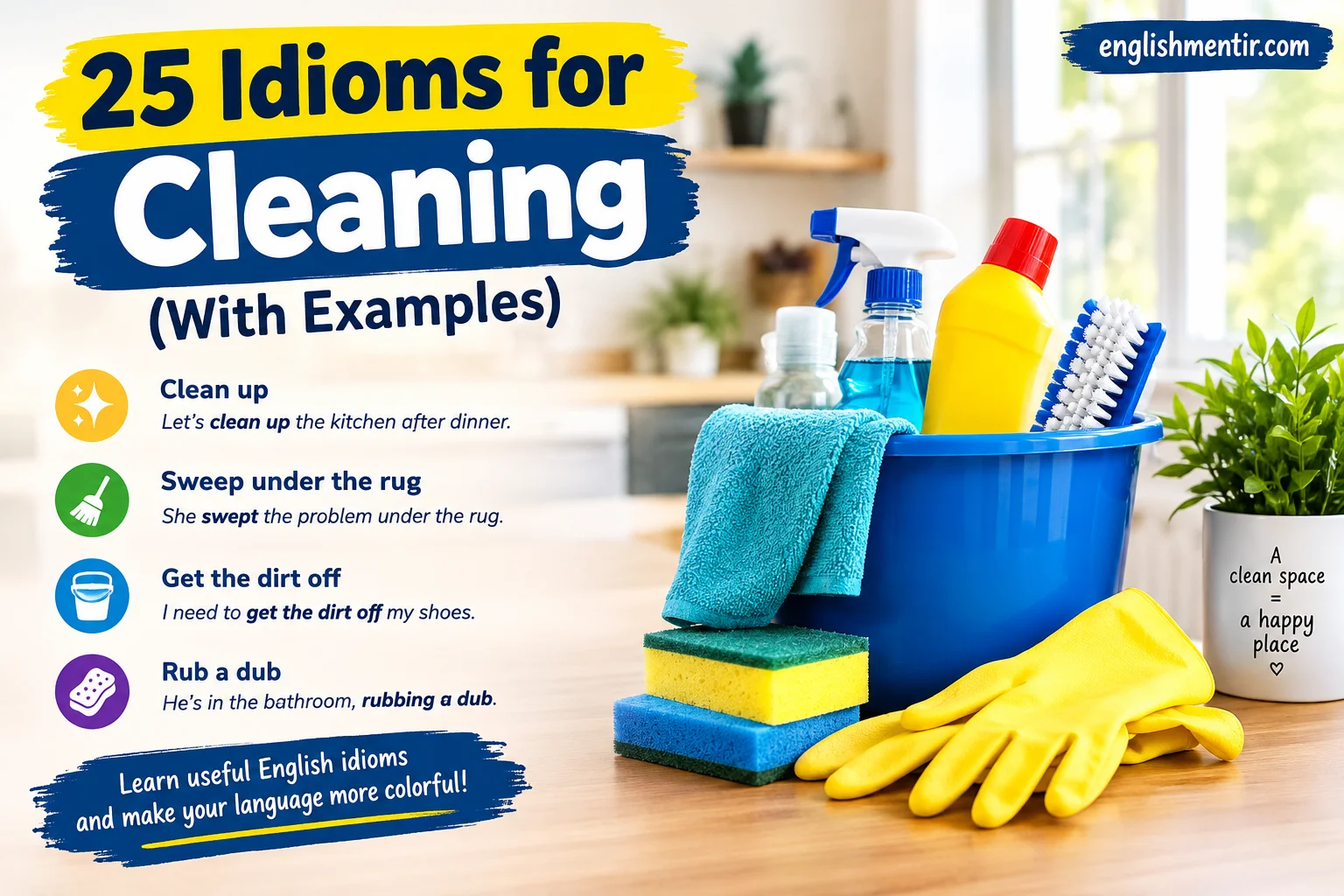
Discover 25 Idioms for Cleaning (With Examples), with simple meanings and fun examples to make everyday English easier and more memorable today!
Across languages, clean idioms can make ordinary actions feel dramatic, funny, or poetic. For English speakers, these idioms are a treasure trove of meaning and humor. Cleaning up your act describes improving behavior, while sweep it under the rug means avoiding a problem rather than literally hiding something beneath a rug. Such expressions make speech more colorful, memorable, and natural, helping us describe actions in creative ways. In my experience, scrubbing away is a useful image for working hard, especially when cleaning becomes a big job in the kitchen.
Consider Sarah, a new office worker who feels overwhelmed by messy paperwork. Her colleague might warn her not to sweep it under the rug, while sliding papers aside or searching for keys creates a literal cleaning scene. For learners, studying these expressions is an opportunity for fun, understanding, and better real-life English. It also connects culture, conversations, vocabulary, and becoming more fluent. A metaphorical mop can help us dive into how an idiom moves from cleanliness and purity to a literal sense and a metaphorical meaning. The origins and story of each phrase may also show links to morality, health, orderliness, and other aspects of life, making the language relatable and useful.
1. Clean Up Your Act
Meaning:
To improve your behavior or correct habits that are causing problems.
In a Sentence:
After missing several deadlines, Jake knew he needed to clean up his act at work.
Other Ways to Say:
- Improve your behavior
- Get your act together
- Straighten yourself out
2. Clean as a Whistle
Meaning:
Something is extremely clean, neat, or spotless.
In a Sentence:
After spending the entire morning scrubbing, the kitchen was clean as a whistle.
Other Ways to Say:
- Spotless
- Immaculately clean
- Neat and tidy
3. Sweep Under the Rug
Meaning:
To hide or ignore a problem instead of dealing with it properly.
In a Sentence:
You can’t sweep the disagreement under the rug forever.
Other Ways to Say:
- Ignore the problem
- Hide the issue
- Avoid dealing with it
4. Sweep Something Away
Meaning:
To remove or eliminate something, especially a problem, feeling, or obstacle.
In a Sentence:
A fresh start helped her sweep away the doubts that had been holding her back.
Other Ways to Say:
- Get rid of
- Remove
- Clear away
5. Wipe the Slate Clean
Meaning:
To forget past mistakes or disagreements and start again.
In a Sentence:
They decided to wipe the slate clean and rebuild their friendship.
Other Ways to Say:
- Start fresh
- Make a new beginning
- Put the past behind you
6. Wash Your Hands of Something
Meaning:
To stop being involved with a person, problem, or situation.
In a Sentence:
After several failed attempts to help, Maria decided to wash her hands of the dispute.
Other Ways to Say:
- Walk away
- Disengage
- Stop getting involved
7. Wash Your Hands
Meaning:
To take responsibility for cleaning your hands, although the expression can also relate to hygiene and preparation.
In a Sentence:
Please wash your hands before preparing the food.
Other Ways to Say:
- Clean your hands
- Rinse your hands
- Wash up
8. Wash Away
Meaning:
To remove something with water or figuratively make an unpleasant feeling or experience disappear.
In a Sentence:
The heavy rain washed away the dirt from the sidewalk.
Other Ways to Say:
- Rinse away
- Remove
- Clear away
9. Wash Out
Meaning:
To clean something by washing it, or to remove a substance through washing.
In a Sentence:
She managed to wash out the coffee stain from her shirt.
Other Ways to Say:
- Rinse out
- Clean
- Remove
10. Scrub Up
Meaning:
To clean yourself thoroughly, especially before eating, working, or entering a particular place.
In a Sentence:
The children were told to scrub up before dinner.
Other Ways to Say:
- Wash thoroughly
- Clean yourself
- Freshen up
11. Spick and Span
Meaning:
Something that is very clean, neat, and well organized.
In a Sentence:
The hotel room was spick and span when we arrived.
Other Ways to Say:
- Spotless
- Neat and tidy
- Perfectly clean
Read More: 25 Idioms for Business (With Examples)
12. Put Your House in Order
Meaning:
To organize your life, affairs, or surroundings and deal with unfinished matters.
In a Sentence:
Before starting the new project, he decided to put his house in order.
Other Ways to Say:
- Get organized
- Sort things out
- Get things under control
13. Clear the Air
Meaning:
To remove tension or misunderstandings by openly discussing a problem.
In a Sentence:
We had an honest conversation to clear the air after the argument.
Other Ways to Say:
- Resolve the tension
- Talk things through
- Set the record straight
14. Clear Out
Meaning:
To remove unwanted things from a place or leave an area.
In a Sentence:
We spent Saturday clearing out the garage.
Other Ways to Say:
- Empty
- Declutter
- Remove unwanted items
15. Clear the Decks
Meaning:
To remove unnecessary tasks or obstacles so you can focus on something important.
In a Sentence:
I’m going to clear the decks this afternoon so I can finish the report.
Other Ways to Say:
- Get organized
- Remove distractions
- Make room
16. Get Rid of the Clutter
Meaning:
To remove unnecessary objects or mess from a space.
In a Sentence:
I’m trying to get rid of the clutter on my desk.
Other Ways to Say:
- Declutter
- Clear out
- Remove unnecessary things
17. Tidying Up
Meaning:
To make a place neat and organized by putting things where they belong.
In a Sentence:
I’ll spend an hour tidying up before our guests arrive.
Other Ways to Say:
- Straighten up
- Organize
- Put things away
18. Straighten Up
Meaning:
To make a room or area neat by arranging or putting things in their proper places.
In a Sentence:
Could you straighten up the living room before dinner?
Other Ways to Say:
- Tidy up
- Neaten
- Organize
19. Make a Clean Sweep
Meaning:
To remove everything unwanted from a place or completely change a situation.
In a Sentence:
The new manager made a clean sweep of the outdated files.
Other Ways to Say:
- Clear everything out
- Start over
- Remove what isn’t needed
20. Clean House
Meaning:
To remove unwanted people or things from an organization, place, or situation.
In a Sentence:
The new director promised to clean house and replace outdated procedures.
Other Ways to Say:
- Make major changes
- Remove what doesn’t work
- Start fresh
21. Dust Off
Meaning:
To clean dust from something, or to bring an old skill, idea, or item back into use.
In a Sentence:
I decided to dust off my old recipe book and try a classic dish.
Other Ways to Say:
- Clean up
- Bring back
- Use again
22. Air Out
Meaning:
To let fresh air into a room or openly discuss something that has been bothering people.
In a Sentence:
Let’s air out the room before the guests arrive.
Other Ways to Say:
- Ventilate
- Freshen
- Discuss openly
23. Polish Up
Meaning:
To clean, improve, or refine something until it looks or sounds better.
In a Sentence:
She spent the evening polishing up her presentation.
Other Ways to Say:
- Improve
- Refine
- Perfect
24. Give Something a Good Scrub
Meaning:
To clean something thoroughly, usually by rubbing it with soap, water, or a cleaning product.
In a Sentence:
The old bathtub needs a good scrub before the weekend.
Other Ways to Say:
- Clean thoroughly
- Scrub thoroughly
- Deep-clean
25. Deep Clean
Meaning:
To clean a place very thoroughly, including areas that don’t receive regular attention.
In a Sentence:
We decided to deep clean the kitchen before the holidays.
Other Ways to Say:
- Clean thoroughly
- Do a detailed cleaning
- Give everything a thorough clean
Exercise to Practice
Test your understanding of these 25 cleaning idioms with the following multiple-choice questions.
1. What does “clean as a whistle” mean?
A. Very noisy
B. Extremely clean
C. Slightly dirty
D. Very expensive
2. What does “sweep something under the rug” mean?
A. Clean the floor
B. Move furniture
C. Hide or ignore a problem
D. Repair something
3. If you “wipe the slate clean,” you:
A. Clean a table
B. Start fresh
C. Paint a wall
D. Wash your hands
4. What does “wash your hands of something” mean?
A. Wash before eating
B. Stop being involved
C. Clean a room
D. Help someone
5. What does “spick and span” describe?
A. A broken object
B. A crowded place
C. Something very clean and neat
D. An old building
6. If you “put your house in order,” you:
A. Sell your house
B. Paint your house
C. Organize your affairs
D. Move to another city
7. What does “clear the air” mean?
A. Open a window
B. Resolve tension or misunderstandings
C. Clean the floor
D. Turn on a fan
8. What does “clear out” mean?
A. Decorate
B. Repair
C. Remove unwanted things
D. Add more items
9. If you “clear the decks,” you:
A. Clean a ship
B. Remove obstacles and prepare to focus
C. Go shopping
D. Take a vacation
10. What does “straighten up” mean?
A. Sit down
B. Make something neat
C. Break something
D. Replace something
11. What does “make a clean sweep” suggest?
A. Make a small change
B. Remove everything unwanted
C. Wash a floor
D. Buy cleaning supplies
12. What does “clean house” mean figuratively?
A. Build a house
B. Wash windows
C. Remove unwanted people or things
D. Move furniture
13. What does “dust off” mean figuratively?
A. Forget something
B. Bring an old thing or skill back into use
C. Throw something away
D. Hide something
14. What does “polish up” mean?
A. Damage something
B. Improve or refine something
C. Forget something
D. Remove something
15. What does “deep clean” mean?
A. Quick cleaning
B. Light dusting
C. Very thorough cleaning
D. Decorating a room
Answers
- B — Extremely clean
- C — Hide or ignore a problem
- B — Start fresh
- B — Stop being involved
- C — Something very clean and neat
- C — Organize your affairs
- B — Resolve tension or misunderstandings
- C — Remove unwanted things
- B — Remove obstacles and prepare to focus
- B — Make something neat
- B — Remove everything unwanted
- C — Remove unwanted people or things
- B — Bring an old thing or skill back into use
- B — Improve or refine something
- C — Very thorough cleaning
FAQs
1. What are cleaning idioms?
Cleaning idioms are expressions that use ideas related to cleaning, tidiness, or removing dirt to express other meanings.
2. What does “cleaning up your act” mean?
Cleaning up your act means improving your behavior or making positive changes in the way you act.
3. What does “sweep it under the rug” mean?
Sweep it under the rug means to hide, ignore, or avoid dealing with a problem instead of solving it.
4. Why should I learn cleaning idioms?
Learning cleaning idioms can improve your English vocabulary, make conversations more natural, and help you understand everyday expressions.
5. Are cleaning idioms used literally?
Not always. Many cleaning idioms have a metaphorical meaning, so their intended meaning can be different from the literal cleaning action.
Conclusion
Learning 25 Idioms for Cleaning (With Examples) can make everyday English more interesting and easier to understand. These expressions connect familiar cleaning actions with ideas about behavior, problems, order, and daily life.
By practicing each idiom with simple examples, learners can build useful vocabulary and feel more confident in real-life conversations.














1 thought on “25 Idioms for Cleaning (With Examples) ”