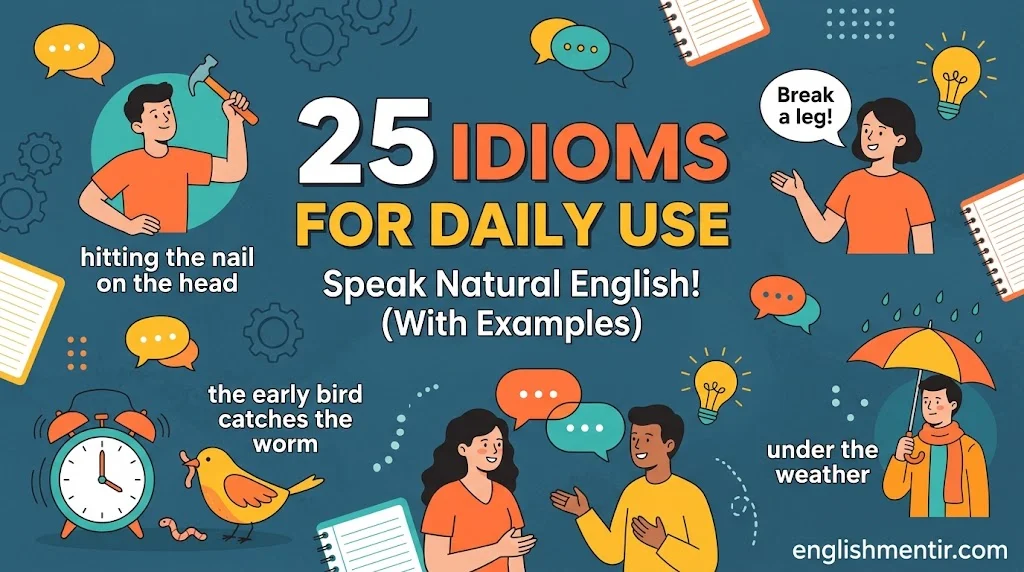
Idioms for daily use are an important part of everyday English communication. They help English learners, students, and professionals speak more naturally and confidently. In daily conversations, people often use idioms at home, in schools, at work, and while talking with friends. Learning these expressions makes it easier to understand native speakers and express your thoughts in a more interesting way.
Using common idioms can also improve your speaking, listening, and writing skills. Many expressions have meanings that are different from their actual words. For example, “hit the hay” means going to sleep, not hitting real hay. When you learn these phrases through books, movies, TV shows, and everyday conversations, you can better understand their meanings and use them correctly in different situations.
In this article, we will explore 25 idioms for daily use with examples to help you improve your English step by step. You will discover useful expressions for casual conversations, workplace communication, and everyday situations. Each idiom will help you express ideas more clearly, make your conversations more engaging, and build confidence when speaking English.
1. A Piece of Cake
Meaning: Something that is very easy to do.
In a Sentence: The English test was a piece of cake because I studied well.
Other Ways to Say: Very easy, simple task, no trouble.
2. Break the Ice
Meaning: To make people feel comfortable when they first meet.
In a Sentence: The teacher told a funny story to break the ice on the first day of class.
Other Ways to Say: Start a conversation, make people comfortable, get things going.
3. Hit the Nail on the Head
Meaning: To say or identify exactly the right thing.
In a Sentence: You hit the nail on the head when you said that communication was our main problem.
Other Ways to Say: Be exactly right, get it right, identify the real issue.
4. Once in a Blue Moon
Meaning: Something that happens very rarely.
In a Sentence: My cousins live abroad, so we meet once in a blue moon.
Other Ways to Say: Rarely, hardly ever, not often.
5. Better Late Than Never
Meaning: It is better to do something late than not do it at all.
In a Sentence: I finally started learning English at the age of thirty. Better late than never!
Other Ways to Say: Late is better than never, eventually get started, do it at last.
6. Under the Weather
Meaning: Feeling slightly sick or unwell.
In a Sentence: I am feeling under the weather, so I will rest at home today.
Other Ways to Say: Feeling unwell, feeling poorly, not feeling well.
7. Cost an Arm and a Leg
Meaning: To be extremely expensive.
In a Sentence: That new laptop costs an arm and a leg, so I am saving money before buying it.
Other Ways to Say: Very expensive, cost a fortune, be overpriced.
8. Spill the Beans
Meaning: To reveal a secret, sometimes accidentally.
In a Sentence: My sister spilled the beans about the surprise birthday party.
Other Ways to Say: Reveal a secret, let the secret out, give something away.
9. Call It a Day
Meaning: To stop working on something for the day.
In a Sentence: We have finished most of the project, so let us call it a day.
Other Ways to Say: Stop working, finish for today, wrap things up.
10. Get Out of Hand
Meaning: To become difficult to control.
In a Sentence: The discussion got out of hand when everyone started shouting.
Other Ways to Say: Become uncontrollable, get out of control, become chaotic.
11. Keep an Eye on
Meaning: To watch or look after someone or something carefully.
In a Sentence: Could you keep an eye on my bag while I buy some water?
Other Ways to Say: Watch carefully, look after, keep watch over.
12. On the Same Page
Meaning: To have the same understanding or agreement about something.
In a Sentence: Before starting the assignment, our group made sure we were on the same page.
Other Ways to Say: Agree, share the same understanding, be in agreement.
13. Burn the Midnight Oil
Meaning: To work or study late into the night.
In a Sentence: I had to burn the midnight oil to finish my assignment before the deadline.
Other Ways to Say: Work late, study late, stay up working.
14. The Ball Is in Your Court
Meaning: It is your turn to take action or make a decision.
In a Sentence: I have shared my suggestions, so the ball is in your court now.
Other Ways to Say: It is your decision, your turn to act, the next move is yours.
15. Let the Cat Out of the Bag
Meaning: To reveal a secret that was supposed to remain hidden.
In a Sentence: Ahmed let the cat out of the bag when he told everyone about the wedding plans.
Other Ways to Say: Reveal the secret, disclose the news, give away the surprise.
16. Pull Someone’s Leg
Meaning: To joke with someone by making them believe something that is not true.
In a Sentence: Do not worry about the missing homework; I am just pulling your leg.
Other Ways to Say: Tease someone, joke around, play a harmless trick.
17. Hang in There
Meaning: To remain patient and keep trying during a difficult time.
In a Sentence: I know your exams are stressful, but hang in there and keep doing your best.
Other Ways to Say: Keep going, stay strong, do not give up.
18. A Blessing in Disguise
Meaning: Something that seems bad at first but later brings a positive result.
In a Sentence: Missing that bus was a blessing in disguise because I met an old friend while waiting for the next one.
Other Ways to Say: Unexpected benefit, hidden advantage, something good in a bad situation.
19. Add Fuel to the Fire
Meaning: To make a bad situation or argument even worse.
In a Sentence: Blaming everyone else will only add fuel to the fire.
Other Ways to Say: Make things worse, increase tension, worsen the situation.
20. Actions Speak Louder Than Words
Meaning: What people do matters more than what they say.
In a Sentence: He promised to help his neighbors and actually showed up to work. Actions speak louder than words.
Other Ways to Say: Deeds matter more than promises, prove it through actions, show rather than tell.
21. In Hot Water
Meaning: To be in trouble because of something you have done.
In a Sentence: Sara was in hot water after forgetting to submit her assignment.
Other Ways to Say: In trouble, in a difficult situation, facing consequences.
22. Learn the Ropes
Meaning: To learn how to do a job or activity.
In a Sentence: It took me a few weeks to learn the ropes at my new job.
Other Ways to Say: Learn the basics, get familiar with a task, understand how things work.
23. Keep Your Fingers Crossed
Meaning: To hope that something good will happen.
In a Sentence: I have an interview tomorrow, so keep your fingers crossed for me.
Other Ways to Say: Wish me luck, hope for the best, stay hopeful.
24. Make a Long Story Short
Meaning: To explain something briefly without sharing every detail.
In a Sentence: To make a long story short, we missed the train but arrived at the meeting on time.
Other Ways to Say: Briefly, in short, to sum it up.
25. Every Cloud Has a Silver Lining
Meaning: Even a difficult situation may have something positive in it.
In a Sentence: Losing that competition helped me understand my weaknesses. Every cloud has a silver lining.
Other Ways to Say: There is hope in every difficulty, look for the positive, something good can come from hardship.
Exercise to Practice: 15 Multiple-Choice Questions
Choose the correct answer for each question to test your understanding of everyday English idioms.
1. What does “a piece of cake” mean?
A. Very expensive B. Very easy C. Very confusing D. Very rare
2. Which idiom means making people comfortable when they first meet?
A. Spill the beans B. Call it a day C. Break the ice D. Burn the midnight oil
3. If something happens “once in a blue moon,” it happens…
A. Every day B. Very quickly C. Very rarely D. At night
4. What does “under the weather” mean?
A. Feeling unwell B. Feeling excited C. Being outdoors D. Feeling sleepy after a party
5. If a phone costs an arm and a leg, it is…
A. Broken B. Very cheap C. Very expensive D. Free
6. What does “spill the beans” mean?
A. Cook a meal B. Reveal a secret C. Make a mess D. Tell a funny story
7. When you “call it a day,” you…
A. Start a new job B. Take a test C. Stop working for the day D. Plan a holiday
8. What does “keep an eye on” mean?
A. Look after carefully B. Ignore completely C. Argue with someone D. Close your eyes
9. If a team is “on the same page,” its members…
A. Read the same book B. Have the same understanding C. Work in different places D. Disagree about everything
10. What does “burn the midnight oil” mean?
A. Waste electricity B. Cook late at night C. Work or study late D. Go to sleep early
11. When “the ball is in your court,” it is your turn to…
A. Play a sport B. Leave the room C. Make a decision or act D. Change the subject
12. What does “pull someone’s leg” mean?
A. Help someone walk B. Joke with someone C. Give someone advice D. Ask for money
13. Which idiom encourages someone not to give up?
A. Hang in there B. Get out of hand C. In hot water D. Let the cat out of the bag
14. What does “in hot water” mean?
A. Taking a warm bath B. Being in trouble C. Feeling comfortable D. Working hard
15. What does “every cloud has a silver lining” teach us?
A. Rain always brings sunshine B. Clouds are beautiful C. Difficult situations can have positive sides D. Problems never end
Answer Key
Correct Answers with Meanings
- B — Very easy
- C — Break the ice
- C — Very rarely
- A — Feeling unwell
- C — Very expensive
- B — Reveal a secret
- C — Stop working for the day
- A — Look after carefully
- B — Have the same understanding
- C — Work or study late
- C — Make a decision or act
- B — Joke with someone
- A — Hang in there
- B — Being in trouble
- C — Difficult situations can have positive sides
FAQs:
1. What are idioms for daily use?
Idioms for daily use are common expressions whose meanings are different from the literal meanings of their words. For example, a piece of cake means something is very easy.
2. Why should I learn everyday English idioms?
Learning everyday idioms helps you speak more naturally, understand conversations, improve listening skills, and express ideas in fewer words.
3. What is the easiest idiom to learn?
A piece of cake is an easy idiom to learn because it means something is simple or easy to complete.
4. How can I use idioms in daily conversations?
Learn each idiom’s meaning, read example sentences, and practice using it in a suitable situation. Avoid using idioms when you are unsure whether they fit the conversation.
5. How many idioms should I learn each day?
Start with two to five idioms a day. Practice their meanings and write your own examples before learning more.
Conclusion:
Learning 25 idioms for daily use can help you communicate more naturally in everyday situations. Expressions such as break the ice, hang in there, and actions speak louder than words make conversations more engaging and help you express your ideas clearly.
The best way to remember these idioms is to practice them in real conversations. Start with two or three expressions each day, write your own sentences, and notice how native English speakers use them. With regular practice, you can build your vocabulary, improve your confidence, and make your English sound more natural.