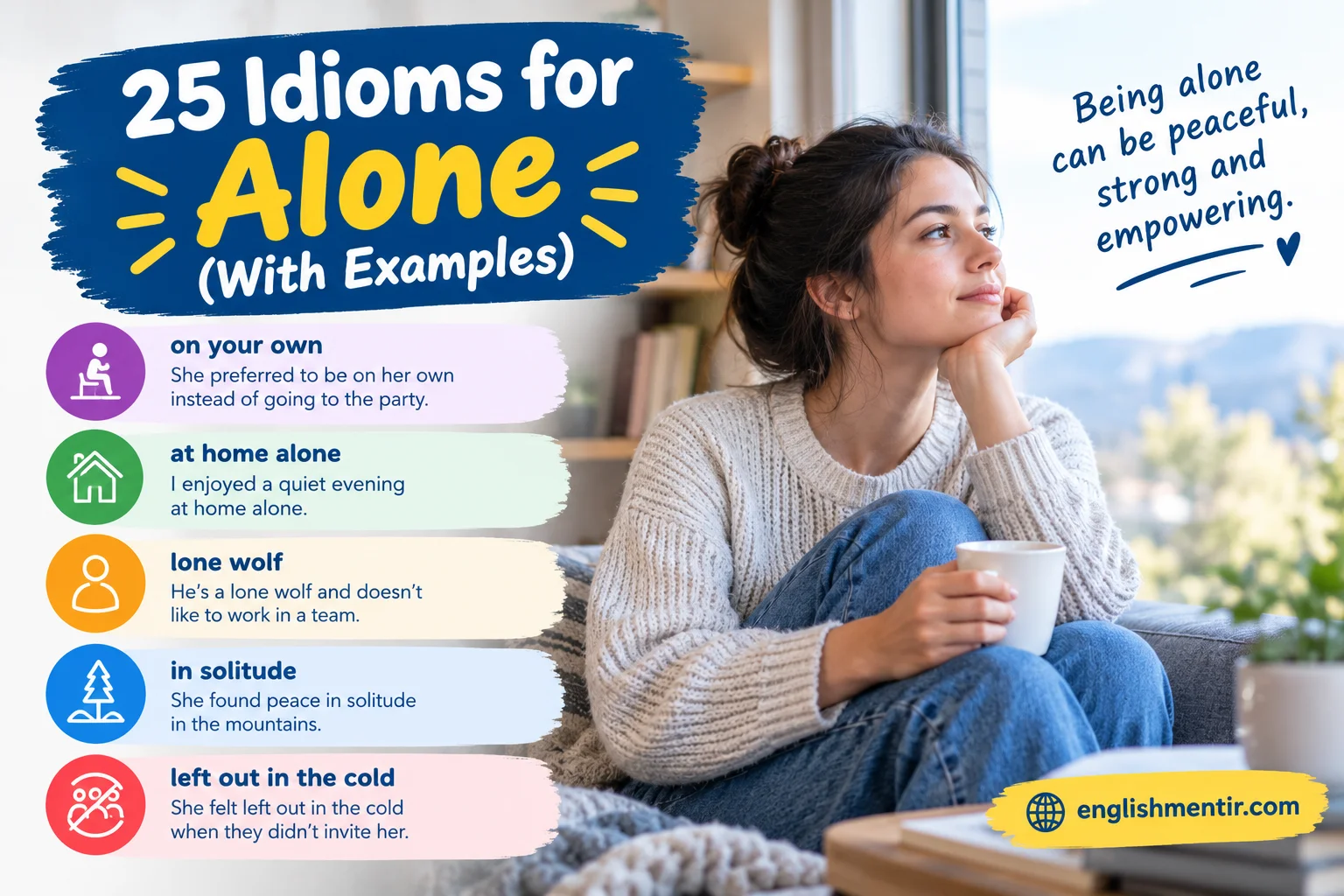
25 Idioms for Alone (With Examples) offer a rich, expressive way to describe solitude, independence, and feelings. Being by oneself is a universal human experience that may bring peace, self-discovery, or loneliness. These idioms help English speakers express such emotions in a more vivid and meaningful way.
Whether someone is on their own, enjoying a moment of solitude, or feeling disconnected from others, these expressions make communication more natural. In my experience, learning idioms related to being alone helps an English learner, student, or professional improve English vocabulary, grammar skills, and reading comprehension.
These valuable tools are useful in casual conversation, formal writing, business communication, meetings, workplace discussions, and storytelling. Learning to integrate them naturally, while understanding tone, formality, and US English and UK English preferences, can help you sound more natural and communicate with greater clarity.
1. On Your Own
Meaning: To be alone or independent, without help from another person.
In a Sentence: After moving to a new city, Maria learned how to live on her own.
Other Ways to Say: independently, by yourself, without help, alone
2. By Yourself
Meaning: To do something alone, without another person.
In a Sentence: I stayed by myself at home while everyone went to the party.
Other Ways to Say: alone, on your own, independently, solo
3. On One’s Own
Meaning: To manage something without assistance or companionship.
In a Sentence: He traveled across the country on his own and enjoyed the experience.
Other Ways to Say: independently, without assistance, alone, unaided
4. All Alone
Meaning: To be completely alone, often emphasizing the absence of others.
In a Sentence: The little boy felt all alone after his friends went home.
Other Ways to Say: completely alone, by yourself, isolated, solitary
5. Alone in the World
Meaning: To feel as if you have no one to depend on or share life with.
In a Sentence: After losing contact with his relatives, he felt alone in the world.
Other Ways to Say: without support, isolated, without companionship, lonely
6. Keep to Yourself
Meaning: To spend time alone and avoid becoming involved with other people.
In a Sentence: She usually keeps to herself and enjoys reading quietly after work.
Other Ways to Say: stay private, remain solitary, avoid socializing, stay by yourself
7. In Solitude
Meaning: To be alone in a peaceful or intentional way, often for reflection.
In a Sentence: He enjoys working in solitude because it helps him concentrate.
Other Ways to Say: alone, privately, in isolation, peacefully by yourself
8. In Your Own Company
Meaning: To be comfortable spending time alone.
In a Sentence: Sarah is happy in her own company and often spends weekends reading.
Other Ways to Say: enjoying solitude, being alone, enjoying your own time, being independent
9. A Lone Wolf
Meaning: A person who prefers to work or live independently rather than with a group.
In a Sentence: James is a lone wolf who prefers solving problems without a team.
Other Ways to Say: independent person, solitary person, individualist, self-reliant person
10. Go It Alone
Meaning: To do something without help or support from others.
In a Sentence: When his business partner left, David decided to go it alone.
Other Ways to Say: work independently, manage alone, act alone, do it yourself
11. Stand Alone
Meaning: To exist, work, or succeed independently of others.
In a Sentence: Her small business was strong enough to stand alone.
Other Ways to Say: operate independently, remain separate, function alone, be independent
12. Left to Your Own Devices
Meaning: To be left alone to make your own decisions or manage a situation yourself.
In a Sentence: When his parents were away, he was left to his own devices.
Other Ways to Say: left alone, allowed to decide, independent, without supervision
13. Out on Your Own
Meaning: To live or act independently without depending on others.
In a Sentence: After graduating, she moved abroad and was finally out on her own.
Other Ways to Say: independent, self-sufficient, living alone, by yourself
14. A World of Your Own
Meaning: To be deeply absorbed in your own thoughts, interests, or activities.
In a Sentence: He was sitting quietly in a world of his own, listening to music.
Other Ways to Say: lost in thought, absorbed, withdrawn, in your own space
15. By Your Lonesome
Meaning: To be completely alone, usually in an informal way.
In a Sentence: She traveled by her lonesome and discovered several beautiful places.
Other Ways to Say: alone, by yourself, solo, without company
16. Like a Hermit
Meaning: To live or behave like someone who spends much of their time away from other people.
In a Sentence: During the winter, he stayed home like a hermit and worked on his novel.
Other Ways to Say: live alone, withdraw, live privately, avoid social activity
17. Fly Solo
Meaning: To do something alone instead of relying on a partner or group.
In a Sentence: I decided to fly solo and attend the conference without my colleagues.
Other Ways to Say: go alone, work independently, act solo, manage by yourself
18. Go Your Own Way
Meaning: To choose an independent path instead of following other people.
In a Sentence: After college, she decided to go her own way and start a creative career.
Other Ways to Say: act independently, follow your own path, choose for yourself, be independent
19. Walk Alone
Meaning: To move through life or a situation without companionship or support.
In a Sentence: Sometimes, you have to walk alone before discovering the people who truly understand you.
Other Ways to Say: face life alone, move independently, stand by yourself, travel alone
20. Left in the Lurch
Meaning: To be left alone in a difficult situation without expected help.
In a Sentence: When his partner canceled at the last minute, he was left in the lurch.
Other Ways to Say: abandoned, left without help, unsupported, stranded
21. Left High and Dry
Meaning: To be left alone without help, support, or resources when you need them.
In a Sentence: The sudden cancellation left us high and dry with nowhere to stay.
Other Ways to Say: abandoned, unsupported, stranded, left helpless
22. On a Lonely Road
Meaning: To experience a difficult journey without much companionship or support.
In a Sentence: Building a new career can feel like being on a lonely road at times.
Other Ways to Say: facing a solitary journey, traveling alone, isolated path, difficult journey
23. In the Wilderness
Meaning: To be alone, separated, or without guidance, especially during a difficult period.
In a Sentence: Without anyone to guide her, she felt in the wilderness during her first year at the new job.
Other Ways to Say: without guidance, isolated, alone, without direction
24. A Solitary Figure
Meaning: A person who appears alone and separate from everyone else.
In a Sentence: He stood as a solitary figure near the window while the crowd celebrated.
Other Ways to Say: lone person, isolated individual, person alone, solitary person
25. March to the Beat of Your Own Drum
Meaning: To live or make choices independently, without simply following other people’s expectations.
In a Sentence: Emma likes to march to the beat of her own drum and choose her own style.
Other Ways to Say: be independent, think for yourself, follow your own path, do things your way
Exercise to Practice: 15 MCQs
Test your understanding of these idioms for alone by choosing the best answer.
1. What does “on your own” usually mean?
A. With a large group
B. Without help from others
C. In a noisy place
D. With your family
2. Which idiom describes someone who prefers to work independently?
A. Left high and dry
B. In the wilderness
C. A lone wolf
D. In a world of your own
3. If someone “flies solo,” what are they doing?
A. Traveling by airplane
B. Doing something alone
C. Avoiding work
D. Joining a team
4. What does “keep to yourself” mean?
A. Talk to everyone
B. Become a leader
C. Avoid much social interaction
D. Ask for help
5. Which phrase means being completely alone?
A. Go your own way
B. All alone
C. Stand alone
D. Own company
6. What does “go it alone” mean?
A. Stop working
B. Handle something without help
C. Follow a friend
D. Join a group
7. Someone who enjoys “their own company” is usually comfortable with:
A. Crowds
B. Competition
C. Solitude
D. Arguments
8. What does “left in the lurch” suggest?
A. Being carefully supported
B. Being left without expected help
C. Being invited somewhere
D. Being successful
9. Which idiom means living independently?
A. Out on your own
B. Left high and dry
C. Like a hermit
D. A solitary figure
10. What does “a world of your own” describe?
A. A busy workplace
B. A public event
C. Being absorbed in your own thoughts
D. A family gathering
11. Which phrase means choosing your own path?
A. Left in the lurch
B. By your lonesome
C. Go your own way
D. In solitude
12. What does “by your lonesome” mean?
A. With a partner
B. With your family
C. Alone
D. In a crowd
13. Someone who “marches to the beat of their own drum” usually:
A. Copies everyone else
B. Makes independent choices
C. Avoids making decisions
D. Follows strict instructions
14. What does “left high and dry” mean?
A. Given extra support
B. Left without assistance
C. Sent on vacation
D. Welcomed by friends
15. Which idiom best describes someone who enjoys peaceful time alone?
A. Left in the lurch
B. In solitude
C. Left high and dry
D. In the wilderness
Answers
- B — Without help from others
- C — A lone wolf
- B — Doing something alone
- C — Avoid much social interaction
- B — All alone
- B — Handle something without help
- C — Solitude
- B — Being left without expected help
- A — Out on your own
- C — Being absorbed in your own thoughts
- C — Go your own way
- C — Alone
- B — Makes independent choices
- B — Left without assistance
- B — In solitude
FAQs:
1. What are idioms for being alone?
Idioms for being alone are expressions that describe solitude, independence, loneliness, or isolation in a more natural and expressive way.
2. Why should I learn idioms for alone?
Learning these idioms can improve your English vocabulary, make your conversations more natural, and help you express feelings and situations with greater clarity.
3. Where can I use idioms for alone?
You can use them in casual conversations, formal writing, storytelling, workplace discussions, and everyday communication.
4. Are idioms for alone useful for English learners?
Yes. They help English learners understand common expressions, improve reading comprehension, and communicate more confidently in English.
5. Can these idioms describe both loneliness and independence?
Yes. Depending on the expression and context, they can describe loneliness, isolation, solitude, self-reliance, or the experience of being independent.
Conclusion:
Learning idioms for alone can make your English more expressive and natural. These phrases give you useful ways to talk about solitude, loneliness, independence, and feeling disconnected from others without always using simple or repetitive words.
Whether you are an English learner, student, or professional, practicing these expressions can improve your vocabulary, communication, and confidence. Using the right idiom in the right context can also make your writing and conversations more engaging and meaningful.