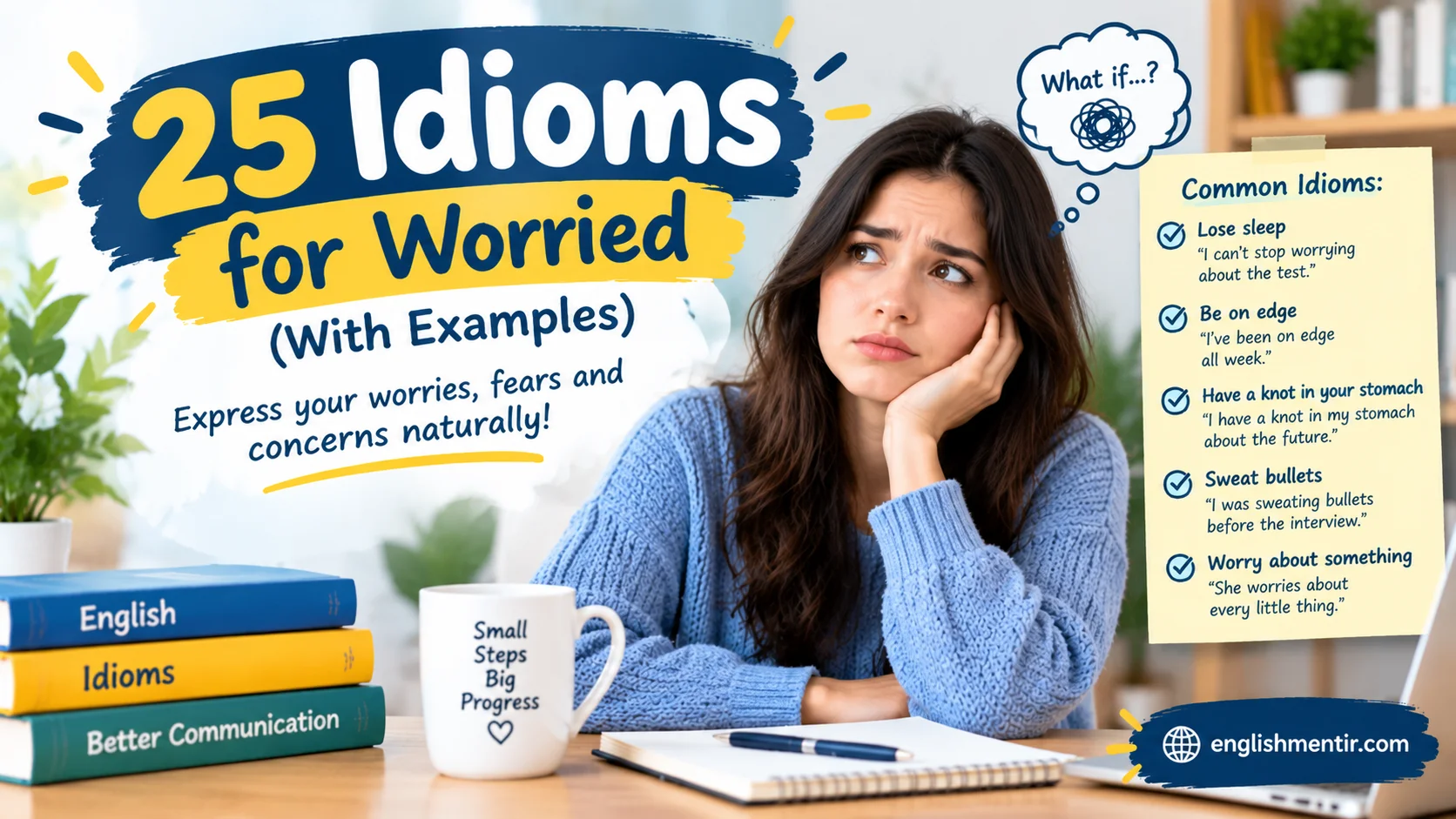
25 Idioms for Worried (With Examples) help English learners, students, and professionals find useful language for feeling worried at school, work, and in daily life. Worry is a human experience that everyone experiences time to time, and the right idioms for worried help people describe emotions clearly and naturally. Instead of saying, “I am worried,” these expressions help you express emotions in real conversations, writing, and speaking, especially when discussing stress, fear, doubt, uncertainty, or feeling anxious. They can also help you sound more fluent and understand native speakers.
English idioms add color, personality, and depth to everyday expressions. They can describe a moment of panic, constant uneasiness, nervousness, mild concern, or deep anxiety. Learning idioms for worry helps you express worry, describe feelings, and communicate emotions in a natural way. Whether you are comforting a friend or explaining feelings, the right words can show care and make communication warmer, clearer, and more personal. These alternative expressions also help you communicate better in different situations, such as an exam, job interview, or big presentation.
This guide includes 25 useful idioms for worried, with simple meanings and examples that are easy to remember. Practice exercises, a quiz, visuals, and infographics can help reinforce phrases and prevent common mistakes. In my experience, regular practice with these learning phrases can improve English speaking, writing, and fluency, while helping you communicate emotions, concern, and anxiety in a more expressive and practical way.
1. On Edge
Meaning:
To feel nervous, tense, or worried, as if something unpleasant might happen.
In a Sentence:
I have been on edge all morning because I am waiting for the interview results.
Other Ways to Say:
- Feel nervous
- Feel tense
- Be anxious
- Feel uneasy
2. Have Butterflies in Your Stomach
Meaning:
To feel nervous or worried, especially before an important event.
In a Sentence:
She had butterflies in her stomach before giving her presentation.
Other Ways to Say:
- Feel nervous
- Feel anxious
- Have nervous feelings
- Feel unsettled
3. Lose Sleep Over Something
Meaning:
To become so worried about something that it affects your sleep.
In a Sentence:
Don’t lose sleep over a small mistake at work.
Other Ways to Say:
- Worry about something
- Be troubled by something
- Stress over something
- Think about something constantly
4. Have a Lot on Your Mind
Meaning:
To have many problems, responsibilities, or worries occupying your thoughts.
In a Sentence:
I have a lot on my mind because my family is moving next month.
Other Ways to Say:
- Have many concerns
- Feel mentally overwhelmed
- Have many things to think about
- Be preoccupied
5. Sweat Bullets
Meaning:
To feel extremely nervous or worried about a situation.
In a Sentence:
I was sweating bullets while waiting for the doctor to call.
Other Ways to Say:
- Be extremely nervous
- Be very anxious
- Panic
- Feel terrified
6. Walk on Eggshells
Meaning:
To behave very carefully because you are worried about upsetting someone.
In a Sentence:
Everyone was walking on eggshells around him after the argument.
Other Ways to Say:
- Be extremely careful
- Tread carefully
- Avoid upsetting someone
- Feel uncomfortable
7. Have a Pit in Your Stomach
Meaning:
To have a strong feeling of worry, fear, or dread.
In a Sentence:
I had a pit in my stomach when I saw the missed calls from the hospital.
Other Ways to Say:
- Feel worried
- Feel dread
- Feel uneasy
- Have a sinking feeling
8. Have a Sinking Feeling
Meaning:
To suddenly feel that something is wrong or something bad may happen.
In a Sentence:
I had a sinking feeling when I realized I had forgotten my passport.
Other Ways to Say:
- Feel uneasy
- Have a bad feeling
- Sense trouble
- Feel concerned
9. Bite Your Nails
Meaning:
To show nervousness or worry, often while waiting for something.
In a Sentence:
He was biting his nails while waiting for the exam results.
Other Ways to Say:
- Feel nervous
- Worry intensely
- Feel anxious
- Be tense
10. Be in a Tizzy
Meaning:
To be very upset, nervous, or worried about something.
In a Sentence:
She was in a tizzy because she could not find her keys.
Other Ways to Say:
- Be upset
- Be nervous
- Be agitated
- Be flustered
11. Have a Lump in Your Throat
Meaning:
To feel strong emotion, nervousness, sadness, or anxiety that makes speaking difficult.
In a Sentence:
I had a lump in my throat before telling my parents the news.
Other Ways to Say:
- Feel emotional
- Feel nervous
- Struggle to speak
- Feel overwhelmed
12. Be Scared Stiff
Meaning:
To be extremely frightened or worried.
In a Sentence:
The sudden noise left me scared stiff.
Other Ways to Say:
- Be terrified
- Be extremely frightened
- Feel panicked
- Be very afraid
13. Be Afraid of the Worst
Meaning:
To worry that the most negative possible outcome may happen.
In a Sentence:
When my brother did not answer his phone, I was afraid of the worst.
Other Ways to Say:
- Expect bad news
- Fear the worst
- Feel deeply concerned
- Imagine a negative outcome
14. Fear the Worst
Meaning:
To believe that something very bad may have happened or may happen.
In a Sentence:
When the storm became stronger, we began to fear the worst.
Other Ways to Say:
- Be deeply worried
- Expect trouble
- Think something bad happened
- Be very concerned
15. Have Your Heart in Your Mouth
Meaning:
To feel very frightened, nervous, or anxious, especially during a sudden or dangerous moment.
In a Sentence:
My heart was in my mouth when I saw the car suddenly stop.
Other Ways to Say:
- Feel terrified
- Feel extremely nervous
- Be frightened
- Feel alarmed
16. Be Up in Arms
Meaning:
To be very upset, angry, or concerned about something.
In a Sentence:
The residents were up in arms about the sudden road closure.
Other Ways to Say:
- Be upset
- Be concerned
- Protest strongly
- Be angry about something
17. Be in Hot Water
Meaning:
To be in trouble or a difficult situation that causes worry.
In a Sentence:
He knew he was in hot water after missing the important deadline.
Other Ways to Say:
- Be in trouble
- Face difficulties
- Be in a difficult situation
- Have a problem
18. Have Cold Feet
Meaning:
To suddenly become nervous or worried about doing something you had planned.
In a Sentence:
She had cold feet before starting her new job.
Other Ways to Say:
- Lose confidence
- Become nervous
- Have doubts
- Feel uncertain
19. Keep Someone in Suspense
Meaning:
To leave someone uncertain and worried because they do not know what will happen.
In a Sentence:
The doctor kept us in suspense while waiting for the test results.
Other Ways to Say:
- Keep someone waiting
- Leave someone uncertain
- Create anxiety
- Keep someone guessing
20. Be in a Panic
Meaning:
To feel sudden and intense fear or worry.
In a Sentence:
She was in a panic when she realized her child was missing in the crowded market.
Other Ways to Say:
- Panic
- Feel terrified
- Become extremely anxious
- Lose control
21. Be Worried Sick
Meaning:
To be extremely worried about someone or something.
In a Sentence:
Her parents were worried sick when she did not return home.
Other Ways to Say:
- Be extremely concerned
- Be deeply worried
- Be very anxious
- Feel distressed
22. Have a Nervous Breakdown
Meaning:
In everyday informal English, this phrase can describe feeling unable to cope with extreme stress or pressure. It is often used loosely, so more precise language may be better in serious situations.
In a Sentence:
After weeks of intense pressure, he felt as though he was about to have a nervous breakdown.
Other Ways to Say:
- Feel overwhelmed
- Feel unable to cope
- Be under extreme stress
- Feel emotionally exhausted
23. Be Beside Yourself
Meaning:
To be extremely upset, anxious, or distressed because of something.
In a Sentence:
She was beside herself with worry when her son did not arrive home.
Other Ways to Say:
- Be extremely distressed
- Be deeply upset
- Feel overwhelmed
- Be very anxious
24. Have a Bad Feeling
Meaning:
To have an uneasy feeling that something may go wrong.
In a Sentence:
I have a bad feeling about taking that road tonight.
Other Ways to Say:
- Feel uneasy
- Sense danger
- Feel concerned
- Have doubts
25. Be Concerned About
Meaning:
To feel worried or uneasy about a person, situation, or possible problem.
In a Sentence:
I am concerned about my friend’s health because she has been unusually quiet.
Other Ways to Say:
- Be worried about
- Be anxious about
- Be troubled by
- Care about
How to Choose the Right Idiom for Worried
Choosing the right idiom for worried depends on how strong the feeling is. For mild concern, expressions such as “have a lot on your mind” or “have a bad feeling” work naturally. For stronger anxiety, you can use phrases such as “on edge,” “lose sleep over something,” or “worried sick.”
The situation also matters. If someone is nervous before an event, “have butterflies in your stomach” or “have cold feet” may be appropriate. If someone is worried about a possible negative outcome, “fear the worst” or “be afraid of the worst” can express that feeling clearly.
Why Use Idioms for Worried?
Idioms make everyday English more expressive. Instead of repeating the word “worried,” you can describe the feeling in a way that gives the listener a clearer picture. For example, “I am on edge” communicates tension, while “I am worried sick” shows much stronger concern.
These expressions are especially useful in conversation, creative writing, storytelling, emails, school assignments, and English-learning activities. Learning several alternatives also helps you avoid repetitive vocabulary and communicate emotions more naturally.
Exercise to Practice: 15 MCQs
Test your understanding of these idioms for worried.
1. What does “on edge” mean?
A. Very relaxed
B. Nervous or tense
C. Extremely happy
D. Completely confused
2. Which idiom describes nervous excitement before an important event?
A. Lose sleep over something
B. Walk on eggshells
C. Have butterflies in your stomach
D. Be up in arms
3. If someone is “worried sick,” what does it mean?
A. They are physically exercising
B. They are slightly interested
C. They are extremely worried
D. They are very relaxed
4. What does “lose sleep over something” mean?
A. Sleep very well
B. Worry so much that it affects your sleep
C. Wake up early for work
D. Take a short nap
5. Which idiom means to behave carefully because you do not want to upset someone?
A. Fear the worst
B. Walk on eggshells
C. Sweat bullets
D. Have cold feet
6. What does “have a sinking feeling” describe?
A. Feeling hungry
B. Feeling excited
C. Feeling that something may be wrong
D. Feeling completely confident
7. If someone is “sweating bullets,” they are:
A. Exercising outdoors
B. Extremely nervous or worried
C. Feeling sleepy
D. Feeling peaceful
8. What does “have cold feet” mean?
A. Have physically cold feet
B. Become excited
C. Become nervous or uncertain about doing something
D. Feel angry with someone
9. Which expression means to expect the most negative outcome?
A. Have butterflies in your stomach
B. Have a lot on your mind
C. Fear the worst
D. Be in hot water
10. What does “be in hot water” mean?
A. Take a warm bath
B. Be in trouble
C. Feel comfortable
D. Go swimming
11. Which idiom means to be extremely frightened?
A. Have a lot on your mind
B. Be scared stiff
C. Be in suspense
D. Have cold feet
12. What does “have your heart in your mouth” usually express?
A. Hunger
B. Happiness
C. Extreme nervousness or fear
D. Boredom
13. If someone is “beside themselves with worry,” they are:
A. Completely calm
B. Slightly interested
C. Extremely distressed or anxious
D. Very sleepy
14. What does “have a lot on your mind” mean?
A. Have nothing to do
B. Have many concerns or thoughts occupying your attention
C. Be physically tired
D. Feel extremely happy
15. Which phrase means to feel worried about a person or situation?
A. Be concerned about
B. Be concerned about
C. Be up in arms
D. Be in a tizzy
Answers to the 15 MCQs
- B — Nervous or tense
- C — Have butterflies in your stomach
- C — They are extremely worried
- B — Worry so much that it affects your sleep
- B — Walk on eggshells
- C — Feeling that something may be wrong
- B — Extremely nervous or worried
- C — Become nervous or uncertain about doing something
- C — Fear the worst
- B — Be in trouble
- B — Be scared stiff
- C — Extreme nervousness or fear
- C — Extremely distressed or anxious
- B — Have many concerns or thoughts occupying your attention
- B — Be concerned about
FAQs:
1. What are some common idioms for worried?
Some common idioms for worried include on edge, a bundle of nerves, bite your nails, lose sleep over something, and have butterflies in your stomach. These expressions help describe different levels of worry and nervousness.
2. Which idiom is best for feeling very worried?
“A bundle of nerves” is a useful idiom for someone who is extremely nervous or worried. For example, She was a bundle of nerves before her interview.
3. Can I use these worried idioms in everyday conversations?
Yes, most of these worried idioms are natural in everyday English. They can make your conversations more expressive and help you describe emotions in a more interesting way.
4. What idiom means worrying about something that may happen?
“Lose sleep over something” means to worry so much about an issue that it affects your ability to relax or sleep. For example, Don’t lose sleep over a small mistake.
5. Are worried idioms suitable for formal writing?
Some are suitable for informal or conversational writing, but not all fit formal situations. In professional or academic writing, simple words such as concerned, anxious, nervous, or uneasy may be more appropriate.
Conclusion:
Learning 25 idioms for worried can help you express anxiety, nervousness, concern, and fear in a more natural way. Expressions such as on edge, a bundle of nerves, and lose sleep over something add variety and emotion to everyday English.
The best way to remember these idioms is to use them in your own sentences and real conversations. With regular practice, you can make your English sound more natural, expressive, and confident when talking about worry and difficult emotions.