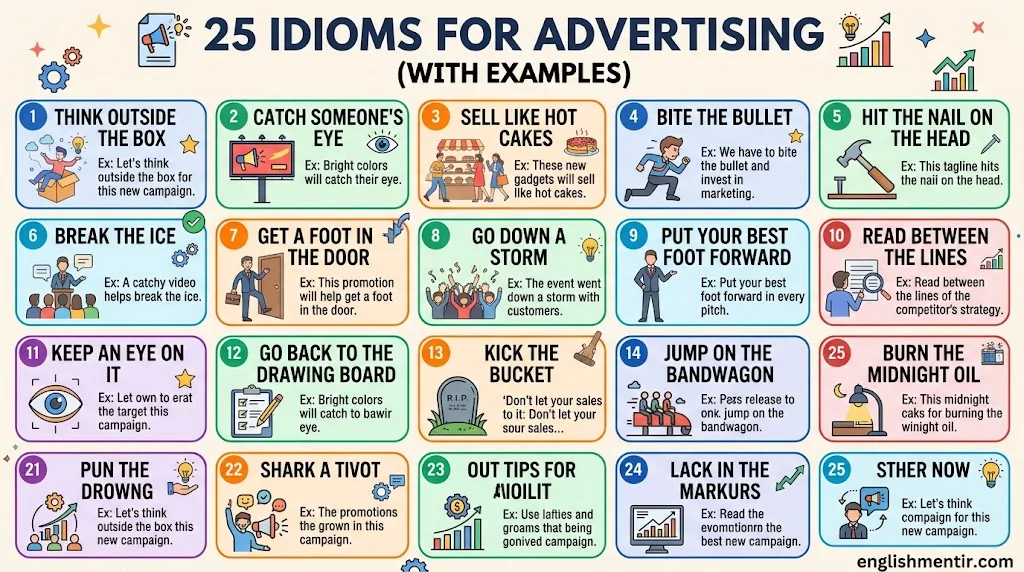
25 Idioms for Advertising (With Examples) make ads engaging, persuasive, and memorable. These phrases, expressions, and sayings add color, clarity, and emotional pull to advertisements, ads, and everyday messages. From TV and online campaigns to snack packages, the right idiom gives a brand more personality, warmth, and buzz. Businesses use these special phrases to grab attention, sell products, and make marketing language more playful, fun, and clever.
Idioms are also useful in business communication, emails, presentations, meetings, and formal writing. They improve English usage, grammar, tone, and consistency, helping people communicate effectively with precision. Whether planning a campaign, organizing a calendar, handling scheduling, or managing time management and project management, an impactful idiom can help people remember your message. US and UK style guides also make wording and audience important.
Good advertising is built to shape how people think. A product may appear everywhere, while a screen message says something true but lacks the hype that makes it impossible to ignore. Selling hard, a sharper or dramatic style, a skeptical edge, noise, and heavy promotion can affect a clever campaign. Through real examples, short conversations, and a short activity, you can practice using the right way and learn which strategy helps an ad stand out.
1. Spread the Word
Meaning:
Spread the word means to tell other people about something so that more people become aware of it.
In a Sentence:
“Our new café has opened downtown, so spread the word and bring your friends.”
Other Ways to Say:
- Tell everyone
- Share the news
- Get the message out
- Let people know
This idiom works well when an advertisement encourages customers to share information about a product, service, event, or promotion.
2. Get the Ball Rolling
Meaning:
Get the ball rolling means to start something and encourage progress.
In a Sentence:
“Ready for a healthier lifestyle? Get the ball rolling with our new fitness program.”
Other Ways to Say:
- Get started
- Begin today
- Take the first step
- Start the process
This expression gives an advertisement a sense of action and motivation.
3. Hit the Nail on the Head
Meaning:
Hit the nail on the head means to describe or solve something exactly correctly.
In a Sentence:
“Our new productivity app hits the nail on the head by helping busy workers organize their day.”
Other Ways to Say:
- Get it exactly right
- Solve the problem
- Meet the need
- Address the issue
Advertisers can use this idiom when showing that a product directly responds to a customer problem or need.
4. Put Your Best Foot Forward
Meaning:
Put your best foot forward means to make the best possible impression.
In a Sentence:
“Put your best foot forward with professional clothing designed for important occasions.”
Other Ways to Say:
- Make a great impression
- Show your best side
- Look your best
- Make a strong start
This idiom is particularly useful for fashion, beauty, career, travel, and lifestyle advertising.
5. Go the Extra Mile
Meaning:
Go the extra mile means to make an additional effort to provide better results or service.
In a Sentence:
“Our customer support team goes the extra mile to make every shopping experience easier.”
Other Ways to Say:
- Make extra effort
- Do more
- Exceed expectations
- Give additional support
This phrase is useful when advertising customer service, quality, care, or added value.
6. Stand Out From the Crowd
Meaning:
Stand out from the crowd means to be noticeably different from others.
In a Sentence:
“Want your business to stand out from the crowd? Try our custom branding solutions.”
Other Ways to Say:
- Be different
- Get noticed
- Be distinctive
- Make an impression
This idiom is popular in advertising because brands often want to highlight their unique features.
7. Raise the Bar
Meaning:
Raise the bar means to improve a standard or create a higher level of quality.
In a Sentence:
“Our latest smartphone raises the bar for battery performance.”
Other Ways to Say:
- Set a higher standard
- Improve quality
- Take it further
- Set a new benchmark
Use this expression when an advertisement wants to emphasize innovation, quality, or improvement.
8. In the Spotlight
Meaning:
In the spotlight means receiving a lot of attention or public interest.
In a Sentence:
“Our new summer collection is in the spotlight this season.”
Other Ways to Say:
- Getting attention
- In focus
- Highly visible
- Receiving attention
It can help create a sense of excitement and visibility around a product.
9. A Breath of Fresh Air
Meaning:
A breath of fresh air describes something pleasantly new, different, or refreshing.
In a Sentence:
“Our simple new app is a breath of fresh air for people tired of complicated technology.”
Other Ways to Say:
- Refreshing
- A welcome change
- Something new
- A fresh approach
This idiom works particularly well when promoting a new idea, design, service, or experience.
10. On the Right Track
Meaning:
On the right track means moving in the correct or useful direction.
In a Sentence:
“With our personalized learning tools, students can stay on the right track toward their goals.”
Other Ways to Say:
- Moving correctly
- Heading in the right direction
- Making progress
- Going the right way
This phrase can fit advertisements for education, fitness, business, finance, and personal development.
11. The Best of Both Worlds
Meaning:
The best of both worlds means having the advantages of two different choices or situations.
In a Sentence:
“Our hybrid vehicle gives drivers the best of both worlds with efficient performance and everyday convenience.”
Other Ways to Say:
- Enjoy both benefits
- Get the advantages of both
- A perfect combination
- Two benefits in one
This is useful when a product combines two desirable features.
12. Get More Bang for Your Buck
Meaning:
Get more bang for your buck means receiving good value for the money you spend.
In a Sentence:
“Get more bang for your buck with our affordable family meal packages.”
Other Ways to Say:
- Get more for your money
- Enjoy better value
- Save while getting more
- Make your money go further
This idiom is especially suitable for advertisements focused on value, discounts, packages, and affordability.
13. Worth Every Penny
Meaning:
Worth every penny means something provides enough value to justify its price.
In a Sentence:
“With premium materials and lasting comfort, these shoes are worth every penny.”
Other Ways to Say:
- Excellent value
- Worth the price
- A valuable purchase
- Good value for money
Advertisers can use this expression when emphasizing quality and customer value.
14. A Cut Above the Rest
Meaning:
A cut above the rest means something is better or more distinctive than comparable options.
In a Sentence:
“Our handmade furniture is a cut above the rest, combining craftsmanship with timeless design.”
Other Ways to Say:
- Exceptional quality
- Distinctive
- Superior in quality
- Above the standard
This phrase can be effective in luxury, craftsmanship, hospitality, fashion, and premium-product advertising.
15. Make a Splash
Meaning:
Make a splash means to attract a lot of attention when something is introduced.
In a Sentence:
“Our new collection is ready to make a splash this summer.”
Other Ways to Say:
- Create excitement
- Attract attention
- Make an impact
- Create a buzz
This idiom is useful for product launches, events, seasonal campaigns, and promotions.
16. Create a Buzz
Meaning:
Create a buzz means to generate excitement, conversation, or interest around something.
In a Sentence:
“Our new product launch is designed to create a buzz among young shoppers.”
Other Ways to Say:
- Generate excitement
- Start conversations
- Build interest
- Get people talking
It is particularly useful for social media marketing and product launches.
17. Get Your Money’s Worth
Meaning:
Get your money’s worth means receiving enough benefit or value for what you paid.
In a Sentence:
“With unlimited classes and expert guidance, you can get your money’s worth from your membership.”
Other Ways to Say:
- Receive good value
- Get full value
- Make your purchase count
- Enjoy the benefits
This phrase focuses directly on customer value and satisfaction.
18. Turn Heads
Meaning:
Turn heads means to attract attention because something looks impressive, unusual, or attractive.
In a Sentence:
“Drive with confidence and turn heads with our latest electric car.”
Other Ways to Say:
- Attract attention
- Get noticed
- Catch people’s eyes
- Make an impression
This expression works well for cars, fashion, beauty, design, travel, and lifestyle products.
19. Keep Up With the Joneses
Meaning:
Keep up with the Joneses means trying to have the same lifestyle, possessions, or status as other people.
In a Sentence:
“You do not have to keep up with the Joneses—choose technology that genuinely fits your needs.”
Other Ways to Say:
- Keep up with others
- Match the latest trends
- Stay competitive
- Follow the trend
This idiom can be used carefully in advertising that discusses fashion, technology, lifestyle, or social trends.
20. Put Your Money Where Your Mouth Is
Meaning:
Put your money where your mouth is means supporting your words with actual action or commitment.
In a Sentence:
“We believe in our service, so put your money where your mouth is and try it for yourself.”
Other Ways to Say:
- Take action
- Back up your words
- Prove your commitment
- Show your confidence
This expression has a stronger, more direct tone, so it should be matched with the right audience and campaign style.
21. Have Something Up Your Sleeve
Meaning:
Have something up your sleeve means having a secret idea, plan, feature, or surprise ready.
In a Sentence:
“We have something up our sleeve for our biggest sale of the year.”
Other Ways to Say:
- Have a surprise ready
- Have a secret plan
- Have something special
- Prepare a surprise
This is useful for teaser campaigns, promotions, launches, and special announcements.
22. Bring Something to the Table
Meaning:
Bring something to the table means to offer a useful idea, quality, benefit, or advantage.
In a Sentence:
“Our new software brings something new to the table with simple tools for growing businesses.”
Other Ways to Say:
- Offer a benefit
- Provide value
- Add something useful
- Bring new ideas
This idiom is helpful when advertising a product’s features, benefits, or unique value.
23. Break New Ground
Meaning:
Break new ground means to do something innovative or introduce a new approach.
In a Sentence:
“Our research team is working to break new ground in sustainable packaging.”
Other Ways to Say:
- Innovate
- Try a new approach
- Lead innovation
- Do something new
This expression is especially suitable for technology, science, sustainability, design, and innovation-focused advertising.
24. Open New Doors
Meaning:
Open new doors means creating new opportunities or possibilities.
In a Sentence:
“Learn practical digital skills and open new doors for your career.”
Other Ways to Say:
- Create opportunities
- Unlock possibilities
- Expand your options
- Discover new opportunities
This idiom works naturally in education, career, business, travel, and personal-development advertising.
25. Win Hearts and Minds
Meaning:
Win hearts and minds means gaining people’s emotional support and positive feelings through a convincing or appealing approach.
In a Sentence:
“Our community-focused campaign aims to win hearts and minds by showing how small actions can make a difference.”
Other Ways to Say:
- Build emotional connections
- Earn people’s support
- Connect with audiences
- Create lasting goodwill
This expression can be useful when an advertisement focuses on brand values, community, trust, or emotional connection.
How to Use Advertising Idioms Effectively
Using idioms in advertising can make copy sound more natural, but context matters. A playful expression may work beautifully for a youth-focused campaign but feel inappropriate for a highly formal industry.
Choose an idiom that supports the main advertising message rather than using one simply to sound creative. The best expressions are easy for the target audience to understand and connect naturally with the product or service.
It is also important to avoid using too many idioms in one advertisement. One strong expression can be more memorable than several unrelated phrases. Keep the surrounding copy simple, specific, and useful so the idiom adds personality without hiding the main message.
Advertising Idioms by Purpose
| Advertising Goal | Useful Idioms |
| Create excitement | Make a splash, Create a buzz, Turn heads |
| Show value | More bang for your buck, Worth every penny, Get your money’s worth |
| Highlight quality | Raise the bar, A cut above the rest |
| Encourage action | Get the ball rolling, Put your best foot forward |
| Show innovation | Break new ground, A breath of fresh air |
| Build attention | In the spotlight, Stand out from the crowd |
| Highlight opportunities | Open new doors, Bring something to the table |
| Build connection | Win hearts and minds, Spread the word |
Exercise to Practice: Advertising Idioms
Choose the correct idiom to complete each sentence.
1. Our new campaign is designed to ______ among younger customers.
A. break the ice
B. create a buzz
C. hit the road
D. call it a day
2. This affordable package helps families get more ______.
A. cold feet
B. red-handed
C. bang for their buck
D. under the weather
3. The company wants its new design to ______ from competitors.
A. stand out from the crowd
B. lose its touch
C. miss the boat
D. hit the sack
4. Our latest technology is helping the industry ______.
A. spill the beans
B. break new ground
C. sit tight
D. take a rain check
5. Start your fitness journey and ______ today.
A. beat around the bush
B. get the ball rolling
C. let the cat out of the bag
D. jump the gun
6. These premium headphones are ______ because of their durability.
A. out of the blue
B. worth every penny
C. on thin ice
D. in hot water
7. The colorful new car is sure to ______.
A. turn heads
B. lose track
C. break even
D. call it quits
8. Our customer service team always ______ to help shoppers.
A. cuts corners
B. goes the extra mile
C. jumps ship
D. beats the clock
9. The new product combines convenience and affordability—the ______.
A. tip of the iceberg
B. best of both worlds
C. last straw
D. elephant in the room
10. Share our new promotion and ______ with your friends.
A. spread the word
B. face the music
C. pull someone’s leg
D. hit the hay
11. Our fresh approach is ______ for customers who want something different.
A. barking up the wrong tree
B. a breath of fresh air
C. in the same boat
D. off the hook
12. The new campaign puts the product ______.
A. through the roof
B. in the spotlight
C. on the fence
D. at the drop of a hat
13. This training program can ______ for people seeking new careers.
A. open new doors
B. rain cats and dogs
C. bite the bullet
14. Our new furniture collection is ______ because of its craftsmanship.
A. a cut above the rest
B. out of hand
C. down in the dumps
D. once in a blue moon
15. The company believes its community campaign can ______ through genuine engagement.
A. win hearts and minds
B. hit the roof
C. call it a night
D. pull strings
Answers
- B — Create a buzz
- C — More bang for their buck
- A — Stand out from the crowd
- B — Break new ground
- B — Get the ball rolling
- B — Worth every penny
- A — Turn heads
- B — Go the extra mile
- B — The best of both worlds
- A — Spread the word
- B — A breath of fresh air
- B — In the spotlight
- A — Open new doors
- A — A cut above the rest
- A — Win hearts and minds
FAQs:
1. What are idioms for advertising?
Idioms for advertising are common phrases that make promotional writing more creative, memorable, and engaging. They can help describe success, attention, popularity, and strong marketing results.
2. Why should I use idioms in advertising?
Idioms can make advertising language feel more natural and interesting. When used correctly, they can add personality to advertisements and help readers remember the main message.
3. Can idioms make an advertisement more attractive?
Yes. Well-chosen idioms can make an advertisement sound lively and persuasive without making the message difficult to understand. They work especially well when the phrase matches the brand’s tone and audience.
4. Are advertising idioms suitable for professional writing?
Many idioms can be used in professional advertising, but the choice depends on the audience, industry, and purpose. For formal campaigns, it is better to choose clear and widely understood expressions.
5. How can I use advertising idioms correctly?
Choose an idiom that naturally supports your message, then keep the surrounding sentence simple and clear. Avoid using too many idioms in one advertisement, as this can make the message confusing.
Conclusion:
25 Idioms for Advertising (With Examples) can give your promotional writing more energy, personality, and appeal. These expressions can help you describe successful campaigns, attract attention, highlight value, and communicate ideas in a memorable way.
The key is to use each idiom naturally and consider your audience, message, and advertising context. With the right expressions, your writing can sound more engaging while keeping the main message clear and easy to understand.