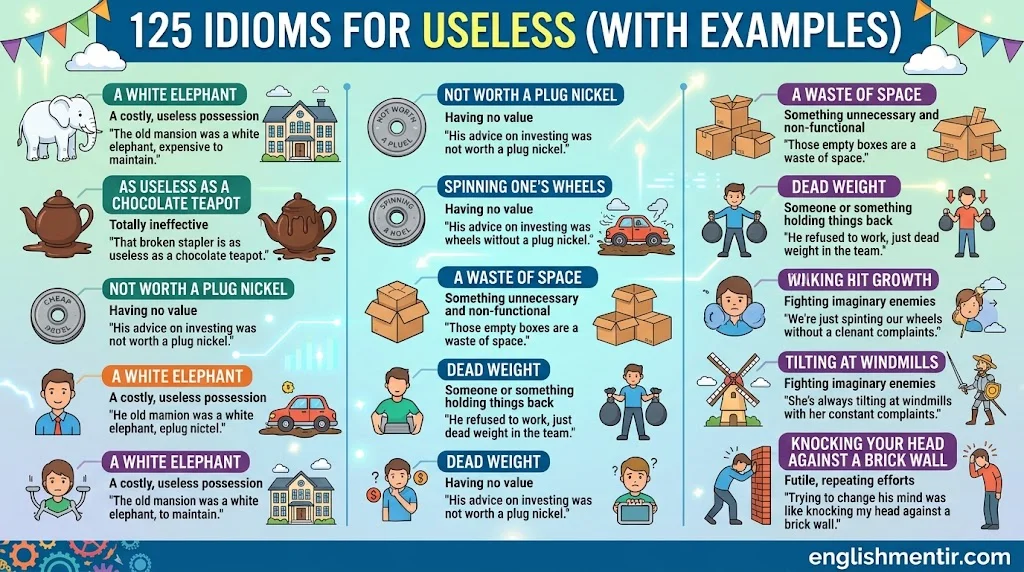
25 Idioms for Useless (With Examples) help people find the right words when something has little value. In English, idioms for useless person offer an expressive way to talk about an ineffective, unhelpful, or useless person through colorful expressions. Some are humorous, lighthearted, critical, or blunt, so the difference helps you choose an expression that fits the context.
In writing, story, and creative writing, common idioms can make a difficult character easier to describe. Their meanings and practical examples can support improving your vocabulary and help you express frustration without repeating the same word. In my experience, these useful idioms offer better ways to communicate when someone contributes very little to a group or task.
In casual conversations and everyday descriptions, understanding what an idiom means can make communication more natural. Instead of using a plain term, an idiom adds meaning, personality, and feeling to your speech, writing, and speaking.
1. Good for Nothing
Meaning: Something or someone that is useless or has no helpful purpose.
In a Sentence:
That broken printer is good for nothing now because it cannot print a single page.
Other Ways to Say: Useless, worthless, unhelpful, ineffective.
2. Of No Use
Meaning: Something that cannot help or serve a useful purpose.
In a Sentence:
This old charger is of no use because it does not work with my phone.
Other Ways to Say: Useless, ineffective, unhelpful, impractical.
3. Of No Value
Meaning: Something that has little or no practical worth.
In a Sentence:
Without the missing information, the report is of no value to the research team.
Other Ways to Say: Worthless, pointless, unhelpful, insignificant.
4. Not Worth a Penny
Meaning: Something has very little or no value, especially financially.
In a Sentence:
The damaged watch is not worth a penny because its main parts are missing.
Other Ways to Say: Worthless, valueless, of little worth, useless.
5. Not Worth the Paper It Is Written On
Meaning: Something is not reliable, useful, or valuable, despite appearing official.
In a Sentence:
The agreement is not worth the paper it is written on because neither side follows it.
Other Ways to Say: Worthless, unreliable, meaningless, ineffective.
6. As Useful as a Chocolate Teapot
Meaning: Something is completely impractical or useless.
In a Sentence:
A raincoat with holes is as useful as a chocolate teapot during a storm.
Other Ways to Say: Completely useless, impractical, ineffective, pointless.
7. As Much Use as a Screen Door on a Submarine
Meaning: Something is totally unsuitable for its purpose.
In a Sentence:
Giving him a paper map without the roads marked is as much use as a screen door on a submarine.
Other Ways to Say: Useless, unsuitable, impractical, ineffective.
8. About as Useful as a Fish with a Bicycle
Meaning: Something is not useful at all because it cannot serve the intended purpose.
In a Sentence:
A computer without a keyboard is about as useful as a fish with a bicycle.
Other Ways to Say: Useless, impractical, ineffective, pointless.
9. Pointless Exercise
Meaning: An action or activity that does not produce a useful result.
In a Sentence:
Repeating the same failed experiment without changing anything is a pointless exercise.
Other Ways to Say: Useless activity, wasted effort, futile task, meaningless action.
10. A Waste of Time
Meaning: Something that uses time without producing a worthwhile result.
In a Sentence:
Arguing about something neither person can change is simply a waste of time.
Other Ways to Say: Pointless, unproductive, futile, ineffective.
11. A Waste of Space
Meaning: Something occupies space without providing a useful purpose.
In a Sentence:
That broken cabinet has become a waste of space in the small room.
Other Ways to Say: Useless object, unnecessary item, dead weight.
12. A Dead Weight
Meaning: A person, object, or responsibility that adds a burden without contributing anything useful.
In a Sentence:
The outdated equipment has become dead weight for the small business.
Other Ways to Say: Burden, liability, useless thing, hindrance.
13. A Paperweight
Meaning: Something that is technically present but has little practical purpose; it can also describe equipment that no longer functions.
In a Sentence:
My old computer is basically a paperweight because it cannot run modern programs.
Other Ways to Say: Useless object, inactive equipment, worthless item.
14. Good for Nothing but…
Meaning: Something is useful only for a very limited or trivial purpose, often humorously.
In a Sentence:
That old tablet is good for nothing but collecting dust.
Other Ways to Say: Barely useful, nearly useless, ineffective, impractical.
15. Collecting Dust
Meaning: An object is not being used and has been sitting somewhere for a long time.
In a Sentence:
The expensive exercise machine is just collecting dust in the garage.
Other Ways to Say: Unused, neglected, idle, sitting unused.
16. Gathering Dust
Meaning: Something remains unused for a long period, suggesting that it has little practical value at present.
In a Sentence:
Those old textbooks have been gathering dust since the course ended.
Other Ways to Say: Unused, idle, forgotten, neglected.
17. Going Nowhere
Meaning: An effort, plan, or situation is making no progress.
In a Sentence:
Our discussions are going nowhere because nobody is willing to consider a new idea.
Other Ways to Say: Unproductive, ineffective, stagnant, pointless.
18. Beating a Dead Horse
Meaning: Continuing to discuss or pursue something that cannot be changed or improved.
In a Sentence:
We have already rejected that proposal, so discussing it again is beating a dead horse.
Other Ways to Say: Wasting effort, repeating a pointless argument, pursuing a lost cause.
19. Barking Up the Wrong Tree
Meaning: Looking for a solution in the wrong place or blaming the wrong person.
In a Sentence:
If you think Maria caused the problem, you are barking up the wrong tree.
Other Ways to Say: Looking in the wrong place, mistaken, misguided, misdirected.
20. Spinning Your Wheels
Meaning: Spending time and energy without making progress.
In a Sentence:
We have been spinning our wheels for hours without finding a solution.
Other Ways to Say: Wasting effort, making no progress, working fruitlessly.
21. Running on Empty
Meaning: Continuing to work with little energy, resources, or support, often making further effort ineffective.
In a Sentence:
The team has been running on empty after weeks of demanding work.
Other Ways to Say: Exhausted, depleted, lacking resources, ineffective.
22. Fighting a Losing Battle
Meaning: Trying to achieve something that has very little chance of success.
In a Sentence:
Trying to repair that completely damaged machine feels like fighting a losing battle.
Other Ways to Say: Futile effort, hopeless task, unsuccessful attempt, pointless struggle.
23. A Fool’s Errand
Meaning: A task that is unlikely to succeed or produce a useful result.
In a Sentence:
Searching for the missing document in an empty building would be a fool’s errand.
Other Ways to Say: Pointless task, futile mission, wasted effort, hopeless assignment.
24. To No Avail
Meaning: An effort was made, but it produced no useful result.
In a Sentence:
She searched for the missing file to no avail.
Other Ways to Say: Without success, unsuccessfully, fruitlessly, in vain.
25. In Vain
Meaning: An action or effort is performed without achieving the desired result.
In a Sentence:
They searched the entire building in vain for the missing keys.
Other Ways to Say: Unsuccessfully, fruitlessly, without result, to no avail.
Exercise to Practice
Choose the best answer for each question. These questions will help you understand how the idioms for useless, pointless, and ineffective work in real sentences.
1. The broken computer is now ______ because it cannot turn on.
A. barking up the wrong tree
B. a paperweight
C. going nowhere
D. a fool’s errand
2. We have discussed the same rejected idea five times. We are ______.
A. collecting dust
B. running on empty
C. beating a dead horse
D. of no value
3. The old exercise machine has been sitting unused for years. It is just ______.
A. gathering dust
B. in vain
C. a losing battle
D. barking up the wrong tree
4. Trying to fix a completely destroyed engine may be ______.
A. a waste of time
B. a dead weight
C. a fool’s errand
D. of no use
5. She searched everywhere for the missing keys, but ______.
A. she was a paperweight
B. to no avail
C. she collected dust
D. she was dead weight
6. If you blame John for the mistake when he was not involved, you are ______.
A. beating a dead horse
B. barking up the wrong tree
C. running on empty
D. gathering dust
7. The old printer occupies half the office but never works. It is ______.
A. a waste of space
B. going nowhere
C. in vain
D. a fool’s errand
8. Repeating the same process without changing anything is a ______.
A. useful exercise
B. pointless exercise
C. paperweight
D. screen door
9. Our project is ______ because nobody has agreed on the next step.
A. going nowhere
B. worth a penny
C. collecting dust
D. good for nothing but paper
10. The team has worked for twelve hours and has almost no energy left. They are ______.
A. barking up the wrong tree
B. running on empty
C. beating a dead horse
D. of no value
11. The document looked official, but it was ______ because nobody recognized its authority.
A. not worth the paper it is written on
B. collecting dust
C. a paperweight
D. going nowhere
12. An expensive object that is never used may simply be ______.
A. gathering dust
B. fighting a bicycle
C. to no avail
D. barking up the wrong tree
13. The volunteers tried several methods, but their efforts were ______.
A. in vain
B. a paperweight
C. dead weight
D. a screen door
14. An object that cannot perform its intended function may be described as ______.
A. of no use
B. going somewhere
C. worth a penny
D. making progress
15. Continuing a task that has almost no chance of success can be called ______.
A. collecting dust
B. fighting a losing battle
C. a paperweight
D. gathering value
Answers
- B — a paperweight
- C — beating a dead horse
- A — gathering dust
- C — a fool’s errand
- B — to no avail
- B — barking up the wrong tree
- A — a waste of space
- B — pointless exercise
- A — going nowhere
- B — running on empty
- A — not worth the paper it is written on
- A — gathering dust
- A — in vain
- A — of no use
- B — fighting a losing battle
FAQs:
1. What are idioms for useless?
Idioms for useless are figurative expressions used to describe something or someone that has little value, does not work, or fails to help in a situation.
2. Why use idioms instead of simply saying “useless”?
Idioms make your language more colorful and natural. They can express frustration, humor, disappointment, or criticism more precisely.
3. Can idioms for useless describe a person?
Yes. Idioms for useless person can describe someone who is ineffective, unhelpful, or contributes very little, depending on the context.
4. Are these idioms suitable for formal writing?
Some are suitable for creative writing, stories, and casual communication, while others may sound humorous or blunt. Always choose an expression that fits the situation.
5. How can I learn these idioms effectively?
Learn each idiom with its meaning, an example, and the context where it is commonly used. Practicing them in writing and conversation can improve your vocabulary.
Conclusion:
Learning 25 Idioms for Useless (With Examples) gives you more natural ways to describe things, efforts, or people that do not provide useful results. Instead of repeating the word “useless,” you can choose an expression that matches the exact situation, whether you want to sound humorous, lighthearted, or more direct.
With regular practice, these idioms can make your English more expressive and engaging. Understanding their meanings and contexts also helps you communicate ideas clearly in everyday conversations, creative writing, and other situations where the right phrase can make your message more effective.