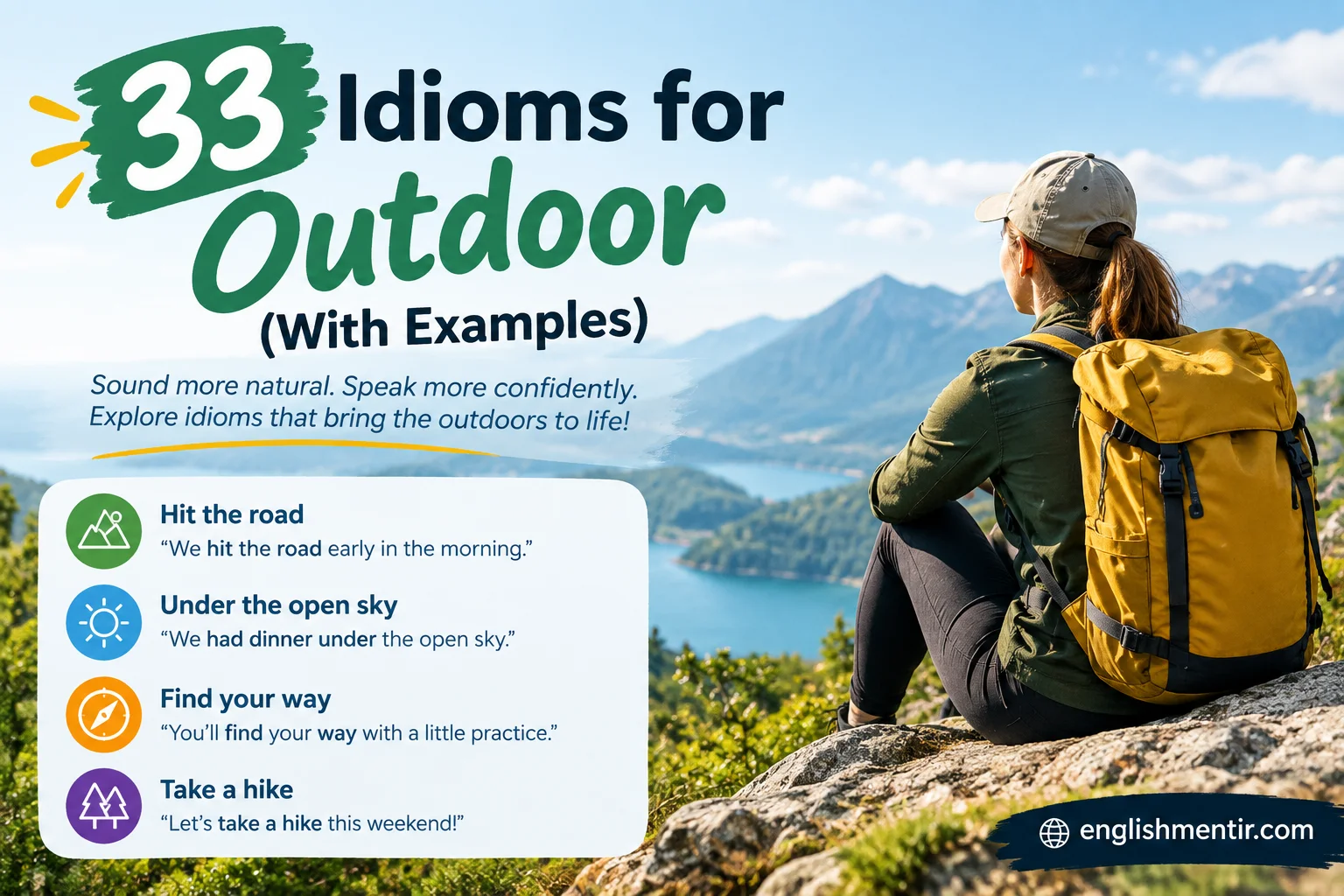
33 Idioms for Outdoor (With Examples) helps learners use outdoor idioms as special phrases whose meaning differs from literal words. They make conversation more colorful, fun, and memorable, helping you express yourself vividly in English. These helpful expressions connect language with the great outdoors, nature, the forest, wind, park, and fresh air. Exploring parks, enjoying nature, and spending time outside can make English feel more natural and enjoyable.
A short story makes these expressions easier to remember. Last weekend, Emma went hiking with her dog, Max. Halfway up the hill, she slipped, laughed, and said “life in the raw!” During a hike, on top of the world you can express happiness and emotion. Examples like this connect idioms with real experiences, humor, and everyday life.
There are 24+ expressions to explore, including Songs with idioms, popular tracks, lyrics, and common English expressions. Phrases like “cry me a river,” “break a heart,” and “hit the road” show deeper meaning beyond the literal sense. Learning idioms through songs can improve vocabulary, listening skills, and fluency, making learning English more effective for real-life communication.
1. A Breath of Fresh Air
Meaning: Something that feels refreshing, new, or pleasant, especially after being indoors or dealing with a difficult situation.
In a Sentence: Walking through the forest was a breath of fresh air after spending all day in the office.
Other Ways to Say: Refreshing experience, welcome change, something revitalizing.
2. Get Some Fresh Air
Meaning: To go outside for a while to enjoy clean air and a change of environment.
In a Sentence: I was feeling tired, so I decided to get some fresh air in the garden.
Other Ways to Say: Go outside, enjoy the outdoors, take some air.
3. Hit the Trail
Meaning: To begin a journey or hike, especially on a natural path.
In a Sentence: We packed our water bottles and hit the trail early in the morning.
Other Ways to Say: Start hiking, begin the journey, set off.
4. Take a Hike
Meaning: To go for a long walk or hike, usually outdoors.
In a Sentence: We decided to take a hike through the hills before sunset.
Other Ways to Say: Go hiking, take a walk, explore the trail.
5. Off the Beaten Path
Meaning: A place that is away from popular or crowded locations.
In a Sentence: We found a quiet lake off the beaten path.
Other Ways to Say: Remote place, hidden spot, less-traveled area.
6. In the Great Outdoors
Meaning: In natural outdoor places, such as forests, mountains, lakes, or countryside.
In a Sentence: My family loves spending weekends in the great outdoors.
Other Ways to Say: In nature, outside, in the countryside.
7. Under the Open Sky
Meaning: Being outdoors with nothing overhead except the sky.
In a Sentence: We enjoyed dinner under the open sky beside the lake.
Other Ways to Say: Outdoors, beneath the sky, in the open air.
8. Sleep Under the Stars
Meaning: To sleep outdoors at night where you can see the stars.
In a Sentence: During our camping trip, we decided to sleep under the stars.
Other Ways to Say: Camp outdoors, sleep outside, spend the night beneath the stars.
9. Go with the Flow
Meaning: To accept a situation naturally instead of trying to control every detail.
In a Sentence: Our hiking route changed because of the weather, so we decided to go with the flow.
Other Ways to Say: Stay flexible, adapt, take things as they come.
10. Weather the Storm
Meaning: To survive or manage a difficult situation.
In a Sentence: The hikers worked together to weather the storm until the weather improved.
Other Ways to Say: Get through difficulties, endure problems, survive challenges.
11. Come Rain or Shine
Meaning: Something will happen regardless of the weather or circumstances.
In a Sentence: We go for our morning walk come rain or shine.
Other Ways to Say: No matter what, whatever happens, regardless of conditions.
12. Under the Weather
Meaning: To feel slightly sick or unwell.
In a Sentence: I stayed home from the hiking trip because I was feeling under the weather.
Other Ways to Say: Feeling sick, feeling unwell, not feeling well.
13. A Walk in the Park
Meaning: Something that is very easy or simple to do.
In a Sentence: The beginner’s trail was a walk in the park for experienced hikers.
Other Ways to Say: Very easy, simple task, easy job.
14. Barking Up the Wrong Tree
Meaning: To look for a solution or blame in the wrong place.
In a Sentence: If you think the weather caused the problem, you may be barking up the wrong tree.
Other Ways to Say: Looking in the wrong place, mistaken idea, following the wrong lead.
15. Can’t See the Forest for the Trees
Meaning: To become so focused on small details that you fail to understand the bigger picture.
In a Sentence: We spent so much time discussing tiny trail problems that we couldn’t see the forest for the trees.
Other Ways to Say: Miss the bigger picture, focus too narrowly, overlook the main issue.
16. Tip of the Iceberg
Meaning: A small visible part of a much larger situation or problem.
In a Sentence: The damaged campsite was only the tip of the iceberg; the entire area needed repairs.
Other Ways to Say: Small part, visible portion, beginning of a larger issue.
17. The Grass Is Always Greener
Meaning: People often think another situation is better than their own.
In a Sentence: He wanted to move to another city, but soon realized that the grass is always greener.
Other Ways to Say: Other options seem better, idealize alternatives, want what others have.
18. Make Hay While the Sun Shines
Meaning: To take advantage of a good opportunity while conditions are favorable.
In a Sentence: The weather was perfect, so we decided to make hay while the sun shines and finish our outdoor project.
Other Ways to Say: Use the opportunity, act while conditions are good, take advantage of the moment.
19. Head in the Clouds
Meaning: To be dreamy or distracted instead of paying attention to what is happening.
In a Sentence: Sarah had her head in the clouds while everyone else was preparing the camping equipment.
Other Ways to Say: Daydreaming, distracted, lost in thought.
20. Go Out on a Limb
Meaning: To take a risk or make a decision without knowing exactly what will happen.
In a Sentence: I went out on a limb and suggested a new hiking route.
Other Ways to Say: Take a risk, take a chance, make a bold move.
21. Leave No Stone Unturned
Meaning: To make every possible effort to find something or solve a problem.
In a Sentence: The search team left no stone unturned while looking for the missing equipment.
Other Ways to Say: Search everywhere, investigate fully, make every effort.
22. Down to Earth
Meaning: Someone who is practical, friendly, and easy to talk to.
In a Sentence: Our hiking guide was very down to earth and made everyone feel comfortable.
Other Ways to Say: Practical, humble, approachable.
23. Keep Your Feet on the Ground
Meaning: To remain realistic and sensible, even when things are going well.
In a Sentence: Even after winning the outdoor competition, Mia kept her feet on the ground.
Other Ways to Say: Stay realistic, remain humble, stay practical.
24. Out in the Open
Meaning: In a visible, public, or outdoor place, rather than hidden away.
In a Sentence: We found a beautiful picnic area out in the open near the river.
Other Ways to Say: In public, outside, in plain view.
25. On the Right Track
Meaning: To be moving in the correct direction or making good progress toward a goal.
In a Sentence: After checking the map, we knew we were on the right track toward the mountain shelter.
Other Ways to Say: Going the right way, making progress, heading correctly.
Exercise to Practice: 15 MCQs
1. What does “hit the trail” mean?
A) Stop walking
B) Begin a hike or journey
C) Sleep outdoors
D) Get lost
2. Which idiom means “a refreshing experience”?
A) Head in the clouds
B) A breath of fresh air
C) Barking up the wrong tree
D) Under the weather
3. What does “off the beaten path” describe?
A) A crowded location
B) A dangerous road
C) A less-traveled place
D) A city center
4. “Sleep under the stars” means:
A) Sleep during the day
B) Sleep outdoors at night
C) Sleep in a hotel
D) Avoid camping
5. Which idiom means “regardless of the circumstances”?
A) Come rain or shine
B) Take a hike
C) Tip of the iceberg
D) Down to earth
6. If something is “a walk in the park,” it is:
A) Difficult
B) Dangerous
C) Easy
D) Expensive
7. What does “under the weather” mean?
A) Feeling unwell
B) Standing outside
C) Enjoying sunshine
D) Feeling excited
8. “Barking up the wrong tree” means:
A) Finding the correct answer
B) Looking in the wrong place
C) Climbing a tree
D) Going hiking
9. Which idiom means “take advantage of a good opportunity”?A) Make hay while the sun shines
B) Head in the clouds
C) Take a hike
D) Under the open sky
10. “The grass is always greener” suggests that:
A) Grass needs water
B) Another situation may seem better
C) Nature is always beautiful
D) Gardens are difficult to maintain
11. What does “go out on a limb” mean?
A) Take a risk
B) Take a rest
C) Follow a trail
D) Find a tree
12. “Leave no stone unturned” means:
A) Avoid searching
B) Search thoroughly
C) Build a wall
D) Leave immediately
13. Someone who is “down to earth” is usually:
A) Confused
B) Practical and approachable
C) Unfriendly
D) Careless
14. What does “keep your feet on the ground” mean?
A) Stay realistic
B) Start running
C) Go camping
D) Walk barefoot
15. If you are “on the right track,” you are:
A) Lost
B) Going in the correct direction
C) Taking a break
D) Walking backward
Answers
1. B — Begin a hike or journey
2. B — A refreshing experience
3. C — A less-traveled place
4. B — Sleep outdoors at night
5. A — Regardless of the circumstances
6. C — Easy
7. A — Feeling unwell
8. B — Looking in the wrong place
9. A — Take advantage of a good opportunity
10. B — Another situation may seem better
11. A — Take a risk
12. B — Search thoroughly
13. B — Practical and approachable
14. A — Stay realistic
15. B — Going in the correct direction
FAQs:
1. What are outdoor idioms?
Outdoor idioms are expressions connected with nature, parks, hiking, fresh air, and outdoor experiences. Their meanings are often different from the literal words.
2. Why should I learn outdoor idioms?
Learning outdoor idioms can make your English more natural, colorful, and memorable. They are also useful in conversations, writing, and everyday communication.
3. What is an example of an outdoor idiom?
“On top of the world” is a common example. It means feeling extremely happy or excited, such as after completing a difficult hike.
4. Can outdoor idioms help English learners?
Yes. They can help learners understand native expressions, improve vocabulary, and become more comfortable with figurative English.
5. How can I remember outdoor idioms easily?
Try using each idiom in a short sentence or connect it with a real outdoor experience. Reading stories and listening to songs can also make them easier to remember.
Conclusion:
Learning outdoor idioms is a fun way to make your English more expressive and natural. These phrases connect everyday language with nature, hiking, parks, fresh air, and outdoor experiences, making conversations more colorful and interesting.
With regular practice, you can understand these expressions more easily and use them naturally in conversations, writing, and presentations. Whether you are an English learner or simply want to expand your vocabulary, these idioms can add more life, humor, and emotion to your communication.