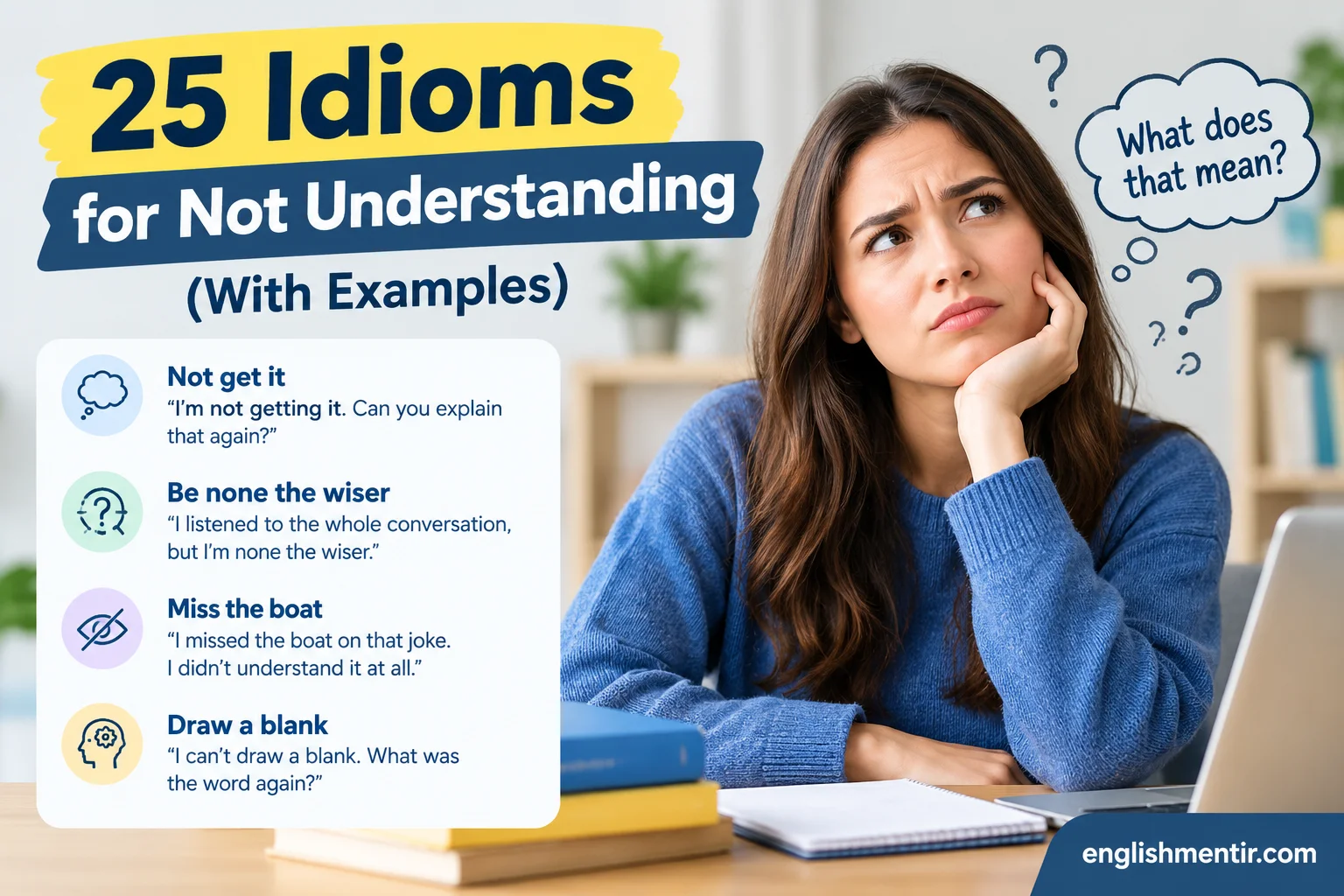
25 Idioms for Not Understanding (With Examples) can make learning English and developing fluency easier beyond grammar and vocabulary. Common idioms, idiomatic expressions, and common phrases in English help you learn English effectively and understand native English speakers in daily conversation, writing, and media.
Good understanding of correct uses helps you sound more fluent and natural. When something doesn’t make sense, you may feel confused, unsure, or unable to follow what someone means. These English idioms, phrases, and expressions give you a conversational response that helps communicate confusion without sounding harsh or dismissive.
These idioms for not understanding make everyday English more interesting, fun, and sometimes tricky. In this article, we explore how to learn and understand English better through conversations and practicing. You will find meanings, practical examples, alternative phrases, and a practice exercise to help you choose the right words and express your thoughts clearly in casual, playful, and professional situations with a friend, coworker, teacher, or family member.
1. It’s All Greek to Me
Meaning: Something is so difficult or unfamiliar that you cannot understand it.
In a Sentence: The technical instructions were all Greek to me, so I asked for help.
Other Ways to Say:
- I don’t understand it.
- It makes no sense to me.
- I’m completely confused.
- I can’t make sense of it.
2. I’m in the Dark
Meaning: You do not have enough information to understand what is happening.
In a Sentence: Everyone seemed to know about the plan, but I was in the dark.
Other Ways to Say:
- I don’t know what’s happening.
- I’m not aware of the details.
- I’m missing some information.
- I’m not sure what is going on.
3. I Can’t Make Head or Tail of It
Meaning: You cannot understand something despite trying.
In a Sentence: I read the report twice, but I couldn’t make head or tail of it.
Other Ways to Say:
- I can’t understand it.
- I can’t figure it out.
- I can’t make sense of it.
- I’m having trouble following it.
4. I’m Drawing a Blank
Meaning: You cannot remember or understand something at that moment.
In a Sentence: When my teacher asked me to explain the formula, I drew a blank.
Other Ways to Say:
- I can’t remember.
- I’m stuck.
- Nothing is coming to me.
- I’m having trouble thinking of an answer.
5. I’m Lost
Meaning: You are confused and do not understand what is being explained.
In a Sentence: I’m completely lost after the second step of the explanation.
Other Ways to Say:
- I’m confused.
- I don’t follow you.
- I’m not following this.
- I need some clarification.
6. I’m Not Following
Meaning: You cannot understand or keep up with someone’s explanation or reasoning.
In a Sentence: I’m not following your argument. Could you explain that part again?
Other Ways to Say:
- I don’t understand.
- I’m having trouble following you.
- Could you clarify that?
- Could you explain it another way?
7. It Goes Over My Head
Meaning: Something is too complicated or advanced for you to understand.
In a Sentence: Most of the discussion about advanced physics went over my head.
Other Ways to Say:
- It is too complicated for me.
- I don’t understand the concept.
- It is beyond my understanding.
- I’m struggling with the idea.
8. I Can’t Wrap My Head Around It
Meaning: You find something difficult to understand or accept mentally.
In a Sentence: I can’t wrap my head around how the machine works.
Other Ways to Say:
- I can’t understand it.
- I’m struggling to understand it.
- I can’t quite grasp it.
- I’m having trouble processing it.
9. I’m Scratching My Head
Meaning: You are confused or puzzled by something.
In a Sentence: I’m scratching my head trying to figure out why the numbers do not match.
Other Ways to Say:
- I’m puzzled.
- I’m confused.
- I’m trying to figure it out.
- I’m not sure what to make of it.
10. I’m None the Wiser
Meaning: After receiving an explanation, you still do not understand something.
In a Sentence: He explained the process twice, but I’m none the wiser.
Other Ways to Say:
- I still don’t understand.
- That didn’t clear things up.
- I’m still confused.
- I still don’t know what it means.
11. It Doesn’t Add Up
Meaning: Something does not make sense or does not seem logical.
In a Sentence: The numbers don’t add up, so I think we should check the report again.
Other Ways to Say:
- It doesn’t make sense.
- Something seems wrong.
- I can’t see the logic.
- The details do not seem to fit.
12. I’m at a Loss
Meaning: You do not know what something means or what to do next.
In a Sentence: After reading the complicated instructions, I was at a loss.
Other Ways to Say:
- I don’t know what to do.
- I’m unsure.
- I’m confused about the situation.
- I don’t know how to respond.
13. I Can’t Get My Head Around It
Meaning: You are struggling to understand something.
In a Sentence: I can’t get my head around why the system keeps rejecting the same file.
Other Ways to Say:
- I can’t understand it.
- I’m struggling to grasp it.
- I can’t figure it out.
- I’m having difficulty understanding it.
14. I’m Baffled
Meaning: You are extremely confused or unable to understand something.
In a Sentence: I was baffled by the sudden change in the instructions.
Other Ways to Say:
- I’m confused.
- I’m puzzled.
- I’m completely unsure.
- I don’t know what to make of it.
15. I’m Puzzled
Meaning: You are unsure about something because it is difficult to understand.
In a Sentence: I’m puzzled by the difference between these two answers.
Other Ways to Say:
- I’m confused.
- I’m unsure.
- I’m trying to understand.
- I’m not clear about it.
16. I’m Clueless
Meaning: You have little or no understanding of something.
In a Sentence: When it comes to fixing cars, I’m completely clueless.
Other Ways to Say:
- I have no idea.
- I don’t know anything about it.
- I’m unfamiliar with it.
- I don’t understand it.
17. I’m Stumped
Meaning: You cannot find an answer or understand how to solve a problem.
In a Sentence: This math problem has stumped me.
Other Ways to Say:
- I’m stuck.
- I can’t solve it.
- I don’t know the answer.
- I can’t figure it out.
18. I’m Boggled
Meaning: You are confused or amazed because something is difficult to understand.
In a Sentence: The amount of information in the report boggled my mind.
Other Ways to Say:
- I’m confused.
- I’m overwhelmed.
- I can hardly understand it.
- It is difficult to process.
19. I’m Out of My Depth
Meaning: You are dealing with something that is beyond your current knowledge or experience.
In a Sentence: I’m out of my depth when it comes to advanced computer programming.
Other Ways to Say:
- This is beyond my knowledge.
- I’m not experienced with this.
- I need some help.
- This is outside my area of expertise.
20. I Can’t See the Wood for the Trees
Meaning: You are so focused on small details that you cannot understand the bigger picture.
In a Sentence: I’ve been working on this project for weeks, and now I can’t see the wood for the trees.
Other Ways to Say:
- I’ve lost sight of the big picture.
- I’m too focused on the details.
- I’m having trouble seeing the overall idea.
- I need to step back and look at it differently.
21. I’m at Sea
Meaning: You feel confused and uncertain about what to do or understand.
In a Sentence: Without clear instructions, I was at sea during the project.
Other Ways to Say:
- I’m confused.
- I’m uncertain.
- I don’t know what to do.
- I feel lost.
22. It’s Beyond Me
Meaning: You cannot understand something because it is too difficult or unfamiliar.
In a Sentence: How the software works is beyond me.
Other Ways to Say:
- I don’t understand it.
- I can’t figure it out.
- I’m not familiar with it.
- I can’t comprehend it.
23. I’m Going Around in Circles
Meaning: You keep thinking about something without reaching an understanding or solution.
In a Sentence: I’ve been going around in circles trying to understand this problem.
Other Ways to Say:
- I’m stuck.
- I’m getting nowhere.
- I keep getting confused.
- I can’t reach a solution.
24. I’m Flummoxed
Meaning: You are completely confused and unsure how to understand or deal with something.
In a Sentence: I was flummoxed by the unexpected question.
Other Ways to Say:
- I’m completely confused.
- I’m puzzled.
- I’m baffled.
- I don’t know what to make of it.
25. I’m Trying to Get My Bearings
Meaning: You are trying to understand a new situation before deciding what to do.
In a Sentence: Give me a moment—I’m trying to get my bearings with this new system.
Other Ways to Say:
- I’m trying to understand the situation.
- I’m getting familiar with things.
- I’m figuring things out.
- I’m trying to get oriented.
How to Choose the Right Idiom for Not Understanding
The best expression depends on why you are confused and who you are speaking to.
For a simple conversation, “I’m lost,” “I’m puzzled,” or “I’m not following” sounds natural and friendly.
When something is highly complicated, expressions such as “It goes over my head” or “It’s beyond me” can work well.
If you cannot solve a particular problem, “I’m stumped” is a useful choice.
When you lack information rather than understanding, “I’m in the dark” is more accurate.
For a professional conversation, softer phrases such as “I’m not following” or “Could you clarify that?” can sound more respectful than saying “I’m clueless.”
Exercise to Practice
Choose the best idiom to complete each sentence.
1. The instructions were so complicated that they were ________.
A. in the dark
B. all Greek to me
C. at sea
D. drawing a blank
2. I read the report three times, but I couldn’t ________.
A. make head or tail of it
B. get my bearings
C. add up
D. draw a blank
3. I’m ________ about why the computer suddenly stopped working.
A. Greek
B. puzzled
C. in the trees
D. wiser
4. I’m not ________ your explanation. Could you repeat that?
A. following
B. adding
C. wrapping
D. sailing
5. Advanced mathematics usually ________.
A. adds up
B. goes over my head
C. gets my bearings
D. draws my head
6. I still don’t understand after his explanation. I’m ________.
A. none the wiser
B. all the trees
C. beyond the dark
D. out of circles
7. I’ve been trying to solve this puzzle for an hour, but I’m ________.
A. stumped
B. Greek
C. in the wood
D. wiser
8. I have no idea how this complicated machine works. It’s ________.
A. at sea
B. beyond me
C. drawing blank
D. all Greek
9. I don’t know what is happening because nobody has told me anything. I’m ________.
A. in the dark
B. out of depth
C. puzzled head
D. going in circles
10. I can’t ________ why she made that decision.
A. wrap my head around
B. add my head
C. make my sea
D. draw my trees
11. The numbers don’t seem logical. They ________.
A. go over my head
B. don’t add up
C. are at sea
D. draw a blank
12. I’ve never worked with this type of software, so I’m ________.
A. out of my depth
B. none the wiser
C. all Greek
D. scratching my trees
13. I’ve been thinking about this problem for hours and getting nowhere. I’m ________.
A. going around in circles
B. in the dark
C. wrapping my depth
D. making head and tail
14. I know the details, but I’ve lost sight of the bigger picture. I can’t ________.
A. see the wood for the trees
B. make the Greek
C. add my head
D. draw my bearings
15. Give me a moment. I’m ________ with this new situation.
A. trying to get my bearings
B. trying to add up
C. trying to draw the trees
D. trying to be Greek
Answers
- B — all Greek to me
- A — make head or tail of it
- B — puzzled
- A — following
- B — goes over my head
- A — none the wiser
- A — stumped
- B — beyond me
- A — in the dark
- A — wrap my head around
- B — don’t add up
- A — out of my depth
- A — going around in circles
- A — see the wood for the trees
- A — trying to get my bearings
FAQs:
1. What are idioms for not understanding?
Idioms for not understanding are expressions used when something is unclear or confusing. They make everyday English more natural and conversational.
2. Why should I learn idioms for confusion?
Learning these English idioms can help you understand English better, especially when speaking with native English speakers or watching media.
3. Can I use these idioms in professional situations?
Yes, but choose your phrase carefully. Some expressions are casual or playful, while others are more suitable for professional situations.
4. What is a simple alternative to an idiom?
You can say, “I don’t understand,” “I’m confused,” or “I’m unsure.” These alternative phrases are clear and useful in many situations.
5. How can I remember these idioms?
Use practical examples, repeat the expressions, and include them in conversations. Regular practicing can help you recognize and use them naturally.
Conclusion:
Learning 25 Idioms for Not Understanding (With Examples) can make your English more flexible and natural. These expressions give you different ways to describe confusion, ask for clarification, and communicate your thoughts clearly.
Keep practicing each idiom in realistic conversations and notice how people use similar phrases in everyday English. With regular practice, you can build your vocabulary, improve fluency, and feel more comfortable when something does not immediately make sense.