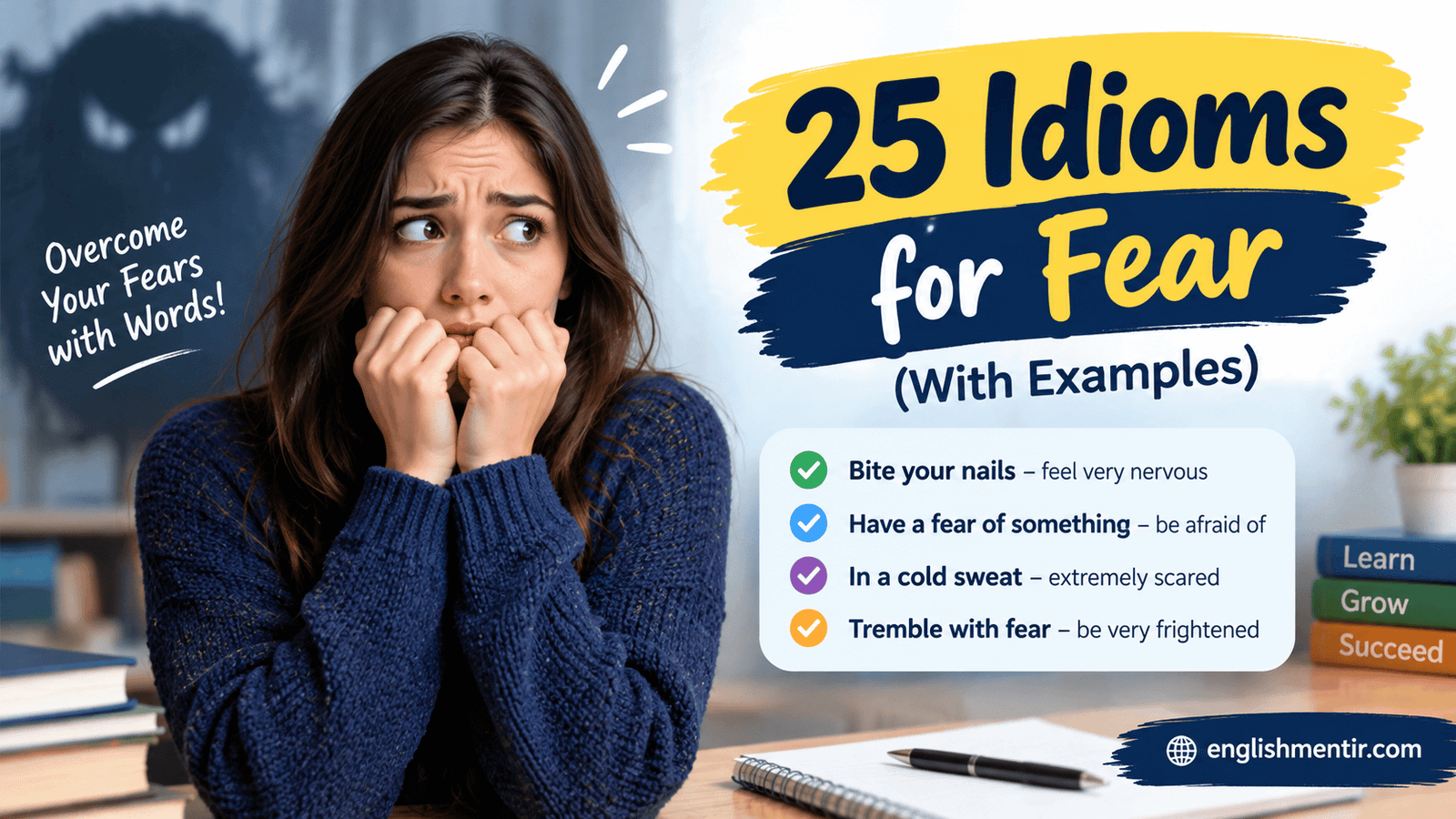
Idioms for fear help you express feelings of fright, nervousness, and anxiety in a more natural and interesting way. They make everyday conversations and writing more expressive.
Learning idioms about fear can improve your English vocabulary and help you describe different situations, from feeling slightly nervous to being extremely frightened.
In this article, you will discover 25 idioms for fear, with their meanings, example sentences, and other ways to say them. These simple examples will help you understand each expression and use it confidently in everyday English.
1. Scared Stiff
Meaning: To be so frightened that you feel unable to move or react.
In a Sentence: I was scared stiff when I heard someone knocking on the door in the middle of the night.
Other Ways to Say:
- Extremely frightened
- Frozen with fear
- Terrified
2. Shake Like a Leaf
Meaning: To tremble because of fear, nervousness, or anxiety.
In a Sentence: The little boy shook like a leaf when he had to speak in front of the entire class.
Other Ways to Say:
- Tremble with fear
- Shake nervously
- Quiver with fright
3. Have Butterflies in Your Stomach
Meaning: To feel nervous or anxious about something that is about to happen.
In a Sentence: I had butterflies in my stomach before my first job interview.
Other Ways to Say:
- Feel nervous
- Be anxious
- Feel on edge
4. Get Cold Feet
Meaning: To become nervous or frightened and hesitate before doing something you planned.
In a Sentence: Sara got cold feet just before stepping onto the stage for her first performance.
Other Ways to Say:
- Lose your nerve
- Become hesitant
- Have second thoughts
5. Have the Heebie-Jeebies
Meaning: To feel uneasy, nervous, or frightened, often because something seems creepy or strange.
In a Sentence: That abandoned house gives me the heebie-jeebies whenever I walk past it.
Other Ways to Say:
- Feel creeped out
- Get the chills
- Feel uneasy
6. Jump Out of Your Skin
Meaning: To react suddenly with extreme surprise or fear.
In a Sentence: I nearly jumped out of my skin when the alarm went off unexpectedly.
Other Ways to Say:
- Be startled
- Get a fright
- Be scared suddenly
7. Make Your Blood Run Cold
Meaning: To frighten someone deeply or make them feel horrified.
In a Sentence: The mysterious message made my blood run cold.
Other Ways to Say:
- Fill someone with horror
- Send chills down someone’s spine
- Terrify someone
8. Have Your Heart in Your Mouth
Meaning: To feel extremely anxious or frightened while waiting for something important or dangerous to happen.
In a Sentence: I had my heart in my mouth as the car skidded toward the edge of the road.
Other Ways to Say:
- Feel terrified
- Be extremely anxious
- Fear the worst
9. Break Out in a Cold Sweat
Meaning: To begin sweating suddenly because of fear, stress, or anxiety.
In a Sentence: He broke out in a cold sweat when he realized he had lost his passport before the flight.
Other Ways to Say:
- Sweat nervously
- Become frightened
- Feel a sudden wave of anxiety
10. Be Frightened Out of Your Wits
Meaning: To be extremely frightened and temporarily unable to think clearly.
In a Sentence: The sudden crash outside frightened me out of my wits.
Other Ways to Say:
- Be terrified
- Be scared senseless
- Be frightened beyond belief
11. Scare the Living Daylights Out of Someone
Meaning: To frighten someone very badly.
In a Sentence: My brother scared the living daylights out of me by hiding behind the door and shouting.
Other Ways to Say:
- Terrify someone
- Give someone a terrible fright
- Scare someone half to death
12. Shake in Your Boots
Meaning: To feel extremely frightened or intimidated.
In a Sentence: The students were shaking in their boots before meeting the strict headteacher.
Other Ways to Say:
- Tremble with fear
- Be very nervous
- Feel intimidated
13. Hair Stand on End
Meaning: To feel intense fear or horror, often because something is frightening or disturbing.
In a Sentence: The ghost story made my hair stand on end.
Other Ways to Say:
- Get goosebumps
- Feel horrified
- Experience a chill of fear
14. Send Shivers Down Your Spine
Meaning: To cause a sudden feeling of fear, horror, or uneasiness.
In a Sentence: The strange whisper coming from the empty room sent shivers down my spine.
Other Ways to Say:
- Give someone the chills
- Make someone feel uneasy
- Send a chill through someone
15. Quake in Your Boots
Meaning: To tremble with fear, especially when facing someone or something intimidating.
In a Sentence: The young boxer was quaking in his boots before his first professional fight.
Other Ways to Say:
- Tremble with fear
- Feel intimidated
- Shake with fright
16. Afraid of Your Own Shadow
Meaning: To be so fearful or nervous that even small things frighten you.
In a Sentence: After watching several horror movies, Daniel was afraid of his own shadow.
Other Ways to Say:
- Be easily frightened
- Be very jumpy
- Be excessively fearful
17. A Nervous Wreck
Meaning: A person who is extremely anxious, worried, or emotionally unsettled.
In a Sentence: I was a nervous wreck while waiting for the results of my final examination.
Other Ways to Say:
- Extremely anxious
- Very stressed
- A bundle of nerves
18. Lose Your Nerve
Meaning: To lose courage or become too frightened to do something.
In a Sentence: He almost lost his nerve before asking for a promotion.
Other Ways to Say:
- Become frightened
- Lose confidence
- Back down out of fear
19. In a Cold Sweat
Meaning: In a state of fear, worry, or nervousness that causes sudden sweating.
In a Sentence: I was in a cold sweat when I thought I had accidentally deleted my important project.
Other Ways to Say:
- Sweating with anxiety
- Extremely worried
- Nervous and frightened
20. Have the Wind Knocked Out of You
Meaning: To feel suddenly shocked, frightened, or emotionally overwhelmed by an unexpected event.
In a Sentence: The unexpected announcement knocked the wind out of me, and I struggled to respond.
Other Ways to Say:
- Be taken aback
- Be deeply shocked
- Feel overwhelmed
21. Scared to Death
Meaning: To be extremely frightened.
In a Sentence: My little sister was scared to death during the thunderstorm.
Other Ways to Say:
- Terrified
- Frightened out of your mind
- Scared stiff
22. Jump at Your Own Shadow
Meaning: To be so nervous or frightened that you react fearfully to minor things.
In a Sentence: After hearing strange noises all night, I was jumping at my own shadow the next morning.
Other Ways to Say:
- Be easily startled
- Be very jumpy
- Be on edge
23. Be on Pins and Needles
Meaning: To feel very nervous or anxious while waiting for an important result or event.
In a Sentence: We were on pins and needles while waiting to hear whether our team had won the competition.
Other Ways to Say:
- Be on edge
- Feel anxious
- Wait nervously
24. Have a Scare
Meaning: To experience a sudden moment of fear or worry.
In a Sentence: We had a scare when the electricity went out during the storm, but everything was fine afterward.
Other Ways to Say:
- Experience a fright
- Get a shock
- Have a frightening moment
25. Fear the Worst
Meaning: To expect that something bad may have happened or is likely to happen.
In a Sentence: When my father did not answer his phone for hours, I began to fear the worst.
Other Ways to Say:
- Expect bad news
- Worry about the outcome
- Imagine the worst
Exercise: Practice Idioms for Fear (15 MCQs)
Test your understanding by choosing the correct answer for each question. The answer key is provided at the end.
1. What does “scared stiff” mean?
A. Slightly confused
B. Extremely frightened
C. Very excited
D. Completely relaxed
2. If you “have butterflies in your stomach,” how do you feel?
A. Hungry
B. Sleepy
C. Nervous
D. Angry
3. What does “get cold feet” mean?
A. Feel nervous and hesitate
B. Become physically cold
C. Feel very confident
D. Fall asleep suddenly
4. Which idiom describes trembling because of fear?
A. Fear the worst
B. Have a scare
C. Lose your nerve
D. Shake like a leaf
5. What does “jump out of your skin” mean?
A. Become tired
B. Be startled suddenly
C. Feel relaxed
D. Become disappointed
6. If something “makes your blood run cold,” it makes you feel:
A. Comfortable
B. Excited
C. Horrified
D. Sleepy
7. Which idiom describes being very anxious while waiting for results?
A. Be on pins and needles
B. Have a scare
C. Shake like a leaf
D. Be afraid of your own shadow
8. What does “scared to death” mean?
A. Feeling bored
B. Being extremely frightened
C. Feeling proud
D. Being mildly surprised
9. Which idiom describes someone who is easily frightened?
A. Fear the worst
B. Have your heart in your mouth
C. Afraid of your own shadow
D. Lose your nerve
10. What does “lose your nerve” mean?
A. Forget someone’s name
B. Become sleepy
C. Lose an object
D. Lose courage because of fear
11. If a story “sends shivers down your spine,” it makes you feel:
A. Frightened or uneasy
B. Hungry
C. Cheerful
D. Relaxed
12. Which expression means to frighten someone very badly?
A. Have butterflies in your stomach
B. Scare the living daylights out of someone
C. Fear the worst
D. Be on pins and needles
13. What does “a nervous wreck” describe?
A. A broken machine
B. A fearless person
C. Someone who is extremely anxious
D. Someone who is very calm
14. If you “fear the worst,” what do you expect?
A. A pleasant surprise
B. A successful result
C. A peaceful evening
D. A bad outcome
15. What does “break out in a cold sweat” mean?
A. Start sweating suddenly because of fear or stress
B. Begin exercising
C. Feel hungry
D. Become very confident
Answers to the 15 MCQs
- B — Extremely frightened
- C — Nervous
- A — Feel nervous and hesitate
- D — Shake like a leaf
- B — Be startled suddenly
- C — Horrified
- A — Be on pins and needles
- B — Being extremely frightened
- C — Afraid of your own shadow
- D — Lose courage because of fear
- A — Frightened or uneasy
- B — Scare the living daylights out of someone
- C — Someone who is extremely anxious
- D — A bad outcome
- A — Start sweating suddenly because of fear or stress
Conclusion:
Learning idioms for fear helps you describe emotions more vividly than using simple words such as scared or nervous. Expressions like scared stiff, get cold feet, and send shivers down your spine allow you to communicate different levels of fear in everyday conversations. Some idioms describe sudden fright, while others express nervousness before an important event or anxiety about an uncertain outcome.
To improve your English, try using one or two of these idioms in your daily conversations, school assignments, or creative writing. Pay attention to the situation in which each expression is used so that your language sounds natural. With regular practice, you can expand your vocabulary, express emotions confidently, and become a more effective English communicator.
FAQs:
1. What are idioms for fear?
Idioms for fear are expressions that describe being frightened, nervous, anxious, or terrified in an imaginative way. Examples include scared stiff, shake like a leaf, and scared to death.
2. What is the most common idiom for being scared?
One widely used expression is scared to death, which means being extremely frightened. Another common expression is scared stiff, which describes being so frightened that you feel unable to move.
3. Which idiom describes nervousness before an important event?
Have butterflies in your stomach is commonly used to describe nervousness before an important event, such as an exam, interview, or public speech.
4. What is an idiom for being easily frightened?
Afraid of your own shadow describes someone who is extremely fearful or easily frightened. Jump at your own shadow is another expression for reacting fearfully to small or unexpected things.
5. How can I learn and remember idioms for fear?
You can learn these expressions by reading their meanings, studying example sentences, and using them in your own conversations. Practice exercises, vocabulary notebooks, and short stories can also help you remember idioms and use them correctly.