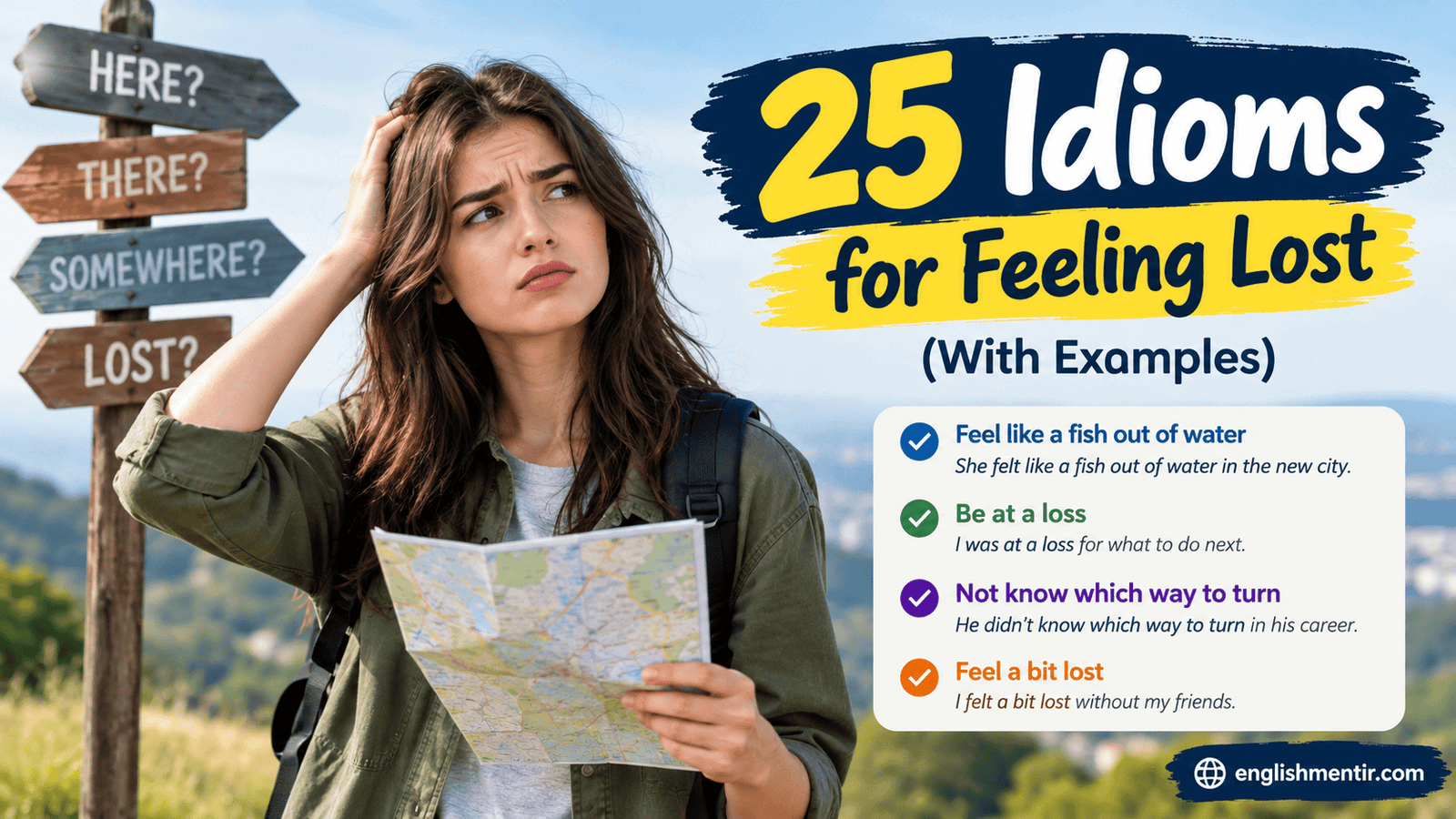
Idioms for feeling lost help you express confusion, uncertainty, and a lack of direction in everyday conversations. They make your English more natural, expressive, and meaningful.
Learning idioms about feeling lost can improve your vocabulary and help you describe situations where you feel confused, struggle to make decisions, or feel unsure about your future.
In this article, you will discover 25 idioms for feeling lost, along with their meanings, example sentences, and other ways to say them. These easy examples will help you understand each expression and use it confidently in everyday English.
1. At a Loss
Meaning: To feel confused or uncertain about what to do or say in a particular situation.
In a Sentence: When my plans suddenly changed, I was at a loss about what to do next.
Other Ways to Say:
- Unsure what to do
- Confused
- Perplexed
- Without an answer
2. Lose Your Way
Meaning: To become unable to find the correct direction, either physically or figuratively in life.
In a Sentence: After changing careers several times, Daniel felt he had lost his way and needed to reconsider his goals.
Other Ways to Say:
- Get off track
- Lose direction
- Feel aimless
- Struggle to find your path
3. In a Fog
Meaning: To feel mentally confused or unable to think clearly.
In a Sentence: After receiving so much unexpected information, I was in a fog and needed time to process everything.
Other Ways to Say:
- Feel bewildered
- Be mentally unclear
- Have a clouded mind
- Struggle to concentrate
4. At Sea
Meaning: To feel completely uncertain or confused about a situation.
In a Sentence: On her first day at the new school, Aisha felt at sea because she did not know anyone or understand the routine.
Other Ways to Say:
- Feel out of your depth
- Be uncertain
- Feel bewildered
- Be unsure of yourself
5. In the Dark
Meaning: To lack important information or knowledge about something.
In a Sentence: Everyone discussed the new project, but I was in the dark about what my responsibilities would be.
Other Ways to Say:
- Be uninformed
- Be unaware
- Lack information
- Not have a clue
6. Up in the Air
Meaning: To be uncertain because a decision, plan, or situation has not been settled.
In a Sentence: My future career plans are still up in the air, so I am exploring different opportunities.
Other Ways to Say:
- Uncertain
- Undecided
- Unsettled
- Not yet determined
7. Not Know Which Way to Turn
Meaning: To feel so confused or overwhelmed that you cannot decide what to do next.
In a Sentence: With several deadlines approaching, Maria did not know which way to turn.
Other Ways to Say:
- Feel overwhelmed
- Be unable to decide
- Feel stuck
- Not know where to begin
8. All at Sea
Meaning: To feel completely confused, especially when dealing with something unfamiliar.
In a Sentence: I was all at sea when my teacher introduced a complicated topic without any examples.
Other Ways to Say:
- Completely confused
- At a loss
- Bewildered
- Unsure how to proceed
9. Out of Your Depth
Meaning: To be involved in a situation that is too difficult or unfamiliar for your current experience or abilities.
In a Sentence: During the advanced training session, I felt out of my depth because everyone else had years of experience.
Other Ways to Say:
- Out of your element
- Overwhelmed
- Unprepared
- Beyond your experience
10. Go Around in Circles
Meaning: To keep repeating the same actions or thoughts without making progress.
In a Sentence: I kept going around in circles while trying to choose the right university.
Other Ways to Say:
- Make no progress
- Keep going over the same things
- Get nowhere
- Remain stuck
11. Lose Sight of the Bigger Picture
Meaning: To become so focused on small details that you forget the main goal or overall purpose.
In a Sentence: While worrying about every minor mistake, I lost sight of the bigger picture and forgot how much progress I had made.
Other Ways to Say:
- Forget the main goal
- Lose perspective
- Miss the overall purpose
- Become distracted by details
12. Be in Two Minds
Meaning: To feel uncertain because you are considering two different choices or opinions.
In a Sentence: I am in two minds about moving abroad because I want new opportunities but will miss my family.
Other Ways to Say:
- Be undecided
- Feel torn
- Have mixed feelings
- Be uncertain
13. Be at a Crossroads
Meaning: To reach an important point in life when you must choose between different directions.
In a Sentence: After graduating, Hassan found himself at a crossroads and had to decide whether to study further or start working.
Other Ways to Say:
- Face a major decision
- Reach a turning point
- Stand at a decision point
- Choose your next direction
14. Be in Uncharted Waters
Meaning: To enter a new or unfamiliar situation without knowing exactly what to expect.
In a Sentence: Starting her own business placed Sara in uncharted waters, but she was willing to learn along the way.
Other Ways to Say:
- Enter unfamiliar territory
- Face the unknown
- Try something new
- Explore new ground
15. Feel Like a Fish Out of Water
Meaning: To feel uncomfortable, awkward, or out of place in an unfamiliar environment.
In a Sentence: As the only new employee at the meeting, I felt like a fish out of water.
Other Ways to Say:
- Feel out of place
- Feel uncomfortable
- Not fit in
- Feel unfamiliar with your surroundings
16. Be at Your Wits’ End
Meaning: To feel so worried or frustrated that you cannot think of any more solutions.
In a Sentence: After trying several ways to solve the problem, I was at my wits’ end.
Other Ways to Say:
- Feel helpless
- Be completely frustrated
- Run out of ideas
- Not know what else to do
17. Be in a Maze
Meaning: To feel confused by a complicated situation that seems difficult to understand or escape.
In a Sentence: With so many conflicting instructions, I felt as though I was in a maze and could not find the right answer.
Other Ways to Say:
- Feel trapped in confusion
- Be bewildered
- Struggle to find a solution
- Feel lost in complexity
18. Wander Aimlessly
Meaning: To move around or spend time without a clear destination, plan, or purpose.
In a Sentence: After leaving his previous job, Omar spent several weeks wandering aimlessly while deciding what he wanted to do next.
Other Ways to Say:
- Drift without direction
- Move without a plan
- Roam without purpose
- Feel directionless
19. Be in a Quandary
Meaning: To be in a difficult situation because you cannot decide what to do.
In a Sentence: I was in a quandary about whether to accept the promotion or remain in my current position.
Other Ways to Say:
- Face a dilemma
- Be in a difficult position
- Feel uncertain
- Struggle to make a decision
20. Lose Your Bearings
Meaning: To become confused about your location, direction, or position in a situation.
In a Sentence: After several unexpected changes at work, I began to lose my bearings and struggled to understand my role.
Other Ways to Say:
- Lose your sense of direction
- Become disoriented
- Feel confused
- Lose your sense of purpose
21. Be All Over the Place
Meaning: To feel disorganized, confused, or unable to focus your thoughts and actions.
In a Sentence: I was all over the place while preparing for my exams because I had not organized my study schedule.
Other Ways to Say:
- Feel scattered
- Be disorganized
- Have trouble focusing
- Feel mentally overwhelmed
22. Go Down a Rabbit Hole
Meaning: To become deeply involved in a subject or activity and lose track of your original purpose.
In a Sentence: I went down a rabbit hole researching career options and ended up more confused than when I started.
Other Ways to Say:
- Get carried away
- Become deeply absorbed
- Lose track of your goal
- Get sidetracked
23. Be at a Standstill
Meaning: To reach a point where no progress is being made.
In a Sentence: My plans for the future were at a standstill because I could not decide which opportunity to pursue.
Other Ways to Say:
- Be stuck
- Make no progress
- Remain at a dead end
- Be unable to move forward
24. Be in a Spin
Meaning: To feel confused, anxious, or overwhelmed by too many things happening at once.
In a Sentence: The sudden changes to our travel plans left me in a spin.
Other Ways to Say:
- Feel flustered
- Be overwhelmed
- Feel disoriented
- Be thrown off balance
25. Drift from Your Path
Meaning: To gradually move away from your original goals, values, or plans.
In a Sentence: I realized I had drifted from my path and needed to focus again on the goals that mattered to me.
Other Ways to Say:
- Lose direction
- Stray from your goals
- Get off track
- Move away from your purpose
How to Use Idioms for Feeling Lost Naturally
Choosing the right idiom depends on the kind of confusion you want to describe. Some expressions focus on decisions, while others describe unfamiliar situations or a lack of progress.
- For decision-making: Use at a crossroads, in two minds, or in a quandary.
- For mental confusion: Use in a fog, at a loss, or all at sea.
- For unfamiliar situations: Use out of your depth, in uncharted waters, or like a fish out of water.
- For a lack of progress: Use going around in circles or at a standstill.
- For losing direction in life: Use lose your way, lose your bearings, or drift from your path.
Writing tip: Idioms make communication more expressive, but they should fit the context. For example, saying “I feel at a crossroads” suggests an important decision, whereas “I am in a fog” suggests difficulty thinking clearly.
Exercise to Practice: 15 Multiple-Choice Questions
Test your understanding of these 25 idioms for feeling lost. Choose the best answer for each question before checking the answer key.
Questions:
1. If you are at a loss, how do you feel?
A. Completely confident
B. Unsure what to do
C. Very excited
D. Extremely relaxed
2. Which idiom describes someone who cannot think clearly?
A. At a standstill
B. In a fog
C. At a crossroads
D. Up in the air
3. If your future plans are up in the air, they are:
A. Completely successful
B. Carefully organized
C. Still uncertain
D. Already completed
4. Which idiom describes reaching an important decision point in life?
A. Be at a crossroads
B. Go down a rabbit hole
C. Be in a spin
D. Wander aimlessly
5. If you feel like a fish out of water, you feel:
A. Comfortable everywhere
B. Out of place
C. Very knowledgeable
D. Completely prepared
6. Which expression means to repeat the same actions without making progress?
A. Lose sight of the bigger picture
B. Be in uncharted waters
C. Go around in circles
D. Lose your bearings
7. If someone is in the dark, they:
A. Lack important information
B. Know every detail
C. Feel physically tired
D. Have made a final decision
8. Which idiom describes feeling overwhelmed because a situation exceeds your experience?
A. Be in two minds
B. Be out of your depth
C. Be at a standstill
D. Drift from your path
9. If you are in a quandary, you are:
A. Enjoying a celebration
B. Making rapid progress
C. Facing a difficult decision
D. Following a clear plan
10. Which expression means to become deeply involved in something and lose track of your original purpose?
A. Go down a rabbit hole
B. Be at a crossroads
C. Be in the dark
D. Lose your bearings
11. If your project is at a standstill, it is:
A. Moving quickly
B. Almost finished
C. Making no progress
D. Improving every day
12. Which idiom describes feeling uncertain between two choices?
A. Be in two minds
B. Be at your wits’ end
C. Wander aimlessly
D. Be all over the place
13. If you lose your bearings, you:
A. Become more confident
B. Become confused about your direction or position
C. Finish a difficult task
D. Find a perfect solution
14. Which expression describes entering an unfamiliar situation?
A. Be in uncharted waters
B. Go around in circles
C. Be at a standstill
D. Lose sight of the bigger picture
15. If you drift from your path, you:
A. Stay focused on your goals
B. Reach your destination immediately
C. Move away from your original goals
D. Make a clear decision
Practice Score
- 13–15 correct: Excellent! You understand these idioms very well.
- 10–12 correct: Good work! Review the expressions you missed.
- 7–9 correct: Keep practicing and create your own example sentences.
- 0–6 correct: Review the meanings and examples, then try again.
Add answer explanationsRemove the answer keyImprove quiz formatting
Answer Key
- B — Unsure what to do
- B — In a fog
- C — Still uncertain
- A — Be at a crossroads
- B — Out of place
- C — Go around in circles
- A — Lack important information
- B — Be out of your depth
- C — Facing a difficult decision
- A — Go down a rabbit hole
- C — Making no progress
- A — Be in two minds
- B — Become confused about your direction or position
- A — Be in uncharted waters
- C — Move away from your original goals
Practice Tip
Give yourself 1 point for each correct answer.
- 13–15 points: Excellent! You understand these idioms very well.
- 10–12 points: Good work! Review the meanings of the expressions you missed.
- 7–9 points: You are making progress. Practice using the idioms in your own sentences.
- 0–6 points: Keep learning! Read the examples again and try the exercise once more.
Conclusion:
Feeling lost is a natural part of life, whether you are facing a difficult decision, adjusting to change, or trying to discover your next step. Learning idioms for feeling lost gives you more ways to describe these experiences clearly and naturally. Expressions such as “at a loss,” “in a fog,” “at a crossroads,” and “lose your way” can help you communicate uncertainty in everyday conversations and writing.
Remember that each idiom has a slightly different meaning. Choose the expression that best matches your situation, and practice using it in original sentences. Most importantly, feeling lost does not mean you have failed. Sometimes, uncertainty is simply part of discovering a new direction.
FAQs:
1. What are the most common idioms for feeling lost?
Some common idioms are at a loss, lose your way, in a fog, at sea, and at a crossroads. They describe confusion, uncertainty, or difficulty deciding what to do next.
2. What idiom means feeling confused and not knowing what to do?
“At a loss” is a common idiom for feeling confused or not knowing how to respond. For example: I was at a loss when my plans suddenly changed.
3. Which idiom describes feeling lost in life?
“Lose your way” is often used when someone feels uncertain about their goals or direction in life. “Be at a crossroads” is useful when someone must make an important life decision.
4. What is the difference between “at a loss” and “at a crossroads”?
“At a loss” means feeling unsure about what to do or say. “At a crossroads” describes reaching a point where you must choose between important options.
5. How can I learn and remember idioms for feeling lost?
Learn each idiom with its meaning, example sentence, and alternative expressions. Then write your own sentence, practice using it in conversation, and complete exercises such as the 15 multiple-choice questions in this article. Regular practice helps you remember the expressions and use them naturally.