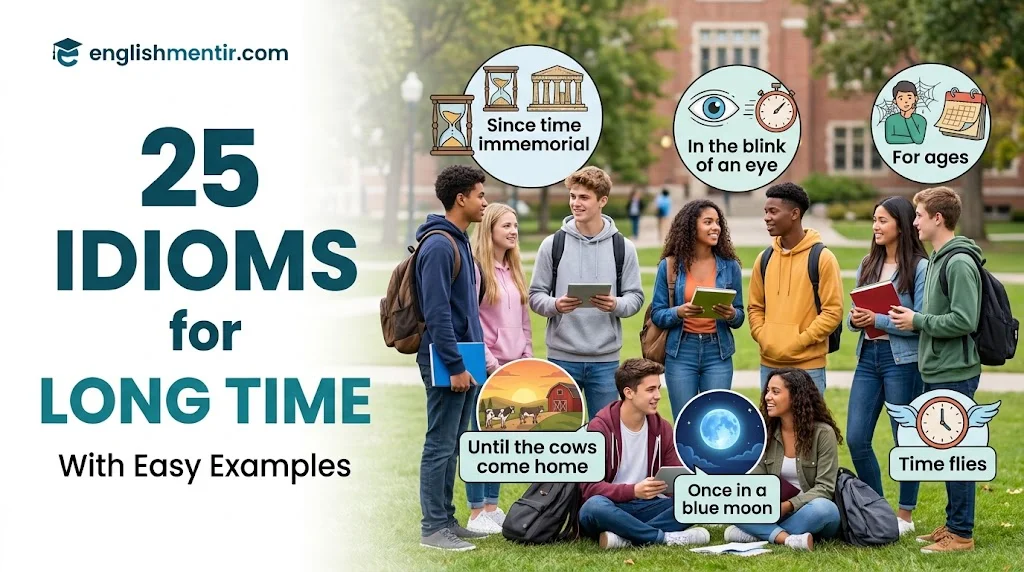
25 Idioms for Long Time (With Examples) help English learners describe years, a long time, waiting, and a long period of time naturally. The right idiomatic expressions make English vocabulary more expressive, engaging, and useful for conversations with native speakers.
These idioms can describe friendship, lasting relationships, projects, and events in academic and professional settings. They are useful in formal writing, formal emails, business communication, professional emails, scheduling meetings, managing projects, and everyday conversations, while adding clarity, style, and personality.
In my experience, a curated list of examples provides helpful guidance for choosing the perfect way to describe time. Understanding US English, UK English, grammar, English usage, and regional preferences can make your writing and speech more precise, polished, relatable, and memorable.
1. For Ages
Meaning: For a very long time, usually much longer than expected.
In a Sentence:
I haven’t seen my childhood friend for ages.
Other Ways to Say:
For a long time, for years, for a very long while.
2. In a Long Time
Meaning: Used when something has not happened for a long period.
In a Sentence:
I haven’t visited my hometown in a long time.
Other Ways to Say:
For years, for quite a while, for a long while.
3. Once in a Blue Moon
Meaning: Something that happens very rarely or after a long period.
In a Sentence:
We only meet once in a blue moon because we live far apart.
Other Ways to Say:
Very rarely, hardly ever, once in a while.
4. Ages Ago
Meaning: Something happened a very long time in the past.
In a Sentence:
We studied together ages ago, but I still remember those days.
Other Ways to Say:
Long ago, years ago, a long time ago.
5. Donkey’s Years
Meaning: An informal expression meaning an extremely long time.
In a Sentence:
I haven’t spoken to him in donkey’s years.
Other Ways to Say:
For ages, for years, for a very long time.
6. Since Time Immemorial
Meaning: Something has existed or happened for a time so long that nobody remembers when it began.
In a Sentence:
People have gathered around this river since time immemorial.
Other Ways to Say:
From ancient times, for centuries, since ancient times.
7. Time Out of Mind
Meaning: Something has been known or remembered for an extremely long time.
In a Sentence:
This tradition has been followed time out of mind.
Other Ways to Say:
For centuries, from ancient times, for countless years.
8. In the Mists of Time
Meaning: Something happened so long ago that it has become unclear or difficult to remember.
In a Sentence:
The true origin of the tradition has disappeared in the mists of time.
Other Ways to Say:
Long ago, in the distant past, many years ago.
9. A Lifetime Ago
Meaning: Something happened so long ago that it feels like an entire lifetime has passed.
In a Sentence:
It feels like a lifetime ago when we first met.
Other Ways to Say:
Many years ago, ages ago, long ago.
10. For the Long Haul
Meaning: To continue doing something for a long period, especially despite difficulties.
In a Sentence:
She joined the company because she planned to stay for the long haul.
Other Ways to Say:
For the long term, for years, for the future.
11. Till the Cows Come Home
Meaning: To continue doing something for a very long or seemingly endless time.
In a Sentence:
We could discuss our favorite movies till the cows come home.
Other Ways to Say:
For hours, endlessly, for a very long time.
12. Until Kingdom Come
Meaning: For an extremely long time, sometimes suggesting forever.
In a Sentence:
He could wait until kingdom come and still not change her mind.
Other Ways to Say:
Forever, indefinitely, for eternity.
13. Year in, Year Out
Meaning: Something happens continuously or repeatedly every year.
In a Sentence:
They visit their grandparents year in, year out.
Other Ways to Say:
Every year, year after year, continuously.
14. Day in, Day Out
Meaning: Something happens every day for a long period, often as part of a routine.
In a Sentence:
She practiced the piano day in, day out to improve her skills.
Other Ways to Say:
Every day, day after day, regularly.
15. Month of Sundays
Meaning: An exaggerated way of saying a very long time.
In a Sentence:
I haven’t seen my old classmates in a month of Sundays.
Other Ways to Say:
Ages, a very long time, countless weeks.
16. Since Forever
Meaning: An informal expression used to say something has existed or happened for an extremely long time.
In a Sentence:
They have been best friends since forever.
Other Ways to Say:
For as long as I can remember, for ages, for years.
17. Long Since
Meaning: Something happened or ended a long time ago.
In a Sentence:
She had long since forgotten the details of that journey.
Other Ways to Say:
A long time ago, long ago, years ago.
18. From Way Back
Meaning: Refers to something that started or happened far in the past.
In a Sentence:
I know him from way back when we were still in school.
Other Ways to Say:
From long ago, from years ago, from the distant past.
19. Back in the Day
Meaning: Refers to a period farther back in the past, often remembered with nostalgia.
In a Sentence:
Back in the day, people spent more time writing letters.
Other Ways to Say:
In the old days, years ago, long ago.
20. In Years
Meaning: Used to emphasize that something has not happened for many years.
In a Sentence:
I haven’t visited that town in years.
Other Ways to Say:
For many years, for ages, for a long time.
21. Over the Years
Meaning: During a long period of time, especially when something gradually changes.
In a Sentence:
Over the years, our friendship has become stronger.
Other Ways to Say:
With time, throughout the years, as time passed.
22. Through the Years
Meaning: Throughout a long period of time, especially while something continues or changes.
In a Sentence:
We have supported each other through the years.
Other Ways to Say:
Over the years, throughout the years, as time went by.
23. Time and Again
Meaning: Something happens repeatedly over a long period.
In a Sentence:
She has proven her dedication time and again.
Other Ways to Say:
Again and again, repeatedly, many times.
24. Since the Beginning of Time
Meaning: Used to describe something that has existed or happened for an extremely long period.
In a Sentence:
People have searched for happiness since the beginning of time.
Other Ways to Say:
Since ancient times, forever, from the earliest days.
25. A Long While
Meaning: An informal expression referring to a considerable period of time.
In a Sentence:
It has been a long while since we last talked.
Other Ways to Say:
A long time, quite a while, for ages.
Exercise to Practice
Choose the correct idiom to complete each sentence.
1. I haven’t seen my cousin ______.
A. day in, day out
B. for ages
C. time and again
D. year in, year out
2. We only visit that restaurant ______.
A. over the years
B. for the long haul
C. once in a blue moon
D. back in the day
3. She has worked at the company ______.
A. for the long haul
B. ages ago
C. in the mists of time
D. once in a blue moon
4. They have supported each other ______.
A. through the years
B. ages ago
C. until kingdom come
D. a month of Sundays
5. I haven’t played that game ______.
A. day in, day out
B. in years
C. time and again
D. year in, year out
6. He practiced his speech ______.
A. once in a blue moon
B. day in, day out
C. ages ago
D. back in the day
7. Nobody knows exactly when the tradition began; it goes back ______.
A. for the long haul
B. since time immemorial
C. a long while
D. in years
8. We used to write letters to each other ______.
A. back in the day
B. time and again
C. till the cows come home
D. for the long haul
9. The origins of the legend have disappeared ______.
A. year in, year out
B. in the mists of time
C. day in, day out
D. once in a blue moon
10. They have visited the village ______.
A. a lifetime ago
B. year in, year out
C. long since
D. from way back
11. It feels like ______ since we were children.
A. day in, day out
B. a lifetime ago
C. time and again
D. year in, year out
12. I have known her ______ when we were classmates.
A. from way back
B. once in a blue moon
C. until kingdom come
D. for the long haul
13. She has demonstrated her talent ______.
A. ages ago
B. time and again
C. in the mists of time
D. a month of Sundays
14. People have told stories around fires ______.
A. for the long haul
B. since the beginning of time
C. day in, day out
D. in years
15. We could talk about our childhood memories ______.
A. till the cows come home
B. long since
C. year in, year out
D. from way back
Answers
- B — For ages
- C — Once in a blue moon
- A — For the long haul
- A — Through the years
- B — In years
- B — Day in, day out
- B — Since time immemorial
- A — Back in the day
- B — In the mists of time
- B — Year in, year out
- B — A lifetime ago
- A — From way back
- B — Time and again
- B — Since the beginning of time
- A — Till the cows come home
FAQs:
1. What are idioms for a long time?
Idioms for a long time are expressions that describe a long period of time without repeatedly using simple phrases like “a long time” or “many years.”
2. Why should I learn idioms for a long time?
Learning these idioms can make your English sound more natural, engaging, and expressive. They are useful in writing, speech, and everyday conversations.
3. Can I use these idioms in formal writing?
Yes, but you should consider the context. Some idioms work well in formal writing, professional emails, and business communication, while others are better for casual conversations.
4. Are these idioms used in both US and UK English?
Many common idioms are understood in both US English and UK English. However, some expressions may have different levels of popularity depending on regional preferences.
5. How can I use long-time idioms correctly?
Pay attention to English usage, grammar, and context. Reading the examples and practicing the expressions in your own sentences can help you use them with greater confidence.
Conclusion:
Learning 25 Idioms for Long Time (With Examples) can help you describe duration, waiting, relationships, projects, and experiences in a more natural way. These expressions can make your English vocabulary richer and help your writing and speech feel more engaging and memorable.
The key is to choose an idiom that matches the context and level of formality. With regular practice, these phrases can become a natural part of your everyday conversations, professional communication, and formal writing, helping you communicate your ideas with greater clarity and confidence.