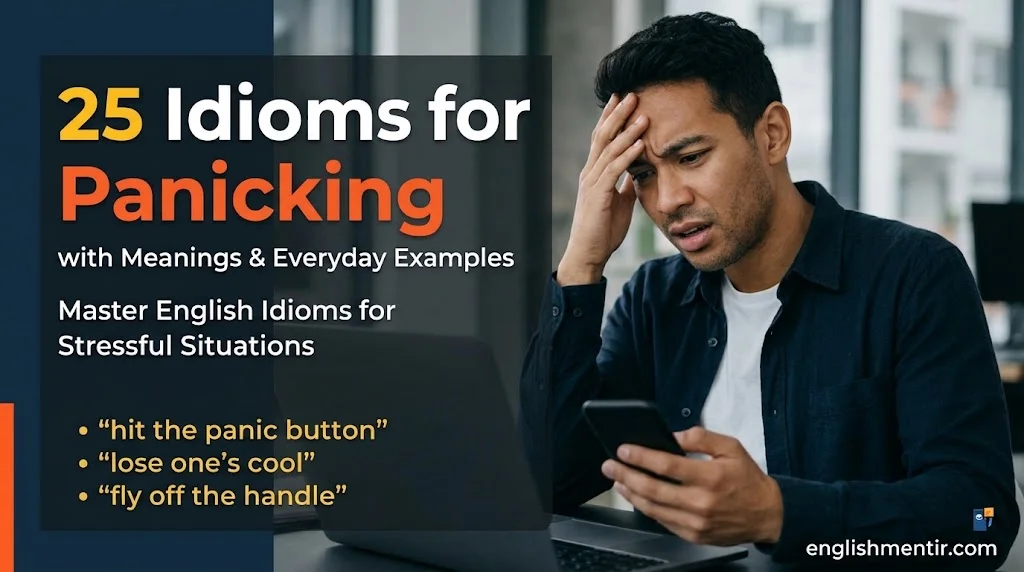
Discover 25 Idioms for Panicking (With Examples) to make your English more natural, expressive, and engaging when talking about fear, nervousness, stress, and sudden worry.
Idioms are special expressions whose meanings differ from the literal meanings of their individual words. Native speakers use these figurative phrases in everyday conversations, movies, books, workplaces, and stressful situations to describe feeling frightened, losing control, or reacting anxiously to unexpected events. For example, “freak out” means to become extremely frightened, worried, or upset about something. Learning idioms for panicking helps English learners, students, and professionals expand their vocabulary, improve communication skills, and express emotions more confidently.
Explore 25 useful idioms for panicking with simple meanings and practical examples to understand their contextual meanings and real-life usage. Regular practice will help you use these expressions naturally in spoken English, writing, and everyday conversations while making your language more fluent, colorful, and effective.
1. Freak Out
Meaning: To become extremely frightened, worried, or upset about something.
In a Sentence: I started to freak out when I realized I had lost my passport before the trip.
Other Ways to Say: Panic, lose control, become extremely anxious, get worked up.
2. Lose Your Head
Meaning: To become so frightened or confused that you cannot think clearly.
In a Sentence: Try not to lose your head when something unexpected happens during the presentation.
Other Ways to Say: Lose your composure, become confused, panic, stop thinking clearly.
3. Have a Panic Attack
Meaning: To experience a sudden episode of intense fear accompanied by physical or emotional symptoms.
In a Sentence: She felt overwhelmed by the crowded room and worried that she might have a panic attack.
Other Ways to Say: Experience intense panic, feel sudden terror, become intensely frightened.
4. Get Into a Flap
Meaning: To become unnecessarily nervous, confused, or excited about a situation.
In a Sentence: My brother got into a flap when he discovered that the guests would arrive earlier than expected.
Other Ways to Say: Get worked up, become flustered, start worrying, become agitated.
5. Be in a Cold Sweat
Meaning: To feel extremely nervous or frightened, sometimes causing you to sweat.
In a Sentence: I was in a cold sweat while waiting for the doctor to explain my test results.
Other Ways to Say: Feel terrified, become very anxious, break into a sweat, feel frightened.
6. Have Your Heart in Your Mouth
Meaning: To feel intense fear or nervousness because something frightening or uncertain is happening.
In a Sentence: My heart was in my mouth when the car suddenly skidded on the wet road.
Other Ways to Say: Feel terrified, have a racing heart, be scared stiff, feel intense anxiety.
7. Be on Pins and Needles
Meaning: To feel extremely anxious or excited while waiting for something important to happen.
In a Sentence: We were on pins and needles while waiting to hear whether our team had won the final.
Other Ways to Say: Feel anxious, be on edge, wait nervously, feel restless.
8. Jump Out of Your Skin
Meaning: To react with sudden, intense fright or surprise.
In a Sentence: I nearly jumped out of my skin when someone knocked loudly on the door in the middle of the night.
Other Ways to Say: Be startled, get a fright, jump with fear, be shocked.
9. Be Scared Stiff
Meaning: To feel so frightened that you can hardly move or react.
In a Sentence: The child was scared stiff when a large dog suddenly ran toward him.
Other Ways to Say: Be terrified, be frozen with fear, feel petrified, be frightened out of your wits.
10. Go to Pieces
Meaning: To lose emotional control because of fear, stress, grief, or pressure.
In a Sentence: She nearly went to pieces when she thought she had missed her final examination.
Other Ways to Say: Break down, become overwhelmed, lose emotional control, fall apart.
11. Be at Your Wits’ End
Meaning: To feel so worried or frustrated that you cannot think of any more solutions.
In a Sentence: I was at my wits’ end after trying everything to fix the computer before the deadline.
Other Ways to Say: Feel helpless, be desperate, run out of ideas, feel overwhelmed.
12. Have a Meltdown
Meaning: To lose emotional control because of overwhelming stress, frustration, or fear.
In a Sentence: He had a meltdown when several urgent tasks arrived at the same time.
Other Ways to Say: Break down, lose control, become overwhelmed, have an emotional outburst.
13. Blow a Fuse
Meaning: To suddenly lose your temper or become extremely angry. It can describe an emotional reaction to pressure, although it usually emphasizes anger rather than fear.
In a Sentence: Dad nearly blew a fuse when he discovered that the car would not start on the morning of his important meeting.
Other Ways to Say: Lose your temper, explode with anger, become furious, snap.
14. Go into a Tailspin
Meaning: To become increasingly confused, anxious, or unable to manage a difficult situation.
In a Sentence: The team went into a tailspin when its main presentation file disappeared minutes before the meeting.
Other Ways to Say: Lose control, become overwhelmed, spiral into panic, fall into confusion.
15. Be in a Dither
Meaning: To be nervous, confused, or unable to decide what to do.
In a Sentence: She was in a dither about what to wear when she learned that the interview would begin in ten minutes.
Other Ways to Say: Be flustered, feel indecisive, become agitated, be in a panic.
16. Run Around Like a Headless Chicken
Meaning: To rush around in a panicked and disorganized way without thinking carefully.
In a Sentence: Everyone was running around like a headless chicken when the fire alarm sounded in the office.
Other Ways to Say: Rush around frantically, act chaotically, scramble in confusion, panic and rush.
17. Hit the Panic Button
Meaning: To react to a difficult situation with sudden fear or take urgent action because something seems to be going wrong.
In a Sentence: We should not hit the panic button just because sales have dropped for one week.
Other Ways to Say: Panic, overreact, raise the alarm, respond urgently.
18. Be in a State
Meaning: To be extremely upset, worried, nervous, or agitated.
In a Sentence: My mother was in a state when I called to say that my train had been delayed for three hours.
Other Ways to Say: Be very anxious, be upset, become distressed, feel worked up.
19. Be All of a Flutter
Meaning: To feel nervous, excited, or emotionally unsettled about something.
In a Sentence: I was all of a flutter before giving my first speech in front of the entire school.
Other Ways to Say: Feel nervous, be flustered, feel excited and anxious, be unsettled.
20. Shake Like a Leaf
Meaning: To tremble noticeably because of fear, nervousness, or cold.
In a Sentence: He was shaking like a leaf before stepping onto the stage for his first performance.
Other Ways to Say: Tremble with fear, shake with nerves, quiver, be visibly frightened.
21. Have Butterflies in Your Stomach
Meaning: To feel nervous excitement or anxiety before an important event.
In a Sentence: I had butterflies in my stomach before my university admission interview.
Other Ways to Say: Feel nervous, have pre-event jitters, feel apprehensive, be on edge.
22. Feel Your Blood Run Cold
Meaning: To experience sudden, intense fear or horror after hearing or seeing something frightening.
In a Sentence: My blood ran cold when I heard footsteps behind me in the empty building.
Other Ways to Say: Feel horrified, be terrified, experience a chill of fear, feel a sudden shock.
23. Be Frozen with Fear
Meaning: To become unable to move or react because of intense fear.
In a Sentence: She was frozen with fear when she noticed smoke coming from the kitchen.
Other Ways to Say: Be paralyzed with fear, freeze up, be unable to move, feel petrified.
24. Get Cold Feet
Meaning: To become nervous or lose confidence just before doing something important or challenging.
In a Sentence: He got cold feet just before walking onto the stage to deliver his speech.
Other Ways to Say: Lose your nerve, become hesitant, feel apprehensive, have second thoughts.
25. Go into a Panic
Meaning: To suddenly become extremely frightened or anxious and struggle to think calmly.
In a Sentence: The passengers went into a panic when they heard an unexpected announcement about the flight.
Other Ways to Say: Start panicking, become alarmed, lose composure, react with fear.
Exercise: Practice Idioms for Panicking
Instructions: Choose the correct answer for each question. Each question has four options. Check the answer key after completing all 15 questions.
Multiple-Choice Questions (MCQs)
1. What does “freak out” mean?
A. To relax completely
B. To become extremely frightened or upset
C. To fall asleep
D. To celebrate happily
2. If you “lose your head,” you:
A. Become unable to think calmly
B. Forget your name permanently
C. Feel hungry
D. Make a careful plan
3. Which idiom describes nervousness while waiting for important news?
A. Blow a fuse
B. Jump out of your skin
C. Be on pins and needles
D. Shake like a leaf
4. If someone is “scared stiff,” they are:
A. Slightly amused
B. Extremely frightened
C. Very tired
D. Deeply relaxed
5. What does “get cold feet” usually mean?
A. To lose confidence before doing something
B. To walk in cold weather
C. To become angry with someone
D. To finish a difficult task
6. Which expression means to rush around in a disorganized, panicked way?
A. Have butterflies in your stomach
B. Be at your wits’ end
C. Run around like a headless chicken
D. Feel your blood run cold
7. If you are “at your wits’ end,” you feel:
A. Certain about every decision
B. Unable to think of any more solutions
C. Excited about a holiday
D. Proud of your achievements
8. What does “jump out of your skin” describe?
A. A sudden reaction to fright or surprise
B. A long journey
C. A difficult examination
D. A feeling of boredom
9. Which idiom describes trembling because of fear?
A. Hit the panic button
B. Go to pieces
C. Shake like a leaf
D. Blow a fuse
10. If someone “has butterflies in their stomach,” they are usually:
A. Nervous or excited about something
B. Angry about a disagreement
C. Feeling sleepy after lunch
D. Completely uninterested
11. What does “go into a tailspin” mean?
A. To become increasingly confused or overwhelmed
B. To complete a task easily
C. To become physically stronger
D. To win a competition
12. Which idiom means to become unable to move because of intense fear?
A. Get into a flap
B. Be frozen with fear
C. Have your heart in your mouth
D. Be all of a flutter
13. If someone “blows a fuse,” they usually:
A. Lose their temper
B. Become sleepy
C. Feel calm
D. Forget an appointment
14. Which expression describes a sudden feeling of horror?
A. Get cold feet
B. Be in a dither
C. Feel your blood run cold
D. Be on pins and needles
15. What does “hit the panic button” mean?
A. To respond calmly to every situation
B. To react with sudden alarm or take urgent action
C. To stop working permanently
D. To avoid making decisions forever
Answer Key
- B — To become extremely frightened or upset
- A — Become unable to think calmly
- C — Be on pins and needles
- B — Extremely frightened
- A — To lose confidence before doing something
- C — Run around like a headless chicken
- B — Unable to think of any more solutions
- A — A sudden reaction to fright or surprise
- C — Shake like a leaf
- A — Nervous or excited about something
- A — To become increasingly confused or overwhelmed
- B — Be frozen with fear
- A — Lose their temper
- C — Feel your blood run cold
- B — To react with sudden alarm or take urgent action
Practice tip: After checking your answers, write one original sentence for each idiom you found difficult. This will help you remember its meaning and use it naturally in everyday English.
Conclusion:
Learning idioms for panicking helps you describe fear, nervousness, and stressful situations in more natural English. Expressions such as freak out, lose your head, and hit the panic button can make everyday conversations more vivid and engaging.
Remember that not every expression has exactly the same meaning. Having butterflies in your stomach often describes ordinary nervousness before an important event, while being frozen with fear suggests a much stronger reaction. Choosing the right idiom helps you communicate your feelings more accurately.
FAQs:
1. What are idioms for panicking?
Idioms for panicking are common English expressions that describe intense fear, sudden anxiety, or losing emotional control. Examples include freak out, lose your head, and go into a panic.
2. What is another way to say “panic”?
You can use expressions such as freak out, lose your composure, hit the panic button, or go into a panic, depending on the situation.
3. Which idiom describes being extremely nervous before an event?
Have butterflies in your stomach is commonly used to describe nervousness before an exam, interview, speech, or other important event.
4. What is the difference between “freak out” and “get cold feet”?
Freak out means to become very frightened, worried, or upset. Get cold feet usually means to lose confidence or become hesitant just before doing something challenging.
5. How can I learn idioms for panicking easily?
Start by learning five idioms at a time, reading their meanings, and creating your own example sentences. Use practice questions, review the expressions regularly, and try to recognize them in books, films, and everyday conversations.