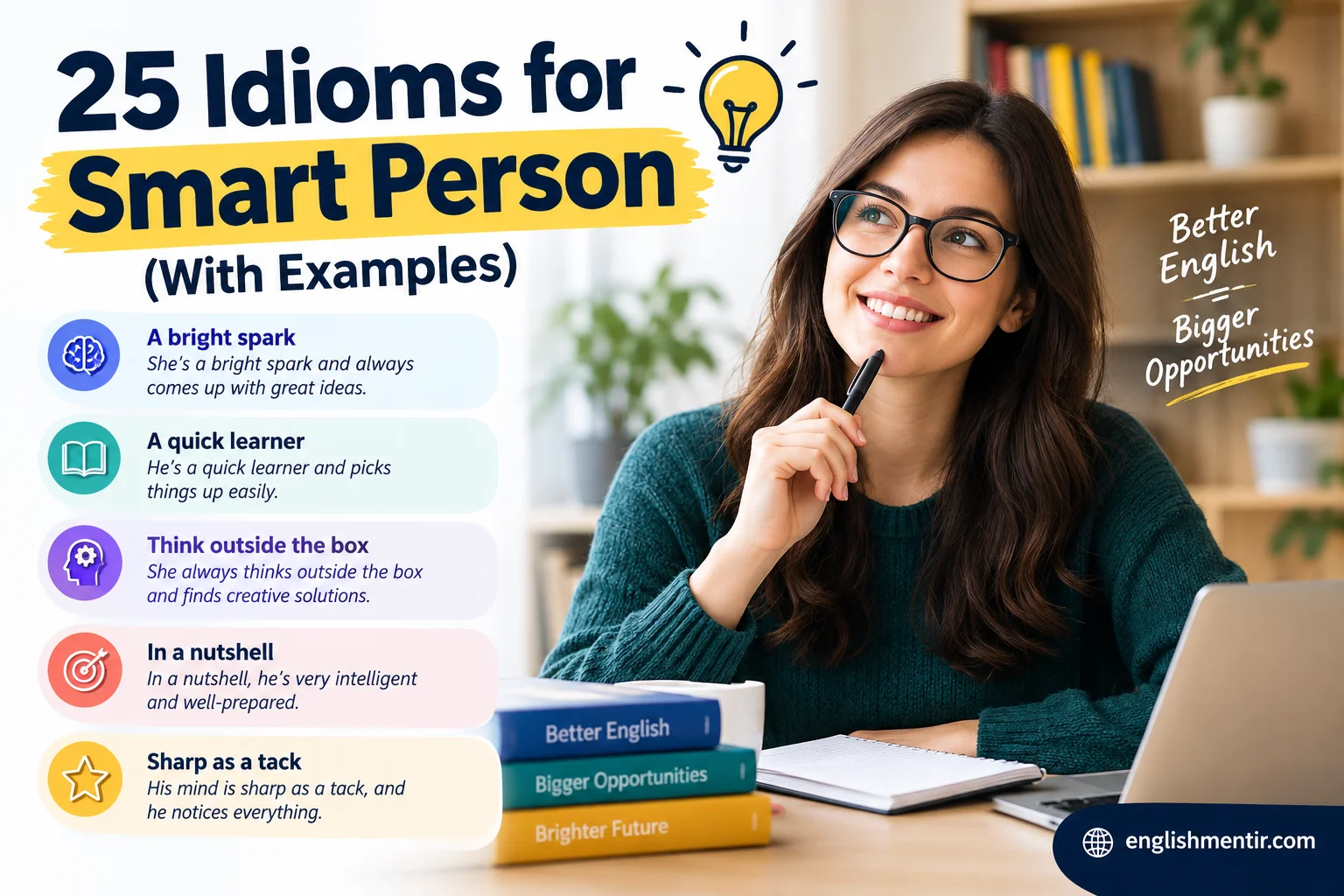
25 Idioms for Smart Person (With Examples) help describe a smart person naturally, showing intelligence, cleverness, wit, and insight beyond a high IQ or knowing everything. These figurative expressions make learning English more creative, expressive, lively, and engaging, while describing thinking quickly, wise decisions, sharp thinking, and quick understanding.
Instead of repeating very smart, you can describe someone as intelligent, sharp, quick-witted, or mentally sharp. For example, Sarah at work can untangle a complex problem in minutes and find a clever solution. Her colleague may say she has a head on her shoulders, showing judgment, problem solving, knowledge, and quiet respect. Such colorful idioms add personality to real life, literature, and workplaces.
These expressions are useful in casual chats, professional settings, writing, school assignment, or a compliment. They make English more fluent, confident, and relatable. This guide helps you explore simple meanings and examples of the best idioms for smart people, improving natural usage, communication, and language.
1. A Sharp Cookie
Meaning: A sharp cookie is someone who is very clever and quick to understand things.
In a Sentence: Sarah is a sharp cookie, so she noticed the mistake immediately.
Other Ways to Say: Clever person, quick thinker, intelligent person.
2. A Bright Spark
Meaning: A bright spark describes someone who is intelligent, creative, and full of good ideas.
In a Sentence: Daniel is a bright spark who always finds creative solutions.
Other Ways to Say: Smart thinker, clever person, intelligent mind.
3. A Whiz Kid
Meaning: A whiz kid is a young person who is exceptionally talented or intelligent.
In a Sentence: The whiz kid solved the difficult computer problem in minutes.
Other Ways to Say: Young genius, talented youngster, clever student.
4. A Brain Box
Meaning: A brain box is an informal expression for someone who is very intelligent.
In a Sentence: Everyone asks Maria for help because she is the brain box of the group.
Other Ways to Say: Genius, intelligent person, clever mind.
5. A Walking Encyclopedia
Meaning: A walking encyclopedia describes someone who has a huge amount of knowledge.
In a Sentence: Ask Omar about history; he is a walking encyclopedia.
Other Ways to Say: Knowledgeable person, expert, well-informed person.
6. Have a Good Head on Your Shoulders
Meaning: This idiom means someone is sensible, practical, and intelligent.
In a Sentence: Emma has a good head on her shoulders, so she makes thoughtful decisions.
Other Ways to Say: Sensible, practical, level-headed.
7. Have a Sharp Mind
Meaning: To have a sharp mind means to think quickly and understand things easily.
In a Sentence: Professor Ali has a sharp mind and remembers complicated details.
Other Ways to Say: Intelligent, quick-thinking, mentally sharp.
8. Quick on the Uptake
Meaning: Someone who is quick on the uptake understands new information very quickly.
In a Sentence: Jake is quick on the uptake, so he learned the new software in one afternoon.
Other Ways to Say: Quick learner, fast thinker, perceptive person.
9. Know One’s Stuff
Meaning: If someone knows their stuff, they have strong knowledge or skill in a particular area.
In a Sentence: You can trust Nina because she really knows her stuff when it comes to finance.
Other Ways to Say: Knowledgeable, skilled, well-informed.
10. Have a Brain Like a Sponge
Meaning: This idiom describes someone who absorbs and remembers information easily.
In a Sentence: My little brother has a brain like a sponge and learns new words quickly.
Other Ways to Say: Fast learner, good at remembering, highly receptive.
11. Pick Things Up Quickly
Meaning: To pick things up quickly means to learn or understand something with little difficulty.
In a Sentence: Lisa picks things up quickly, even when the subject is complicated.
Other Ways to Say: Learn quickly, catch on fast, understand easily.
12. Get the Picture
Meaning: To get the picture means to understand what is happening or what someone means.
In a Sentence: After Tom explained the problem, I finally got the picture.
Other Ways to Say: Understand, catch on, see the point.
13. Put Two and Two Together
Meaning: This idiom means to use clues and information to reach a logical conclusion.
In a Sentence: Maya put two and two together and realized who had left the door open.
Other Ways to Say: Figure out, connect the clues, draw a conclusion.
14. Think Outside the Box
Meaning: To think outside the box means to find creative or unusual solutions.
In a Sentence: Our designer thought outside the box and created a completely new layout.
Other Ways to Say: Think creatively, innovate, find a new approach.
15. Have a Lot on the Ball
Meaning: To have a lot on the ball means to be capable, intelligent, and effective.
In a Sentence: Jessica has a lot on the ball and handles difficult projects confidently.
Other Ways to Say: Capable, competent, intelligent.
16. Know Which Way the Wind Is Blowing
Meaning: This idiom means to understand a situation, trend, or people’s feelings before making a decision.
In a Sentence: A smart manager knows which way the wind is blowing before changing the company’s plans.
Other Ways to Say: Read the situation, understand the trend, judge the mood.
17. Be Ahead of the Curve
Meaning: Someone who is ahead of the curve understands or adopts new ideas before many others.
In a Sentence: Priya is ahead of the curve because she started learning artificial intelligence early.
Other Ways to Say: Be innovative, stay ahead, lead the trend.
18. Be a Mastermind
Meaning: A mastermind is someone who plans or organizes something with great intelligence and skill.
In a Sentence: The project manager was the mastermind behind the successful campaign.
Other Ways to Say: Strategist, brilliant planner, clever organizer.
19. Have a Head for Numbers
Meaning: To have a head for numbers means to be naturally good at mathematics, calculations, or financial matters.
In a Sentence: Ahmed has a head for numbers, so he manages the budget easily.
Other Ways to Say: Good at math, numerically skilled, mathematically minded.
20. Have a Memory Like an Elephant
Meaning: This expression describes someone who has an excellent memory.
In a Sentence: My grandmother has a memory like an elephant and remembers events from decades ago.
Other Ways to Say: Excellent memory, remember everything, strong recall.
21. Know It Like the Back of Your Hand
Meaning: This idiom means to know something extremely well.
In a Sentence: David knows the city like the back of his hand.
Other Ways to Say: Know thoroughly, know extremely well, be familiar with.
22. A Mine of Information
Meaning: A mine of information is someone or something containing a large amount of useful knowledge.
In a Sentence: Our librarian is a mine of information about local history.
Other Ways to Say: Information source, knowledgeable person, useful resource.
23. On the Ball
Meaning: Someone who is on the ball is alert, capable, and quick to understand or respond.
In a Sentence: The new assistant is really on the ball and rarely misses an important detail.
Other Ways to Say: Alert, attentive, capable.
24. A Thinking Cap
Meaning: To put on your thinking cap means to start thinking carefully about a problem or question.
In a Sentence: Let’s put on our thinking caps and find a solution to this challenge.
Other Ways to Say: Think carefully, concentrate, use your mind.
25. A Wise Old Head
Meaning: A wise old head describes someone who has great wisdom and experience, often despite their age.
In a Sentence: Our coach is a wise old head who always gives practical advice.
Other Ways to Say: Wise person, experienced thinker, knowledgeable adviser.
How to Choose the Right Idiom for a Smart Person
The best idiom depends on what kind of intelligence you want to describe. Use “a sharp cookie” or “bright spark” for someone who is naturally clever. “Walking encyclopedia” works better for someone with extensive knowledge, while “quick on the uptake” focuses on fast understanding.
For creative intelligence, phrases such as “think outside the box” and “ahead of the curve” are useful. If you want to describe practical intelligence, “a good head on your shoulders” is a natural choice. Choosing the right expression makes your English sound more precise and natural.
Exercise: Practice These Smart-Person Idioms
Choose the correct answer for each question.
1. What does “a sharp cookie” mean?
A. Someone who is quiet
B. Someone who is clever
C. Someone who is tired
D. Someone who is angry
2. Which idiom describes someone with a lot of knowledge?
A. A walking encyclopedia
B. A thinking cap
C. On the ball
D. A sharp cookie
3. If someone learns very quickly, they are:
A. Behind the curve
B. Quick on the uptake
C. A wise old head
D. A mine of information
4. What does “think outside the box” mean?
A. Follow the same method
B. Avoid difficult ideas
C. Think creatively
D. Stop thinking
5. Which phrase means someone is sensible and practical?
A. A whiz kid
B. A good head on your shoulders
C. A brain like a sponge
D. A mastermind
6. If someone “knows their stuff,” they are:
A. Confused
B. Unprepared
C. Knowledgeable or skilled
D. Uninterested
7. What does “put two and two together” mean?
A. Do basic mathematics
B. Connect clues to reach a conclusion
C. Repeat information
D. Forget important details
8. Which idiom describes someone with an excellent memory?
A. Think outside the box
B. A memory like an elephant
C. Ahead of the curve
D. On the ball
9. “On the ball” means:
A. Alert and capable
B. Physically active
C. Confused
D. Very relaxed
10. What does “ahead of the curve” suggest?
A. Being late
B. Avoiding change
C. Being advanced or early with new ideas
D. Making frequent mistakes
11. Someone who is “a mastermind” is usually a:
A. Beginner
B. Skilled planner
C. Careless person
D. Slow learner
12. What does “have a head for numbers” mean?
A. Dislike mathematics
B. Be naturally good with numbers
C. Forget calculations
D. Avoid financial matters
13. If you “know something like the back of your hand,” you:
A. Have never seen it
B. Know it extremely well
C. Find it confusing
D. Want to learn it later
14. What does “a brain like a sponge” suggest?
A. Someone who forgets everything
B. Someone who dislikes learning
C. Someone who absorbs information easily
D. Someone who avoids information
15. What does “put on your thinking cap” mean?
A. Take a break
B. Think carefully about a problem
C. Ignore a question
D. Ask someone else to decide
Answers
- B — Someone who is clever
- A — A walking encyclopedia
- B — Quick on the uptake
- C — Think creatively
- B — A good head on your shoulders
- C — Knowledgeable or skilled
- B — Connect clues to reach a conclusion
- B — A memory like an elephant
- A — Alert and capable
- C — Being advanced or early with new ideas
- B — Skilled planner
- B — Be naturally good with numbers
- B — Know it extremely well
- C — Someone who absorbs information easily
- B — Think carefully about a problem
FAQs:
1. What are idioms for a smart person?
Idioms for a smart person are figurative expressions used to describe someone who is intelligent, clever, quick-thinking, or mentally sharp.
2. Why should I use idioms for smart people?
They make your English more natural, colorful, and engaging. They can also help you sound more fluent, confident, and relatable.
3. Can these idioms be used in professional settings?
Yes. Many idioms can work well in professional settings, especially when talking about someone’s problem solving, judgment, or clever ideas.
4. Are these idioms suitable for English learners?
Yes. Learning these expressions can improve learning English, communication, and natural language use when speaking or writing.
5. Can I use these idioms in casual conversations?
Absolutely. They are useful in casual conversations, everyday chats, compliments, and real-life situations when describing a smart person.
Conclusion:
Learning 25 Idioms for a Smart Person (With Examples) gives you more expressive ways to talk about intelligence, cleverness, wit, and quick thinking. Instead of repeatedly saying “very smart,” you can choose colorful expressions that make your English sound more natural and engaging.
These idioms can be useful in casual conversations, writing, school work, and professional communication. With regular practice, you can understand their meanings more easily and use the right expressions naturally when describing someone who is intelligent, sharp, or quick-thinking.